Pass the American Government CLEP Exam on Your First Try
Everything you need to pass — 363 flashcards, practice questions, and expert study guides.
No textbooks required.

Everything you need to pass — 363 flashcards, practice questions, and expert study guides.
No textbooks required.
InstantCert's American Government CLEP study system is designed for real exam results. No fluff. No expensive textbooks. Just what you need to pass — and nothing you don't.
The American Government CLEP exam lets you earn college credit without paying for an entire course. We help you master exactly what the exam tests, so you don't waste time on what it doesn't.
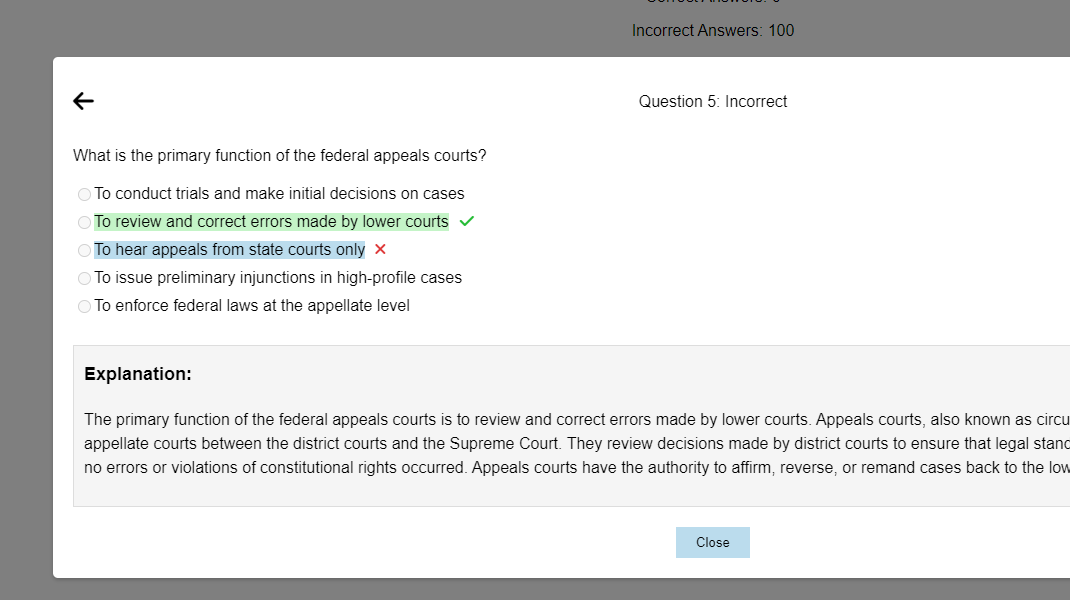
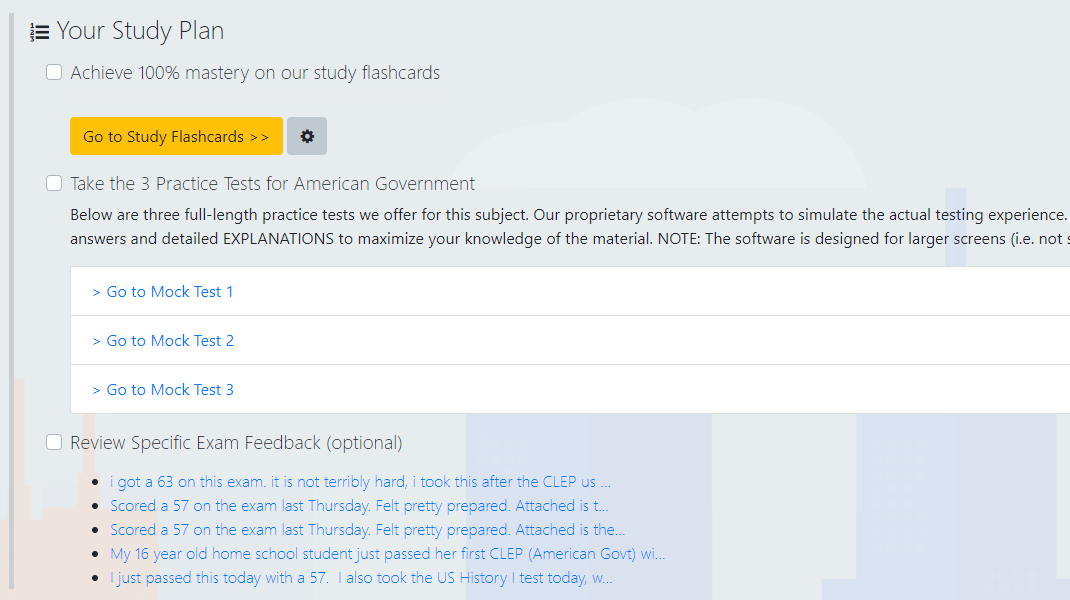
Three full-length, timed, practice tests with 95-100 questions each allow you to drill the concepts and test-taking skills you need to ACE your exam.
Results reported by real students preparing with InstantCert since 2006.
This study guide was easy to navigate and had rationales that were easy to understand! Made passing the American Gov CLEP exam possible in just 3 days of studying. The price was also a selling point for me.
Katelynn Weldon
Everything the American Government CLEP tests — organized, simplified, and optimized for passing. We focus only on what the exam actually tests, so you don't waste time on what it doesn't.
Click any topic below to see exactly what you'll feel confident answering on test day.
The major formal and informal institutional arrangements and powers
Structure, policy processes, and outputs
Relationships among these three institutions and links between them and political parties, interest groups, the media, and public opinion
Structure and processes of the judicial system with emphasis on the role and influence of the Supreme Court
The development of civil rights and civil liberties by judicial interpretation
The Bill of Rights
Incorporation of the Bill of Rights
Equal protection and due process
Political parties (including their function, organization, mobilization, historical development, and effects on the political process)
Interest groups (including the variety of activities they typically undertake and their effects on the political process)
Elections (including the electoral process)
Processes by which citizens learn about politics
Political participation (including voting behavior)
Public opinion
Beliefs that citizens hold about their government and its leaders
Political culture (the variety of factors that predispose citizens to differ from one another in terms of their political perceptions, values, attitudes, and activities)
The influence of public opinion on political leaders
Federalism (with attention to intergovernmental relations)
Separation of powers
Checks and balances
Majority rule
Minority rights
Considerations that influenced the formulation and adoption of the Constitution
Theories of democracy
A typical college american government course costs $1,000+InstantCert helps you earn that credit for a fraction of the cost.