
What This Exam Covers
The Art of the Western World DSST covers art from ancient civilizations to the contemporary period. You need to know major styles, key movements, representative artists, and specific works across painting, sculpture, and architecture.
Exam at a Glance
| Questions | 100 multiple choice |
| Time | 120 minutes |
| Passing score | 400 (scaled score) |
| College credits | 3 semester hours (lower-level) |
| Exam fee | $100 (military free) |
What's on the Art of the Western World DSST / DANTES*?
| Period | Weight | Key Artists and Topics |
|---|---|---|
| Ancient World | 15% | Ancient Near East and Egypt; Greek architecture and sculpture (Parthenon, Polykleitos, Phidias); Roman art and architecture (Ara Pacis, Pantheon, Colosseum); cultural and religious context |
| Middle Ages | 12% | Early Christian and Byzantine art and mosaics; Romanesque architecture and sculpture; Gothic cathedrals and stained glass; symbolism in medieval religious imagery |
| Renaissance | 15% | 15th-century Italy (Masaccio, Donatello, Botticelli, Brunelleschi, linear perspective); 15th-century Northern Europe (Van Eyck, oil painting); 16th-century Italy (Leonardo, Michelangelo, Raphael); 16th-century Northern Europe (Dürer, Holbein) |
| Baroque | 10% | Italy, France, and Spain (Caravaggio, Bernini, Velázquez); Holland and Flanders (Rembrandt, Vermeer, Rubens); chiaroscuro and dramatic use of light |
| Rococo and Neoclassicism | 9% | Rococo ornament and lightness (Watteau, Fragonard, Boucher); Neoclassical restraint (David, Ingres); Enlightenment influence on art |
| Romanticism and Realism | 8% | Romantic emotion and drama (Delacroix, Goya, Turner, Géricault); Realist social observation (Courbet, Millet, Daumier); shift toward everyday subjects |
| Impressionism and Post-Impressionism | 8% | Impressionism (Monet, Renoir, Degas, Cassatt); Post-Impressionism (Cézanne, Van Gogh, Gauguin, Seurat); light, color theory, and break from academic tradition |
| Early Twentieth Century | 12% | Emergence of Modernism (Fauvism, Cubism with Picasso and Braque, Futurism, Expressionism); art between the World Wars (Dada, Surrealism with Dalí and Magritte, Bauhaus) |
| Postwar to Postmodern and Contemporary | 11% | Abstract Expressionism (Pollock, de Kooning, Frankenthaler); Pop Art; Minimalism; Conceptual Art; Feminist art; Postmodernism and installation art |
Source: For a full breakdown of what is on the exam, see the DSST / DANTES Art of the Western World exam fact sheet.
How hard is the Art of the Western World DSST / DANTES*?
This exam can be quite challenging because you need to not only understand what styles define the art periods but also some of the works. There aren't a ton of questions that have specific paintings and they often come from the main artists of the era.
Our 73% pass rate is the lowest for any DSST exam, reflecting the difficulty many people face. That being said, it is also one of the least popular exams so not many students have submitted marks.
Students who have taken art history, visited museums, or have a background in the humanities could study in a few weeks. Newcomers to art should plan on studying for a couple of months.
How to study for the Art of the Western World DSST / DANTES*
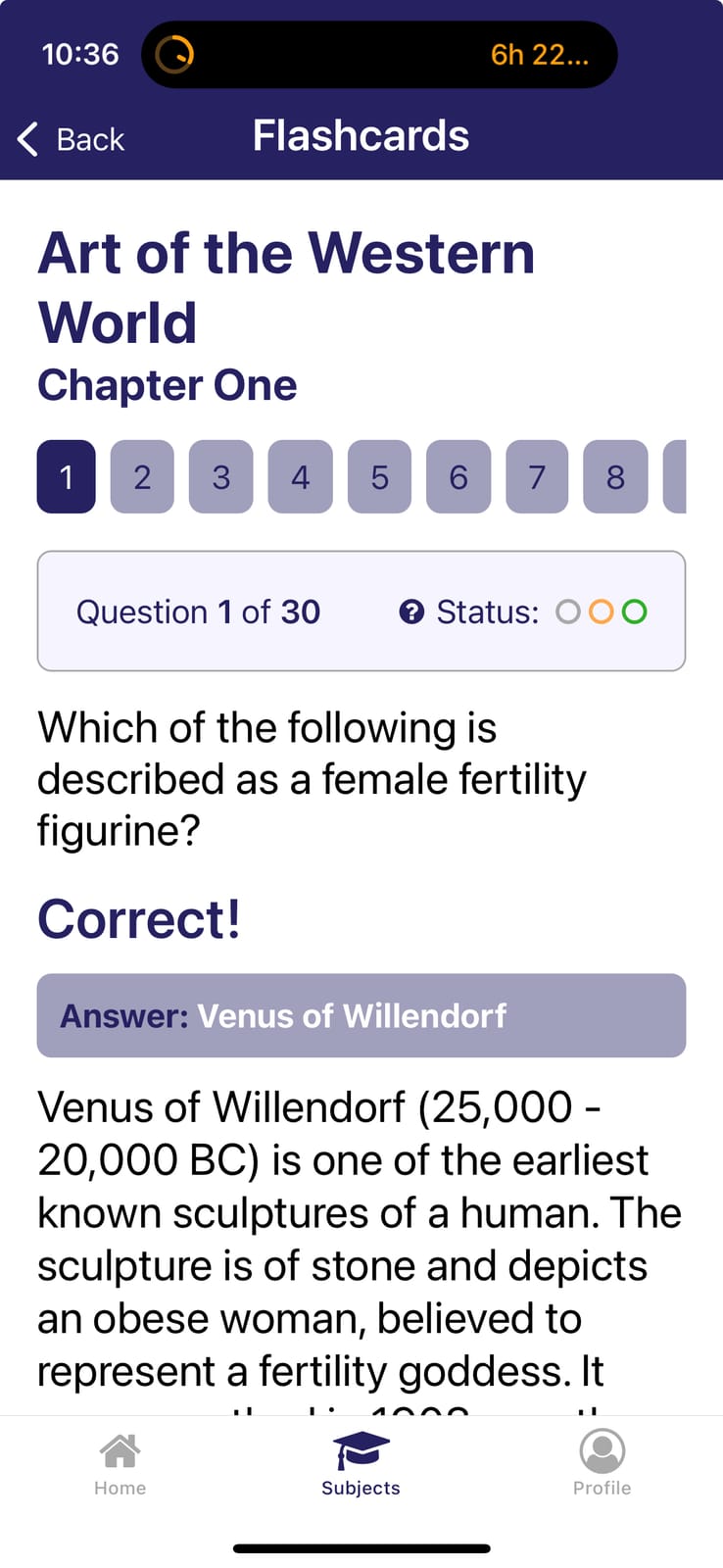
- Work through the InstantCert flashcards period by period. For each major artist, try to learn a few of their best-known works. This should give you an idea of the style of the era, and hopefully, one of the works you learn will be a question on the actual exam.
- For free videos on Art History, these episodes cover a lot of what you will need to know.
- Annenberg Learner has a great course, although it is a bit long.
- Download the official DSST Art of the Western World fact sheet for 12 free sample questions.
- Know the distinctions between similar-looking movements: Baroque vs. Rococo, Romanticism vs. Realism, Impressionism vs. Post-Impressionism.
What score do you need to pass?
A scaled score of 400 is the standard passing threshold at most institutions.
ACE recommends this exam as 3 lower-level baccalaureate semester hours, and credit typically counts toward a humanities, art history, or general education requirement. Confirm with your registrar how the credit applies before you start studying.
Pass and the credit appears on your transcript with no letter grade. Fail and the attempt does NOT appear on your transcript at all.
Can you pass Art of the Western World DSST / DANTES* with just flashcards?
People definitely pass just with the flashcards, but the low pass rate reflects how difficult this exam can be. If you are coming from no art history background, it is definitely in your best interest to take a look at some of the free resources out there.
Which colleges accept the Art of the Western World DSST / DANTES*?
Most colleges and universities accept DSST credit and award 3 semester hours for a passing score. ACE recommends this exam at the lower-level baccalaureate level, which means it typically satisfies a humanities, art history, or general education elective requirement.
Most institutions cap how many DSST and CLEP credits count toward a degree, so confirm your school's rules before you commit to the exam.
Art of the Western World DSST / DANTES* vs. taking the class
An introductory art history course at a community college costs a few hundred dollars at in-state rates. At a four-year university, the same course typically runs $1,500 to $3,000 or more. The DSST earns you the same 3 credit hours for $100, and it is free for active duty military.
| Exam fee | $100 (military free) |
| Typical tuition equivalent | $1,000–$3,000+ (one semester) |
| Credits earned | 3 semester hours (lower-level) |
| Time to prepare | 5–7 weeks self-study |
| GPA impact | None, pass/fail only |
| Failed attempt on transcript | No |
If you have an art background, or have taken the humanities CLEP, then this exam is a great way to get a quick credit. However, if you are genuinely interested in Art, the classroom discussions can be really valuable.
Happy testing!