What This Exam Covers
The Introductory Psychology CLEP covers a full semester of intro psych: biological bases of behavior, sensation and perception, learning and cognition, developmental psychology, personality, psychological disorders, and treatment. This is one of the most popular exams in the CLEP catalog, and 95% of our students pass it.
Exam at a Glance
| Questions | 95 multiple choice |
| Time | 90 minutes |
| Passing score | 50 (most schools) |
| College credits | 3 semester hours (typical) |
| Exam fee | $97 |
What's on the Introductory Psychology CLEP*?
| Category | Weight | Topics |
|---|---|---|
| History, Approaches, and Methods | 11–12% | History of psychology; behavioral, cognitive, humanistic, psychodynamic, and biological approaches; research design and methods; ethics in psychological research |
| Biological Bases of Behavior | 8–9% | Neuroanatomy, neural transmission, endocrine system, genetics and behavior, brain structure and function, psychopharmacology basics |
| Sensation and Perception | 7–8% | Sensory transduction, thresholds and signal detection, vision, audition, other senses, perceptual organization and constancy |
| States of Consciousness | 5–6% | Sleep and dreaming, hypnosis, meditation, psychoactive drugs and altered states, biological rhythms |
| Learning | 8–9% | Classical conditioning (Pavlov), operant conditioning (Skinner), observational learning (Bandura), cognitive learning, reinforcement schedules |
| Cognition | 8–9% | Memory (encoding, storage, retrieval), forgetting, problem solving, decision making, language and thought, creativity |
| Motivation and Emotion | 5–6% | Theories of motivation (drive, arousal, incentive, Maslow's hierarchy), hunger and sexuality, emotional theories (James-Lange, Cannon-Bard), achievement motivation |
| Developmental Psychology Across the Lifespan | 8–9% | Prenatal and childhood development, adolescence, adult development and aging, theories of development (Piaget, Erikson, Kohlberg), nature vs. nurture |
| Personality | 7–8% | Psychoanalytic, neo-Freudian, trait, humanistic, social-cognitive, and behavioral theories; personality assessment techniques |
| Psychological Disorders and Health | 8–9% | Anxiety, mood, psychotic, dissociative, and personality disorders; DSM classification; health psychology and stress |
| Treatment of Psychological Disorders | 6–7% | Psychoanalytic, behavioral, cognitive, humanistic, and group therapies; biological treatments (drug therapy, ECT); community mental health |
| Social Psychology | 9–10% | Attitudes and persuasion, conformity and obedience, group behavior, attribution, prejudice and discrimination, prosocial behavior |
| Statistics, Tests, and Measurement | 3–4% | Descriptive statistics, normal distribution, reliability and validity, types of psychological tests, interpreting research findings |
Source: For a full breakdown of what is on the exam, see the College Board Introductory Psychology CLEP page.
How hard is the Introductory Psychology CLEP*?
This is a moderate exam but many of our students have passed with just our flashcards. The content is broad, covering many sub-disciplines, but none of it is difficult. It's vocabulary and conceptual understanding, not math or lab technique. Most students find it interesting to study because it relates to how people think. The tricky parts are specific theorists and their frameworks (Freud, Piaget, Skinner, Erikson, Maslow), psychological disorder names, and research methods. If you've learned psychology in the past try just our flashcards — if not, plan for 2 to 6 weeks of study from scratch.
How to study for the Introductory Psychology CLEP*
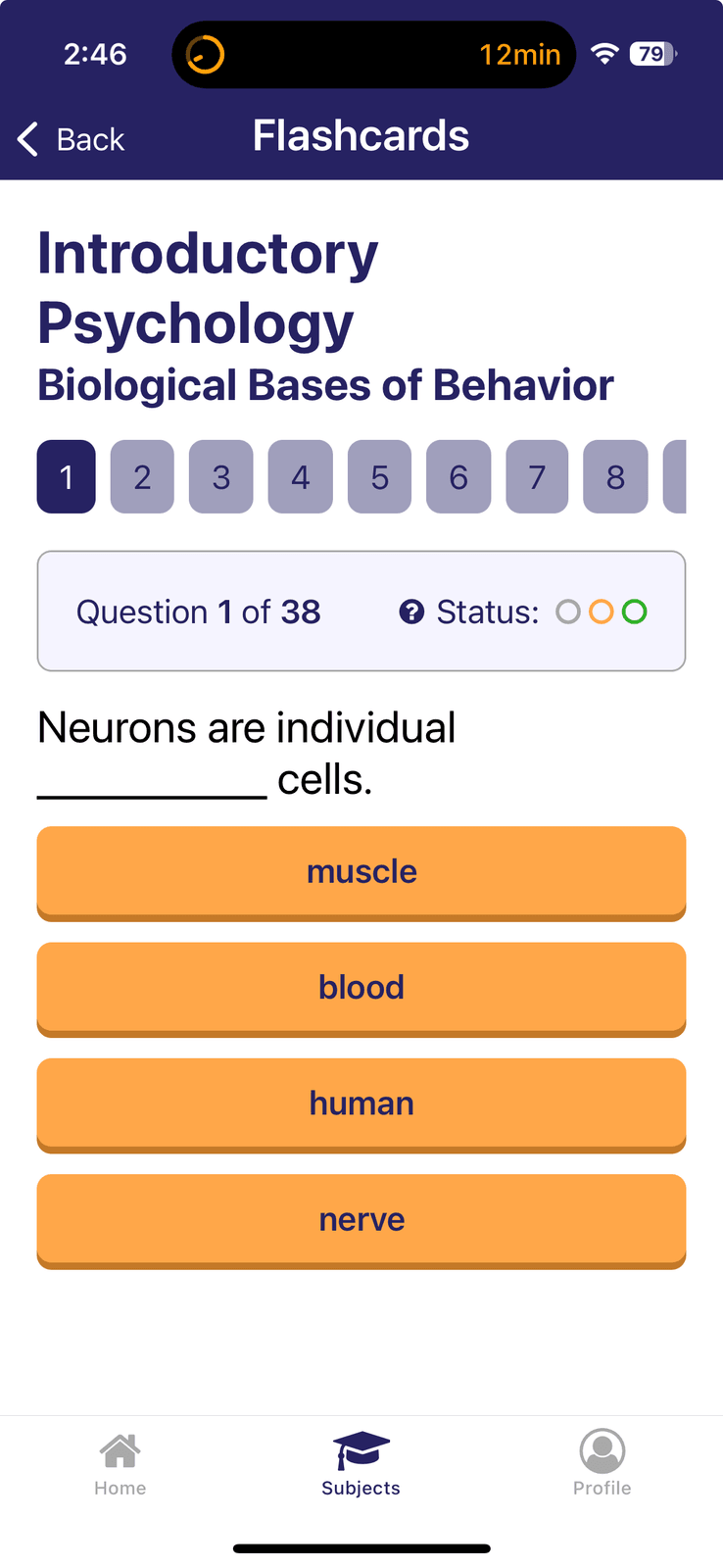
- Work through the InstantCert flashcards, paying close attention to theorists and their theories. This is a high-yield area and a frequent source of errors for students who don't pay attention to psychologists' names.
- Use the College Board's free Introductory Psychology practice questions to see how terminology gets tested in context.
- Crash Course Psychology on YouTube covers the entire CLEP syllabus in 40 free episodes, particularly valuable for the disorders and biological bases sections, which benefit from visual explanation.
- ModernStates.org has a free Introduction to Psychology course built for CLEP prep. A solid complement to the flashcards, especially for the research methods and social psychology sections.
What score do you need to pass?
A score of 50 is the standard passing threshold at most schools but some require 60. Psychology credit typically counts toward social science or general education requirements or as a psychology elective. Confirm with your institution before you start studying.
Fail and the attempt does NOT appear on your transcript. You can retake after 3 months.
Can you pass Introductory Psychology CLEP* with just flashcards?
Many students do, especially those with some past knowledge in psychology. The content is wide but shallow, making flashcards efficient. Students who supplement with Crash Course Psychology tend to feel more confident, especially on the biological bases and disorders sections. Either way, 95% of our students pass. That number reflects what happens when you study material that is not overly technical and happens to be genuinely interesting.
Which colleges accept the Introductory Psychology CLEP*?
Over 2,900 accredited U.S. colleges and universities accept CLEP credit, and Introductory Psychology is one of the most widely accepted exams. Most schools award 3 semester hours.
A few schools, particularly highly selective universities, do not accept CLEP credit. A few require a score of 60 rather than the standard 50. Confirm your school's policy before you sit for the exam.
Use the College Board's CLEP credit-granting policy search tool to look up exactly what your school awards. Search by institution, select Introductory Psychology, and you will see their minimum score requirement and how many credits they grant. However, it's always best to check with your school because this tool is not always up to date.
Introductory Psychology CLEP* vs. taking the class
A single semester of intro psych tuition runs $1,500 to $4,000 or more, depending on your school, and that's before books.
| Exam fee | $97 one-time |
| Typical tuition equivalent | $1,500–$4,000+ (one semester) |
| Credits earned | 3 semester hours (typical) |
| Time to prepare | 2–6 weeks self-study |
| GPA impact | None, pass/fail, not graded |
Psychology is one of those courses where the classroom version tends to move slowly. A lot of lecture time on content that is not hard to learn on your own. If you have any background in psychology or you have always been curious about the subject, this exam rewards self-study well. Fail and you are out $97 and have to wait 3 months to retake. Pass and you skip the course entirely.
Happy testing!