
What This Exam Covers
The Criminal Justice DSST exam covers how crime is defined, measured, and theorized. It then examines each major component of the U.S. criminal justice system: law enforcement, courts, and corrections.
The material may feel familiar, given the prevalence of the criminal justice system on TV and movies. However, the exam tests your understanding of the system's structure, not laws themselves.
Exam at a Glance
| Questions | 100 multiple choice |
| Time | 120 minutes |
| Passing score | 400 (scaled score) |
| College credits | 3 semester hours (typical) |
| Exam fee | $100 (military free) |
What's on the Criminal Justice DSST / DANTES*?
| Category | Weight | Topics |
|---|---|---|
| Criminal Behavior | 15% | Defining crime, types of crime (felonies, misdemeanors), juvenile delinquency (emergence, risk factors, causation), measurement of crime (UCR, NCVS, survey and research data), crime rates and trends in the U.S., theories of crime |
| Criminal Justice System | 25% | Historical origins and legal foundations (statutory, common, case, procedural, and substantive law), crime control model vs. due process model, criminal justice agencies (law enforcement, courts, and corrections) |
| Law Enforcement | 20% | History of policing, types of law enforcement agencies, roles and responsibilities (discretion, integrity, community safety), issues and trends in policing (PTSD, subculture and demographics) |
| Court System | 20% | History of the court system, organization and levels (federal and state), adult and juvenile courts, pretrial and trial processes (bail, plea bargaining, prosecutorial and judicial discretion, diversion, waiver, jury, verdict), sentencing options and trends |
| Corrections | 20% | History of corrections, philosophies of punishment (rehabilitation, restoration, deterrence, incapacitation, retribution), probation and parole, adult prison facilities (administration and overcrowding), juvenile correctional facilities, capital punishment, inmate characteristics (subculture, gangs and demographics), issues and trends (inmate rights, security, healthcare, privatization, wrongful conviction) |
Source: For a full breakdown of what is on the exam, see the DSST / DANTES Criminal Justice exam fact sheet.
How hard is the Criminal Justice DSST / DANTES*?
Many find this exam easy because they've learned some topics through everyday life.
You won't need to know technical details, but you will need to know the vocabulary.
If you have a background in law or the legal industry, a week or less of studying should suffice. If you're new to the subject, you can still pass in under a month.
How to study for the Criminal Justice DSST / DANTES*
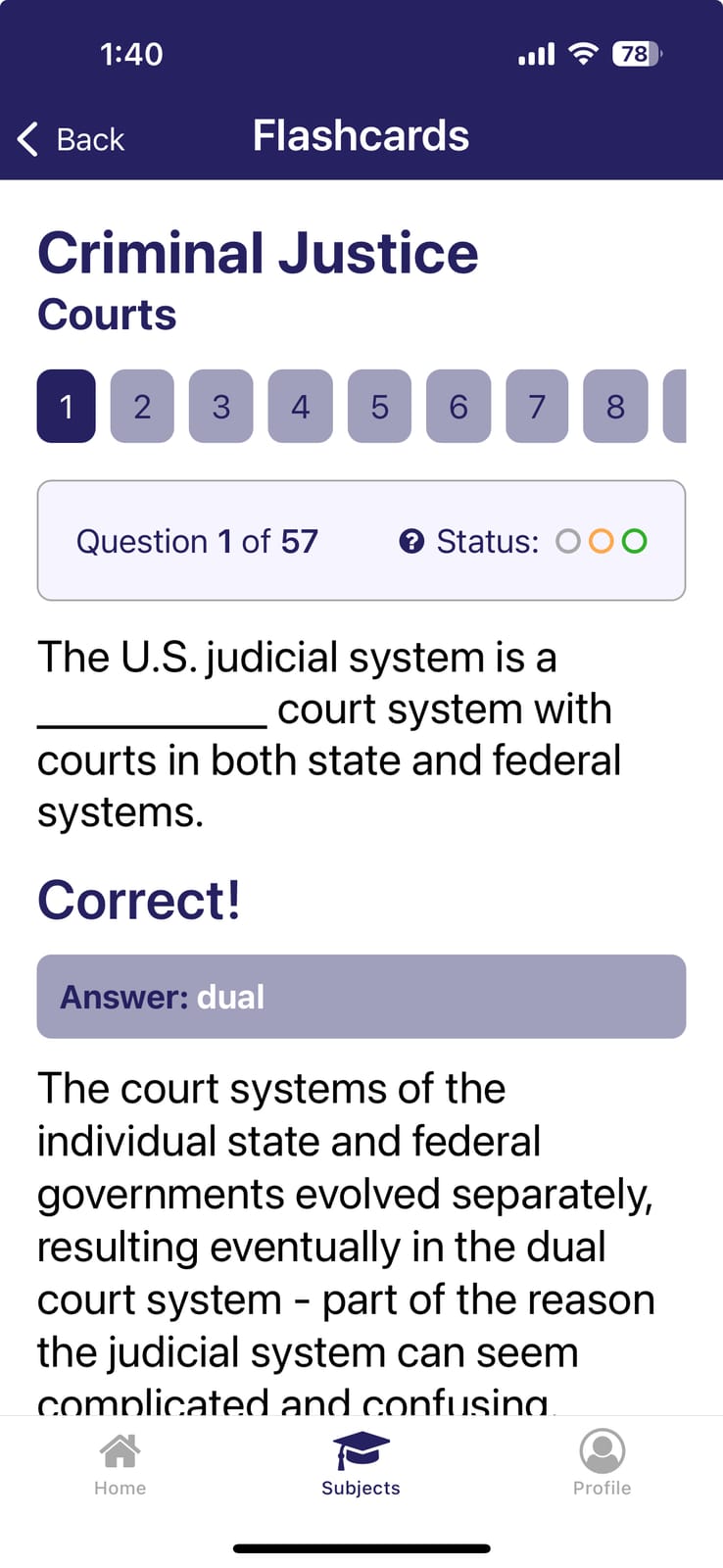
- Work through the InstantCert flashcards, noting if you lack knowledge in a specific area, such as courts. Review that section again or find a free resource if you keep getting the questions wrong.
- Download the official DSST Criminal Justice fact sheet, which includes 4 free questions you can use to test your knowledge.
- CliffsNotes is a great free resource on criminal justice.
Know the major theories, such as: biological (Lombroso), psychological (personality and mental disorder), and sociological (strain theory, social learning, labeling theory), as they all appear in the Criminal Behavior section and are easy to mix up.
What score do you need to pass?
A score of 400 is the standard passing threshold at most schools, but some require 500. Credit typically satisfies a criminal justice, social science, or general elective requirement. Confirm with your institution how the credit applies before you start studying.
Pass and the credit appears on your transcript with no letter grade. Fail and the attempt does NOT appear on your transcript at all. Military test-takers can retest after 6 months.
Can you pass Criminal Justice DSST / DANTES* with just flashcards?
Yes, since much of the exam is memorizing the vocabulary, this is a great one for flashcards.
The results speak for themselves, as 96% of students reported a pass (last updated 2026), which is one of the highest rates for DSST.
Which colleges accept the Criminal Justice DSST / DANTES*?
Most colleges and universities accept DSST credit and award 3 semester hours for a passing score. Criminal Justice credit typically satisfies a criminal justice program requirement, a social science elective, or a general education requirement, depending on your school. Policies vary, and most institutions cap how many DSST and CLEP credits count toward a degree, so confirm your school's rules before you commit to the exam.
Criminal Justice DSST / DANTES* vs. taking the class
An introductory criminal justice course at a community college typically runs a few hundred dollars. At a four-year university, the same course costs $1,000 to $3,000 or more. The DSST gets you the same 3 credit hours for $100, and it is free for active duty military.
| Exam fee | $100 (military free) |
| Typical tuition equivalent | $700–$3,000+ (one semester) |
| Credits earned | 3 semester hours (typical) |
| Time to prepare | 3–4 weeks self-study |
| GPA impact | None, pass/fail only |
| Failed attempt on transcript | No |
If you simply need a credit, this exam is a no-brainer. You likely have some knowledge of the justice system, and the rest can be memorized. However, if you plan to take upper-level criminal justice courses, classroom time would serve you better.
Happy testing!