
What This Exam Covers
The Introduction to Educational Psychology CLEP covers cognitive and behavioral theories of learning, child and adolescent development (Piaget, Vygotsky, Erikson, Kohlberg), student motivation, individual differences including learning disabilities and giftedness, classroom assessment, pedagogy, and research design in education.
If you are pursuing a field in education, counseling, or social work, this CLEP will be great for getting you a credit.
Exam at a Glance
| Questions | 100 multiple choice |
| Time | 90 minutes |
| Passing score | 50 (most schools) |
| College credits | 3 semester hours (typical) |
| Exam fee | $97 |
What's on the Introduction to Educational Psychology CLEP*?
Nine categories. The one that surprises most students: Individual Differences is the LARGEST section at 17%, not a minor topic. Here's the full breakdown from the College Board:
| Category | Weight | Topics |
|---|---|---|
| Individual Differences | 17% | Intelligence, genetic vs. environmental influences, learning exceptionalities, giftedness, learning disabilities, behavior disorders, ability grouping |
| Cognitive Perspective | 15% | Attention, perception, memory, problem-solving, transfer, conceptual change, cognitive applications in the classroom, language |
| Development | 15% | Cognitive development (Piaget, Vygotsky), social and emotional development (Erikson), moral development (Kohlberg), gender identity, language acquisition |
| Testing | 12% | Classroom assessment, formative and summative evaluation, grading, norm-referenced and criterion-referenced tests, reliability, validity, test bias, high-stakes assessment, statistics interpretation |
| Behavioral Perspective | 11% | Classical conditioning, operant conditioning, reinforcement schedules, behavioral applications in educational settings |
| Motivation | 10% | Attribution theory, expectancy-value, goal orientation, intrinsic and extrinsic motivation, self-efficacy, self-determination theory, learned helplessness, teacher expectations, anxiety |
| Pedagogy | 10% | Instructional planning, objective writing, constructivist methods, scaffolding, cooperative learning, classroom management, differentiated instruction, technology in education |
| Research Design and Analysis | 5% | Longitudinal and experimental studies, case studies, surveys, observations, interviews, correlation versus causation |
| Multiculturalism | 5% | Ethnic, racial, and cultural issues in education, socioeconomic status, bilingualism, gender differences, immigration, culturally responsive teaching |
Source: For a full breakdown of what is on the exam, see the College Board Introduction to Educational Psychology CLEP page.
How hard is the Introduction to Educational Psychology CLEP*?
This is a fairly easy CLEP exam, especially for those with any psychology background. A lot of it is vocabulary, which you can easily learn by drilling our flashcards. A lot of this exam is about learning definitions although you will need to know how they apply. Plan on three to four weeks of study if you have no background, but if you've done psychology before, you can study in as little as a few days.
How to study for the Introduction to Educational Psychology CLEP*
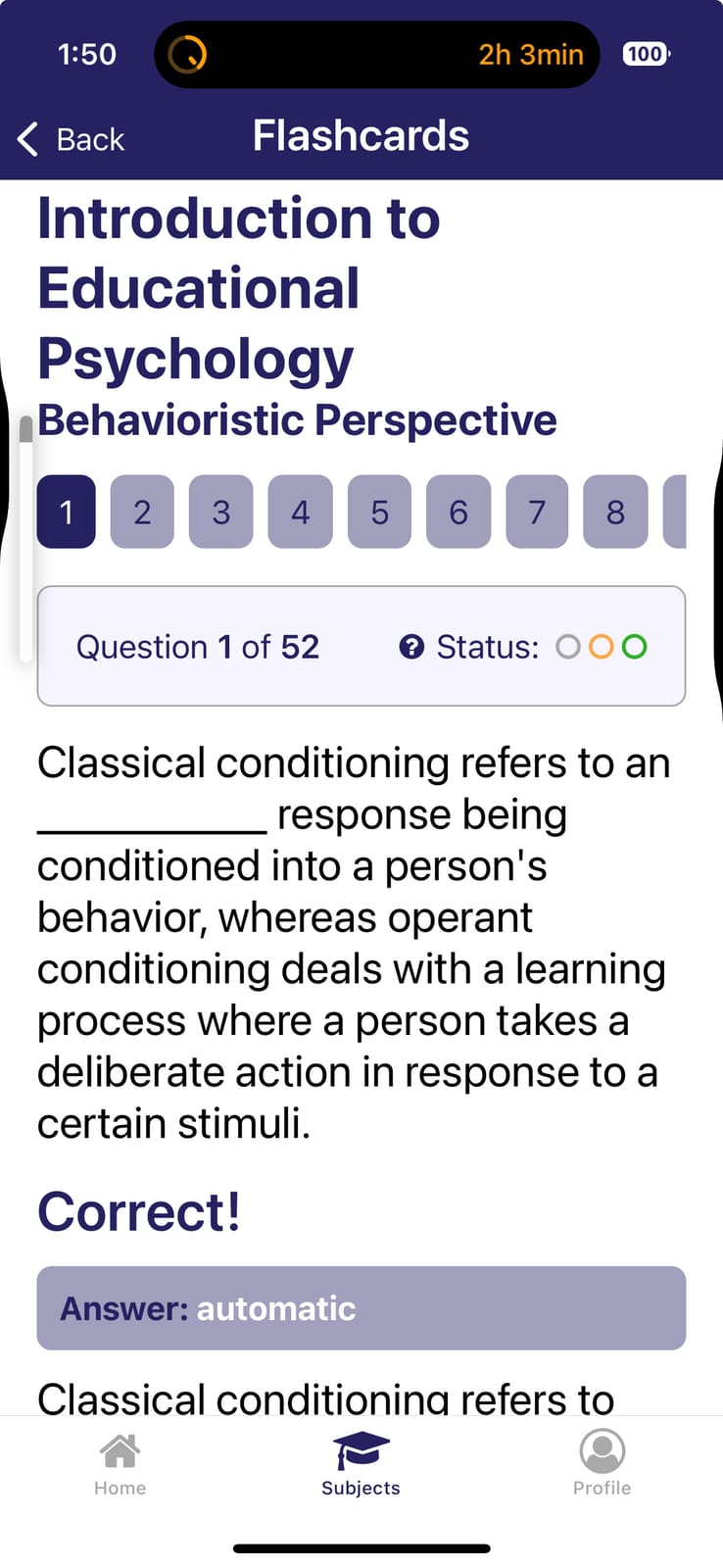
- Work through the InstantCert flashcards paying close attention to theorists. Piaget, Vygotsky, Skinner, Bandura, and Bloom all appear frequently.
- Use the College Board's free Educational Psychology practice questions to get a few free questions.
- Modern States has a free course on educational psychology. It goes very in depth so use the flashcards to figure out what areas you need to study before you begin.
- Bloom's Taxonomy comes up in a lot of questions. Learn what it is, all 6 levels, and how they apply to education.
What score do you need to pass?
A score of 50 is the standard pass rate at most schools, but some require 60. Educational Psychology credit often counts toward education prerequisites or general social science credit.
Fail and the attempt does NOT appear on your transcript at all. You can retake after 3 months, but you will lose the $97 exam fee.
Can you pass Introduction to Educational Psychology CLEP* with just flashcards?
Yes, many students pass with just our flashcards and the answers that come with each card. Since much of the exam involves memorizing concepts, flashcards work well. Our 92% pass rate reflects that most of our students do great on this exam.
Which colleges accept the Introduction to Educational Psychology CLEP*?
Most colleges accept the Introduction to Educational Psychology CLEP and award 3 credit hours. Credits awarded and minimum score requirements vary by school.
Use the College Board's CLEP credit-granting policy search tool to look up exactly what your school awards. Search by institution, select Introduction to Educational Psychology, and you will see their minimum score requirement and credit amount. Even with this tool, it is best to check with your school as it is not always up to date.
Introduction to Educational Psychology CLEP* vs. taking the class
This exam is equivalent to one semester of introductory educational psychology. At $97, it costs a fraction of what tuition runs for that course at most schools.
| Exam fee | $97 one-time |
| Typical tuition equivalent | $500–$3,000+ (one semester) |
| Credits earned | 3 semester hours (typical) |
| Time to prepare | 3–5 weeks self-study |
| GPA impact | None, pass/fail, not graded |
CLEP makes sense if you just need the credit, especially if you have a psychology background already. The class makes more sense if your program requires a letter grade for prerequisites, or if you want classroom experience such as group discussions.
Happy testing!