
What This Exam Covers
The Principles of Statistics DSST covers five content areas: descriptive statistics, probability, correlation and regression, sampling distributions, and inferential statistics, each worth exactly 20%.
This exam requires you to perform actual math calculations, not just learn theories. A non-programmable calculator is permitted, and a standard Z table is provided within the exam itself.
Exam at a Glance
| Questions | 100 multiple choice |
| Time | 120 minutes |
| Passing score | 400 (scaled score) |
| College credits | 3 semester hours (lower-level) |
| Exam fee | $100 (military free) |
| Calculator | Non-programmable calculator permitted; Z table provided |
What's on the Principles of Statistics DSST / DANTES*?
| Category | Weight | Topics |
|---|---|---|
| Foundations of Statistics | 20% | Data types and levels of measurement (nominal, ordinal, interval, ratio), sample vs. population, distribution; sampling types (random vs. nonrandom), sample size, bias, research design; descriptive statistics (measures of central tendency, dispersion, shape of distribution, five-number summary, IQR, outliers); visual representations (bar graphs, stem-and-leaf plots, histograms, line graphs, box plots) |
| Probability | 20% | Basic concepts (experiment, sample space, event, relative frequency, law of large numbers); probability rules for dependent and independent events (addition, multiplication, conditional probability); combinations and permutations; discrete distributions (expected values, binomial, Poisson, geometric); continuous distributions (uniform and normal) |
| Correlation and Regression | 20% | Scatter plots; linear correlation (strength and direction); linear regression (line of best fit, slope, y-intercept, residuals, coefficient of determination); prediction using the linear model |
| Sampling Distributions | 20% | Standard scores (Z scores); sampling distributions of a mean (standard error, normal approximation); Central Limit Theorem |
| Inferential Statistics | 20% | Confidence intervals; hypothesis testing (one and two-tailed, null and alternative hypotheses, significance level); Type I and Type II errors; inference for the mean or proportion of a population (large and small samples); comparing two sample means and proportions (z-tests and t-tests); comparing means of more than two samples (ANOVA); non-parametric testing (Chi-square for goodness of fit and contingency tables) |
Source: DSST / DANTES Principles of Statistics exam fact sheet.
How hard is the Principles of Statistics DSST / DANTES*?
This can be a very challenging exam for those without any statistics background. Even math-savvy students may struggle with statistics.
If you have any prior statistics or probability course, even at the high school level, then you will find this manageable, as it does not go into advanced statistical analysis. Plan to study a couple weeks to refresh your knowledge.
Starting from zero, plan for 6 to 8 weeks because you will need to learn a lot as well as do a lot of practice questions.
Our students have a 93% pass rate, so in the end, this exam can be relatively easy to pass if you put in the work.
How to study for the Principles of Statistics DSST / DANTES*
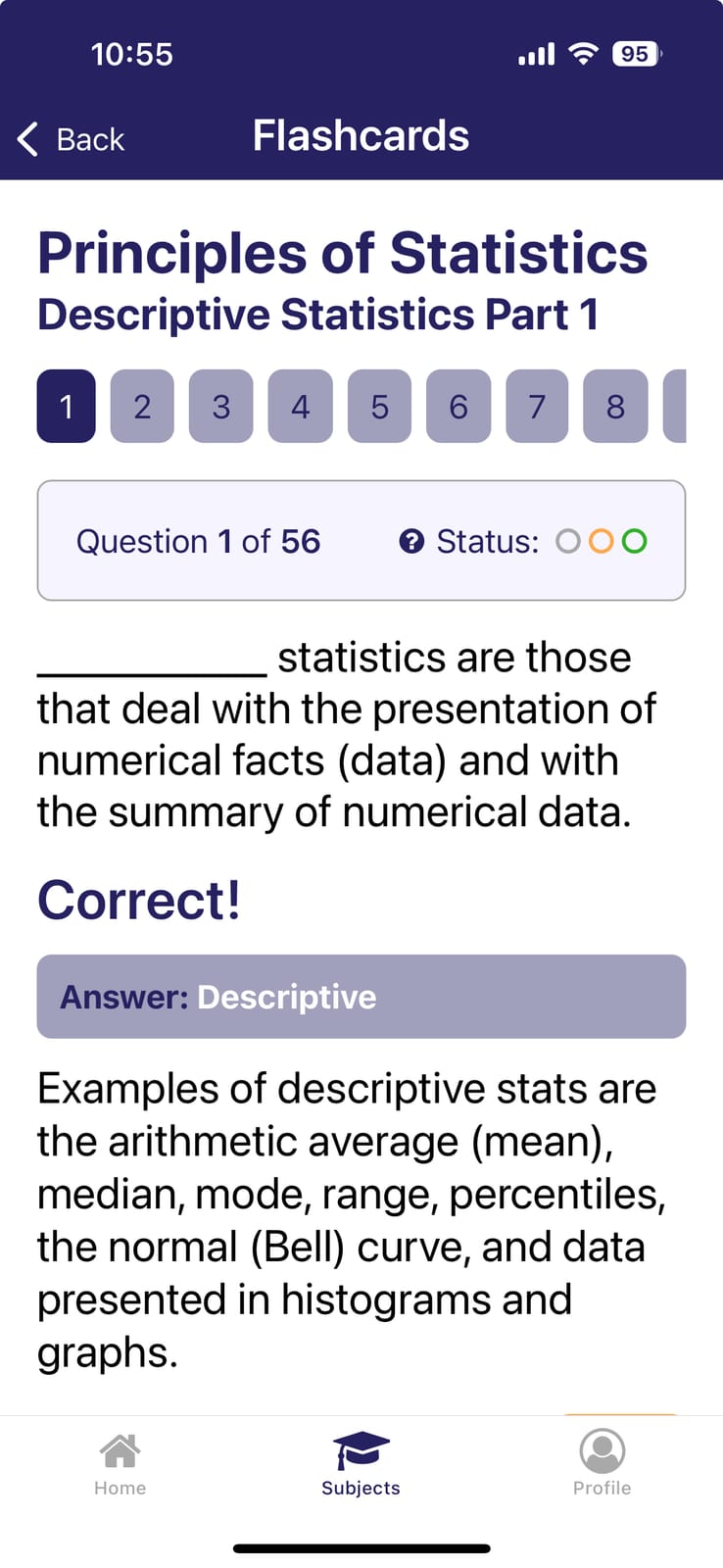
- Work through the InstantCert flashcards section by section and actually solve the calculation problems using paper or calculator. For hypothesis testing, practice the full sequence on multiple problems: state H₀ and H₁, set the significance level, calculate the test statistic, decide whether to reject H₀. Do this until the steps are automatic.
- Download the official DSST fact sheet from GetCollegeCredit.com for free sample questions.
- Khan Academy's free Statistics and Probability course is one of the best free resources available for this exam. It covers every section with interactive exercises and worked examples at exactly the right depth.
- The Z table is provided inside the exam, and you do NOT need to memorize it. What you do need is enough practice with Z score problems that you know how to use the table quickly.
What score do you need to pass?
A score of 400 is the standard passing threshold at most institutions.
ACE recommends this exam as 3 lower-level baccalaureate semester hours, and credit typically counts toward a math, statistics, or quantitative reasoning general education requirement.
Confirm with your institution how the credit applies before you start studying, as schools vary on score cutoffs and limits on how many DSST or CLEP credits you can use.
Pass and the credit appears on your transcript with no letter grade. Fail and the attempt does NOT appear on your transcript at all.
Can you pass Principles of Statistics DSST / DANTES* with just flashcards?
For most students, yes, but make sure you are working through the problems, not just taking calculated guesses.
295 out of 317 students who submitted results passed, which is a 93% pass rate (last updated 2026).
Which colleges accept the Principles of Statistics DSST / DANTES*?
Most colleges and universities accept DSST credit. ACE recommends this exam at the lower-level baccalaureate level for 3 semester hours, and it typically satisfies a mathematics, statistics, or quantitative reasoning general education requirement.
Each institution sets its own rules on how DSST credits apply and how many test-out credits count toward a degree. Confirm with your registrar before you start studying.
Principles of Statistics DSST / DANTES* vs. taking the class
Introductory statistics is a required course at a lot of schools. At a community college, it runs a few hundred dollars in-state; at a four-year university, the same 3-credit course typically costs $1,000 to $3,000 or more. The DSST gets you the same 3 credit hours for $100, and active duty military pay nothing.
| Exam fee | $100 (military free) |
| Typical tuition equivalent | $700–$3,000+ (one semester) |
| Credits earned | 3 semester hours (lower-level) |
| Time to prepare | 4–8 weeks self-study |
| GPA impact | None, pass/fail only |
| Failed attempt on transcript | No |
For students who want the credit and can handle the math, this is one of the better exams to test out of. Statistics tends to consume a full semester and carries real GPA risk for students who struggle with it. If you will need advanced statistics in your degree, then it may be a good idea to take the class where you can work with your professor or assistant to understand the concepts completely.
Happy testing!