10 Free Questions that should take you about 5 minutes to complete.
Question 1
blank is arrested and threatened with losing a pound of flesh when he reneges on a loan in "The Merchant of Venice".
Bassanio, in an attempt to win the hand of Portia by selecting the right treasure chest, borrows money from the merchant Antonio, who in turn borrows the money from Shylock—with a pound of his flesh as a guarantee. When Antonio's wealth is reported lost at sea, Shylock has Antonio arrested and tries to claim his right to the pound of flesh—and Antonio's life. At the last minute, Antonio is saved by a lawyer (actually Portia in disguise), who points out that the contract is flawed since the deal is that Shylock gets a pound of flesh, but he can't take that without taking some of Antonio's blood.
Question 2
An English blank is composed of three quatrains and one couplet.
An English sonnet (also known as a Shakespearean sonnet) begins with three quatrains (a quatrain is a stanza containing 4 lines) and concludes with a couplet (two rhyming lines). It follows the rhyme scheme abab cdcd efef gg. An English sonnet is 14 lines long (divided into 4 stanzas), and it has no required number of caesuras, or pauses within a line.
Question 3
John Bunyan's Pilgrim's Progress is a(n) blank of religious salvation.
When a story as a whole represents something else entirely through extensive use of symbolism, it is known as an allegory. Generally, the characters in an allegory lack personally defining characteristics, and instead exist to embody an emotion or virtue.
Question 4
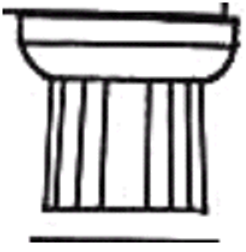
Identify the Greek column below: blank
The simplest column form, Dorics have flat capitals and plain shafts.
Question 5
"That government is best which governs least" is a quote from Henry David Thoreau's essay, blank.
Thoreau encourages people to follow their own conscience, not necessarily the one prescribed to them by the government, but if in doing so they go against the law, they must be prepared to handle the consequences. Thoreau spent time in jail for refusing to pay taxes to support the Mexican War.
Question 6
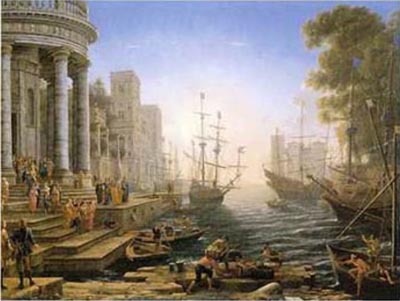
Baroque painter blank made Seaport.
Known for his brilliantly lit landscape pieces, Lorrain (1600-1682) also did Enchanted Castle and Rebecca's Wedding.
Question 7
Developed in 1907 by Pablo Picasso and his contemporaries, blank replaced the artistic tendencies of previous generations with fragmented three-dimensional images.
Originally done almost exclusively in blacks, whites, and grays, the abstract cubist forms were designed to appeal to the human intellect. By the 1920s, cubism took on more colors and represented less images of nature.
Question 8
Leonardo da Vinci and Raphael were both artists during the blank period.
From 1490 to 1520, High Renaissance style was composed of order, grace, and harmony, with perfectly proportioned subjects. Michelangelo was also an artist from this time period.
Question 9
The Edo Period in Japan introduced a new form of wood-block art known as blank.
Harunobu, Kiyonaga, Utamaro, Hokusai, and Hiroshige were all well-known ukiyo-e artists, a style initially appealing only to those of low social status with enough money to spend on art. Over time, these pictures of the "floating" world gained international renown during the Edo Period (1615-1867).
Question 10
A famous technique of Bach, blank is the integration of independent melodies into a homogenous sound.
There are five types of counterpoint: note against note, two notes against one, four notes against one, syncopation, and florid counterpoint (the latter of which is a combination of the first four types).
The Humanities CLEP is a recognition exam. Names, works, periods, and terms. A score in this range usually means a lot of them are not there yet. Scale it to 140 questions and you would be missing more than half. With that being said, 10 questions is a sample, not a diagnosis, and almost nobody walks in knowing both halves. Some people know the books and have never looked at a painting, and some are the reverse. Take the next 10 before you decide how much work is ahead of you.
Right in the middle. Scale it to 140 questions and you are somewhere near the passing line, which is a scaled 50 that College Board never publishes as a raw count. Close enough to be worth studying for. Not close enough to walk in cold, on an exam that about 1 in 3 test takers fail. Look at which ones you missed. If they bunch up on the literature side or the arts side, you have found where your study time goes. Ten questions is a sample, not a diagnosis, so take the next set and see if the number holds.
You did well. On Shakespeare, the sonnet, the major art movements, and Bach, you are in good shape. Two things to keep in mind, though. Ten questions is a sample, not a diagnosis. And a good score here says NOTHING about the parts this quiz does not sample. The real exam shows you paintings, sculptures, and buildings and asks you to identify them, and only two questions here did that. There is also nothing in this set on film or dance, and only one question each on poetry, music, and architecture. Take the next 10, then check the category weights below to see where your study time should go.
The ones you missed, with the right answer
You did not miss any. Round 2 covers Greek tragedy, philosophy, three more artists and movements, and film.
Antonio is arrested and threatened with losing a pound of flesh when he reneges on a loan in "The Merchant of Venice".
An English sonnet is composed of three quatrains and one couplet.
John Bunyan's Pilgrim's Progress is a(n) Allegory of religious salvation.
Identify the Greek column below: Doric
"That government is best which governs least" is a quote from Henry David Thoreau's essay, Civil Disobedience.
Baroque painter Claude Lorrain made Seaport.
Developed in 1907 by Pablo Picasso and his contemporaries, Cubism replaced the artistic tendencies of previous generations with fragmented three-dimensional images.
Leonardo da Vinci and Raphael were both artists during the High Renaissance period.
The Edo Period in Japan introduced a new form of wood-block art known as Ukiyo-e.
A famous technique of Bach, Counterpoint is the integration of independent melodies into a homogenous sound.
Get 10 more questions, free
Round 2 is 10 more questions from the same 516 cards, and 6 of the 10 are Fine Arts. It covers a trilogy of Greek tragedies, the art movement that came out of World War I, a period of Japanese painting, the composer who created the symphonic poem, and the film technique of montage. Enter your email and the link is on its way.
Or skip ahead: the full Humanities study guide has all 516 flashcards, $20/month, 30-day money-back guarantee. Get the study guide
Free Humanities Practice Test PDF
Would you rather download a PDF so you could read or print the practice questions? Below you can download the same 10 Humanities CLEP questions. The answer key has an explanation for every question. If the PDF helps, consider ordering the full study guide.
The Humanities CLEP stands in for a full year of intro humanities, which is why most schools award 6 semester hours for it and not 3. It is also the longest CLEP exam by question count: 140 multiple-choice questions in 90 minutes. College Board splits it down the middle, half Literature and half Fine Arts. The general breakdown is below.
Category
Share of exam
What is in it
Drama
10%
Greek tragedy and comedy, Shakespeare, modern playwrights, dramatic terms
Poetry
10 to 15%
Poetic forms (sonnet, epic, ode), meter and rhyme, poetic devices, major poets by period
Fiction
15 to 20%
Novels and short stories from the first novels through the modern era, major authors and works, genres, literary terms
Nonfiction and Philosophy
10%
Essays, speeches, and criticism, plus the major philosophers and schools of thought
Visual Arts
20%
Painting and sculpture: artists, styles, movements, and periods from the ancient world to the modern era, Western and non-Western
Music
15%
Composers by period (Baroque, Classical, Romantic), genres and musical forms (sonata, symphony, opera, fugue), basic terminology
Film and Dance
10%
Film directors and techniques, ballet and modern dance, other performing arts
Architecture
5%
Styles and periods (Classical, Romanesque, Gothic, modern), structural terms, major buildings
Questions
140 multiple choice
Time
90 minutes
Passing score
50 (some schools require 60)
College credits
6 semester hours (typical)
Exam fee
$97
Retake wait after a fail
90 days
How do our free questions compare to the real exam?
The sample questions are just a small part of the full study guidebut you can see the breakdown below. The paid study guide covers all sections
Below are ten of the most recent Humanities scores submitted by InstantCert students. These are unfiltered, real results. 50 passes at most schools.
Date of Exam
Result
Score
Jul 22, 2026
passed
60
Jul 22, 2026
passed
60
Jul 22, 2026
passed
60
Jul 22, 2026
passed
60
Jul 22, 2026
passed
60
Jul 22, 2026
passed
60
Jul 22, 2026
passed
60
Jul 22, 2026
passed
60
Jul 22, 2026
passed
60
Jul 22, 2026
passed
60
Live, unfiltered results posted by real InstantCert students. 1,166 submitted so far, 1,086 of them passing.
What Humanities Students Say About InstantCert
Reviews from people who used our Humanities study materials
“
I have used InstantCert twice now to aid my studying for CLEP tests. If it was not for the information contained within their flashcards, I am not confident that I would have been able to pass like I did.
I used this to help me pass two CLEP tests (I think they were the humanities and American history 1 tests). I found this very helpful. I also liked as a dyslexic who struggles with spelling that they didn't always require perfect spelling.
Finished all the free questions and ready to study for real? Each question was made by a human. No AI involved.
516 Humanities flashcards, each one with an explanation of why the answer is right. The questions on this page came directly from our study guide. The cards cover both halves of the exam: literature, visual arts, music, film, dance, and architecture.
Specific Exam Feedback forum on DegreeForum.net, where members post what was on their exam, how long they studied, and what they scored.
All 60+ other InstantCert study guides for CLEP, DSST, and TECEP exams.
$20/month, cancel anytime.
30-day money-back guarantee. If you are not happy in the first 30 days, just email, and I'll give you your money back.
One limit you should know about. The flashcards describe artworks in words, and the real exam shows them to you. Pair the cards with a few hours of Khan Academy Art History and you have both covered.
Only the College Board has real Humanities CLEP questions, and usually even their practice test has old ones. These 10 come straight out of our 516-card Humanities study guide.
Do these practice questions cover the whole Humanities CLEP exam?
No, our 20 free questions (10 on this page, 10 more by email) are just a small sample of our complete study guide. If you'd like questions on the entirety of the exam, please consider ordering our full study guide.
How many questions is the real exam?
140 multiple-choice questions in 90 minutes, which works out to about 39 seconds per question. It is the longest CLEP exam by question count.
What score passes?
50, at most schools. Scores run on a scale of 20 to 80, and some schools require a 60, so check your school's CLEP policy before you register.
How hard is the Humanities CLEP exam?
Humanities can be a hard one if you haven't had much exposure. If you've had a lot of exposure to arts then you may have an easier time but will still require some studying.
How do I get the next 10 questions?
Finish the 10 above, enter your email on the score screen and you get 10 more free practice questions.
Is the study guide enough on its own?
Some of our students have passed using only our study guide. 93% of the InstantCert students who reported a score passed. One of our Google reviewers wrote that without the flashcards, "I am not confident that I would have been able to pass like I did."
Is there a free Humanities CLEP practice test PDF?
How many practice questions should I do before the exam?
The real exam is 140 questions and their is no right answer to how many you should do. Our full version contains 516 cards. If you can run through them all without much difficulty you should pass the test with no problem.
Is the College Board Humanities CLEP practice test worth it?
Yes. It is the only place to see retired real questions but they only offer a few questions.
How long should I study for the Humanities CLEP?
This one can take considerable time if you have no experience in the humanities. 4 to 8 weeks is fairly typical.
Want direct access to people who have passed? The Specific Exam Feedback thread on DegreeForum.net is where they post what they studied and what they scored. Join today and ask away. Happy testing!