
What This Exam Covers
The Financial Accounting CLEP covers how businesses record, summarize, and report financial transactions, and is equivalent to a first-year accounting course. It starts from basic GAAP principles and the accounting cycle, and then continues through preparing and reading the three core financial statements: the income statement, the balance sheet, and the statement of cash flows.
Exam at a Glance
| Questions | ~75 multiple choice |
| Time | 90 minutes |
| Passing score | 50 (most schools) |
| College credits | 3 semester hours (typical) |
| Exam fee | $97 |
What's on the Financial Accounting CLEP*?
Five content areas. The Balance Sheet carries the most weight — plan to spend more time there than anywhere else.
| Category | Weight | Topics |
|---|---|---|
| Balance Sheet | 30–40% | Cash and internal controls, accounts and notes receivable, inventory valuation, long-term assets, depreciation, amortization, depletion, intangible assets, accounts and notes payable, long-term liabilities, stockholders' equity, preferred and common stock, retained earnings, liquidity and solvency analysis |
| General Topics | 20–30% | GAAP, double-entry accounting, the accounting equation, transaction analysis, the accounting cycle, financial statement relationships, business ethics, forms of business organization |
| Income Statement | 20–30% | Presentation formats, revenue and expense recognition, cost of goods sold, nonoperational items, profitability analysis |
| Statement of Cash Flows | 5–10% | Indirect method, operating activities, financing activities, investing activities, noncash transactions, cash flow analysis |
| Miscellaneous | Less than 5% | Investments, contingent liabilities |
Source: For a full breakdown of what is on the exam, see the College Board Financial Accounting CLEP page.
How hard is the Financial Accounting CLEP*?
This is one of the harder CLEPs because you don't just need to memorize vocabulary; you actually need to learn some accounting. The exam asks you to calculate, not just define, journal entries, depreciation methods, and other accounting principles.
Students with bookkeeping, accounting, or finance backgrounds will move significantly faster through the material. Starting from scratch, plan 5 to 8 weeks of consistent study. If you have never looked at an income statement, expect a couple of months of study.
How to study for the Financial Accounting CLEP*
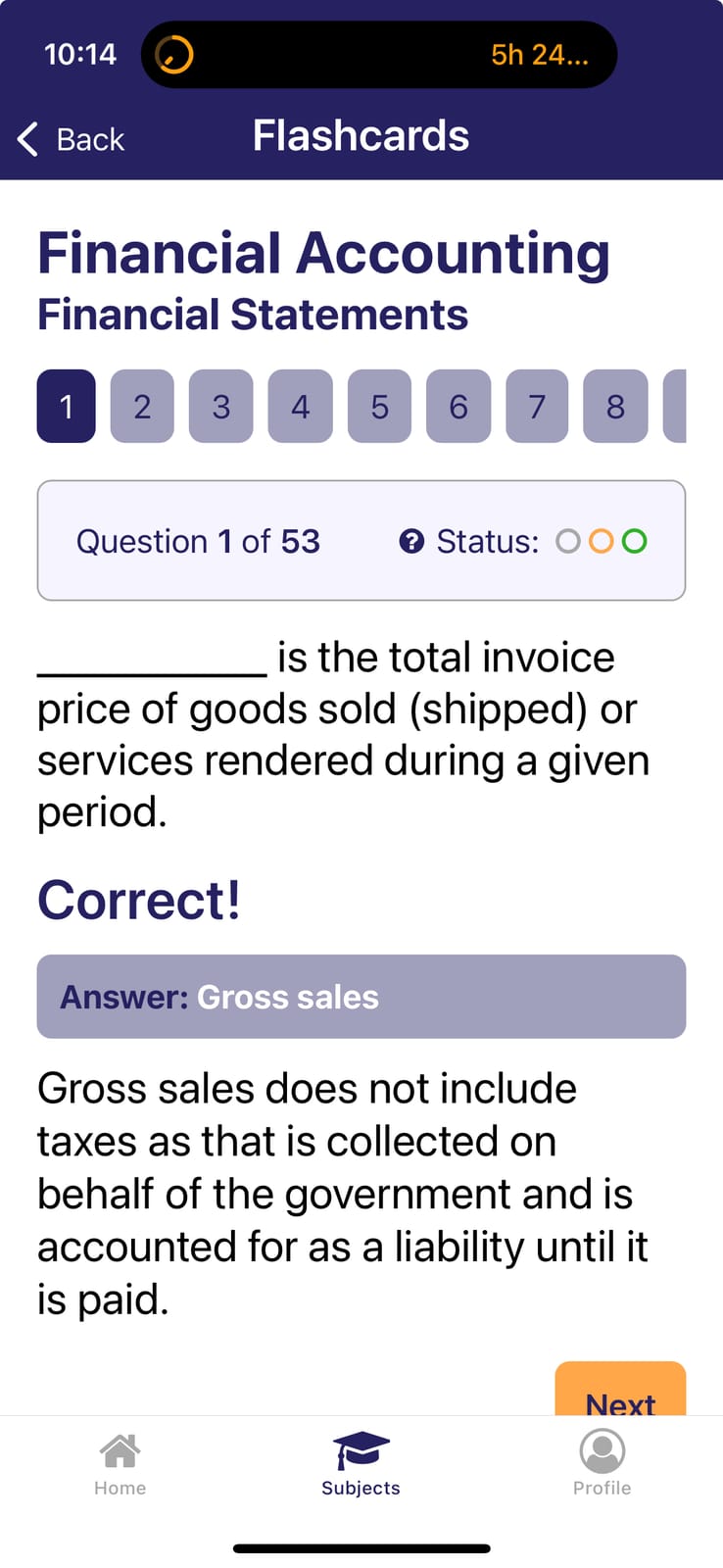
- Work through the InstantCert flashcards, treating every problem as a live practice calculation. Don't just guess — read the answer carefully to figure out where you went wrong. Journal entries, depreciation schedules, and ratio calculations need to be done by hand until you master them. Knowing the concept is NOT enough on this exam.
- Learn Account is a great video resource. It can be quite long but works through the concepts you will need.
- If a traditional course is more your style, Principles of Accounting is essentially a free online first-year textbook.
- The College Board has a few free Financial Accounting practice questions to test yourself on actual exam-style problems.
- Khan Academy's Accounting and Financial Statements course is another solid free option, especially for the balance sheet and income statement sections.
What score do you need to pass?
50 is the standard passing threshold for the Financial Accounting CLEP, but some schools require 60. Usually this exam satisfies a core business requirement, but check with your school for its policy.
Pass and the credit shows up on your transcript. Fail and the attempt does NOT appear on your transcript. You can retake after 3 months, but you will lose the $97 exam fee.
Can you pass Financial Accounting CLEP* with just flashcards?
Yes, but this is an exam where other material helps a lot. The flashcards cover the concepts and vocabulary thoroughly, but you really need to know how to work through the problems, not just memorize answers.
Which colleges accept the Financial Accounting CLEP*?
Most colleges accept the Financial Accounting CLEP and award 3 semester hours. It often counts toward a first-year business or accounting requirement. Some programs require an actual course, so check with your school for their policy.
Use the CLEP policy search tool to look up exactly what your school awards. One thing to note is that it can sometimes be out of date, but it will give you a good idea of what your school accepts.
Financial Accounting CLEP* vs. taking the class
One semester of introductory financial accounting costs several hundred to several thousand dollars, but the CLEP costs $97, so it obviously wins on cost.
| Exam fee | $97 one-time |
| Typical tuition equivalent | $500–$4,000+ (one semester) |
| Credits earned | 3 semester hours (typical) |
| Time to prepare | 5–8 weeks self-study |
| GPA impact | None, pass/fail, not graded |
| Accounting software | Not tested on the CLEP; the class typically includes QuickBooks or similar |
The CLEP makes the most sense if you have a business, bookkeeping, or finance background and want to skip the intro course. Taking the class makes more sense if your accounting program uses this course as a hard prerequisite for intermediate accounting, or if you specifically want the hands-on experience for upper-level classes.
Happy testing!