
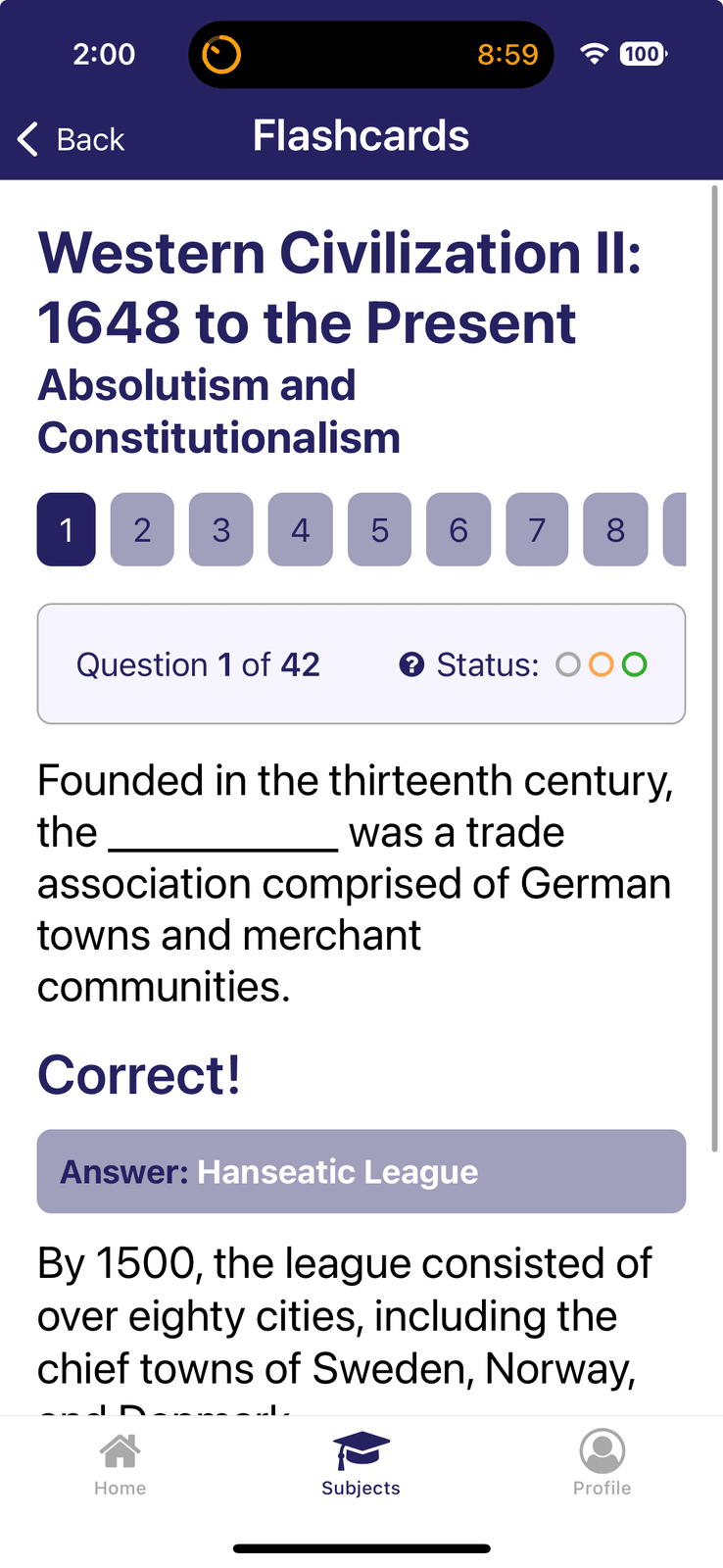
What This Exam Covers
The Western Civilization II CLEP covers European and Western history from 1648 to the present. This means it includes absolutism, the Scientific Revolution, the Enlightenment, the French Revolution and Napoleon, industrialization, the rise of nationalism, both World Wars, the Cold War, and modern Europe. It is equivalent to the second semester of a full year undergraduate western history class.
Exam at a Glance
| Questions | 120 multiple choice |
| Time | 90 minutes |
| Passing score | 50 (most schools) |
| College credits | 3 semester hours (typical) |
| Exam fee | $97 |
What's on the Western Civilization II CLEP*?
| Topic | Weight | Key Content |
|---|---|---|
| Absolutism and Constitutionalism, 1648–1715 | 7%–9% | Louis XIV and French absolutism, the Fronde, the Glorious Revolution, constitutional monarchy in England, Habsburg and Hohenzollern states |
| Competition for empire and economic expansion | 4%–6% | Mercantilist theory and practice, colonial competition among European powers, the slave trade, overseas trade networks |
| The Scientific View of the World | 5%–7% | Copernicus, Galileo, Newton, the Scientific Revolution, the mechanistic worldview, impact of science on religious thought |
| Period of Enlightenment | 7%–9% | Locke, Voltaire, Rousseau, Montesquieu, natural rights, the social contract, enlightened despotism |
| Revolution and Napoleonic Europe | 10%–13% | Causes and phases of the French Revolution, Declaration of the Rights of Man, Napoleon's rise and fall, the Congress of Vienna |
| The Industrial Revolution | 7%–9% | Origins in Britain, mechanization and the factory system, urbanization, working-class conditions, early labor movements |
| Political and cultural developments, 1815–1848 | 6%–8% | Conservatism and reaction after Vienna, liberalism and nationalism as reform movements, the Revolutions of 1848, Romanticism |
| Politics and diplomacy in the Age of Nationalism, 1850–1914 | 8%–10% | Unification of Germany and Italy, Bismarck and Realpolitik, the balance of power, the alliance system, crises leading to 1914 |
| Economy, Culture, and Imperialism, 1850–1914 | 7%–9% | The new imperialism in Africa and Asia, Social Darwinism, the Scramble for Africa, positivism and realism in culture |
| The First World War and the Russian Revolution | 10%–12% | Causes and course of WWI, trench warfare, the home front, the Treaty of Versailles, the Russian Revolution of 1917, early Bolshevik rule |
| Europe Between the Wars | 7%–9% | Weimar Republic, the Great Depression in Europe, rise of fascism in Italy, rise of Nazism in Germany, Stalin's Soviet Union, appeasement |
| The Second World War and contemporary Europe | 8%–10% | Causes and course of WWII, the Holocaust, the Cold War, decolonization, European integration, post-1945 political developments |
Source: For a full breakdown of what is on the exam, see the College Board Western Civilization II CLEP page.
How hard is the Western Civilization II CLEP*?
Because of the sheer time scale, this exam can be moderately hard. You are covering 350 years of European history across political, economic, military, and cultural dimensions. However, you are looking for the grand ideas rather than specific leaders or other obscure details. You're not expected to recall specific leaders or details, but rather to recognize major events, understand their causes, and grasp their consequences.
The two biggest sections are Revolution and Napoleonic Europe (10%–13%) and WWI and the Russian Revolution (10%–12%). Together, they account for nearly a quarter of the exam.
If you studied European history in the past, you probably need about 2-4 weeks to prepare. If you're starting from scratch and have no history background, plan for more like 2 months.
How to study for the Western Civilization II CLEP*
- Work through the InstantCert flashcards and keep track of what periods you are getting wrong. Read the full explanation even when you get the answer right, so you understand the event and its causes.
- Use the College Board's free Western Civilization II practice questions to get a few free practice questions.
- Crash Course European History is a great way to learn if you prefer videos instead of writing. The episodes cover the Enlightenment, the French Revolution, nationalism, WWI, WWII, and the Cold War.
- ModernStates.org has a free Western Civilization II course built for CLEP prep and goes into a bit more detail than the Crash Course videos.
What score do you need to pass?
A score of 50 will get you a passing score at most schools, but some require a 60. Western Civilization II credit typically satisfies a humanities or history credit requirement. Confirm your school's policy before you test.
Passing the exam and earning 3 semester hours will show up on your transcript as a Pass with no letter grade and no GPA impact. Fail and the attempt does NOT appear on your transcript. You can retake after 3 months, but you forfeit the $97 exam fee.
Can you pass Western Civilization II CLEP* with just flashcards?
Many of our students have passed the exam only with the flashcards. History content is well-suited to flashcard study because the exam rewards recognition of events, causes, and outcomes. This is different from classroom-based history, which often requires essays and deep analysis.
Which colleges accept the Western Civilization II CLEP*?
Most accredited U.S. colleges and universities accept the Western Civilization II CLEP for 3 semester hours, typically toward a humanities or history general education requirement. A few highly selective schools do not accept CLEP credit at all. Schools also often cap the total CLEP and DSST credit that counts toward a degree.
Use the College Board's CLEP credit-granting policy search tool to check what your institution's policies are. The tool is not always current, so confirm with your school or advisor before you start studying.
Western Civilization II CLEP* vs. taking the class
If you need 3 semester hours of history or humanities credit, the CLEP is a straightforward financial win. History or humanities majors who want a deeper grounding in modern Europe will get more from a classroom course. However, for satisfying a general education requirement, there is no reason to pay for a semester when the CLEP is an option.
| Exam fee | $97 (military: 1 free attempt) |
| Tuition equivalent | $500 to $1,500+ for a 3-credit course |
| Credits earned | 3 semester hours |
| Prep time | 3 to 7 weeks depending on background |
| GPA impact | None (pass/no record) |
| Transcript for fail | No record |
Happy testing!