
What This Exam Covers
The History of the Vietnam War DSST / DANTES exam spans Vietnam's pre-colonial roots through the fall of Saigon and its aftermath. It begins with a brief section on Vietnam's pre-war history, covering about 10% of the exam. The exam follows the war's progression, tracing how one decision led to the next. Understanding the war's overall dynamics is more valuable than memorizing dates and battles.
Exam at a Glance
| Questions | 100 multiple choice |
| Time | 120 minutes |
| Passing score | 400 (scaled score) |
| College credits | 3 semester hours (typical) |
| Exam fee | $100 (military free) |
What's on the History of the Vietnam War DSST / DANTES*?
| Period / Topic | Weight | Content |
|---|---|---|
| Vietnam Before 1940 | 5% | Cultural and religious traditions, Chinese political domination, French colonialism, Ho Chi Minh, the rise of Vietnamese nationalism and communism |
| WWII, Cold War, and the First Indochina War (1940-1955) | 9% | Vietnam under Japanese occupation, Vietnamese declaration of independence, restoration of French rule, Viet Minh vs. French military strategy, Dienbienphu, the Geneva Conference |
| Diem and Nation-Building (1955-1963) | 10% | U.S. support for Diem, growing Southern insurgency, JFK and counter-insurgency, the Buddhist crisis, the coup against Diem |
| LBJ Americanizes the War (1964-1965) | 10% | Gulf of Tonkin incident and resolution, Rolling Thunder air campaign, introduction of U.S. combat troops, escalation through July 1965 |
| America Takes Charge (1965-1967) | 10% | Westmoreland's attrition strategy, search and destroy operations, Ia Drang Valley, impact on Vietnamese society, measures of success |
| Home Front USA (1963-1967) | 8% | The Great Society vs. war spending, the credibility gap, congressional dissent, television and the press, the draft and draft resistance |
| Tet (1968) | 9% | Communist planning and objectives, the Tet offensive, reactions in the U.S. and Saigon, LBJ declines to run, the 1968 election |
| Vietnamization (1969-1973) | 10% | Nixon and Kissinger, Vietnamization and troop withdrawal, pacification and the Phoenix program, My Lai, secret negotiations, the 1972 Spring offensive, Paris Peace Accords |
| The War at Home (1968-1972) | 8% | Campus unrest, peace moratoria, the counterculture and silent majority, the Pentagon Papers, the Miami and Chicago conventions |
| Cambodia and Laos | 8% | Ho Chi Minh Trail, the secret bombing, Lon Nol and the U.S. incursion into Cambodia, the Khmer Rouge, the fall of Phnom Penh |
| "A Decent Interval" (1973-1975) | 8% | Cease-fire violations, Watergate and Nixon's resignation, the War Powers Act, the Great Spring Offensive, the fall of Saigon |
| U.S. Legacies and Lessons | 5% | The Vietnam Syndrome and foreign policy, returning veterans, POW/MIA issues, economic consequences, impact on the U.S. military and media |
Source: For a full breakdown of what is on the exam, see the DSST / DANTES A History of the Vietnam War exam page.
How hard is the History of the Vietnam War DSST / DANTES*?
A lot of students from the US already have some understanding of the Vietnam war. Maybe you watched the Ken Burns documentary. 96% of InstantCert students who submitted results passed this exam, one of our highest pass rates. The flashcards are chronological, making them suitable for sequential study. Veterans and military personnel tend to master this material faster than others. Those starting from scratch should plan 3 to 5 weeks of dedicated study time.
How to study for the History of the Vietnam War DSST / DANTES*
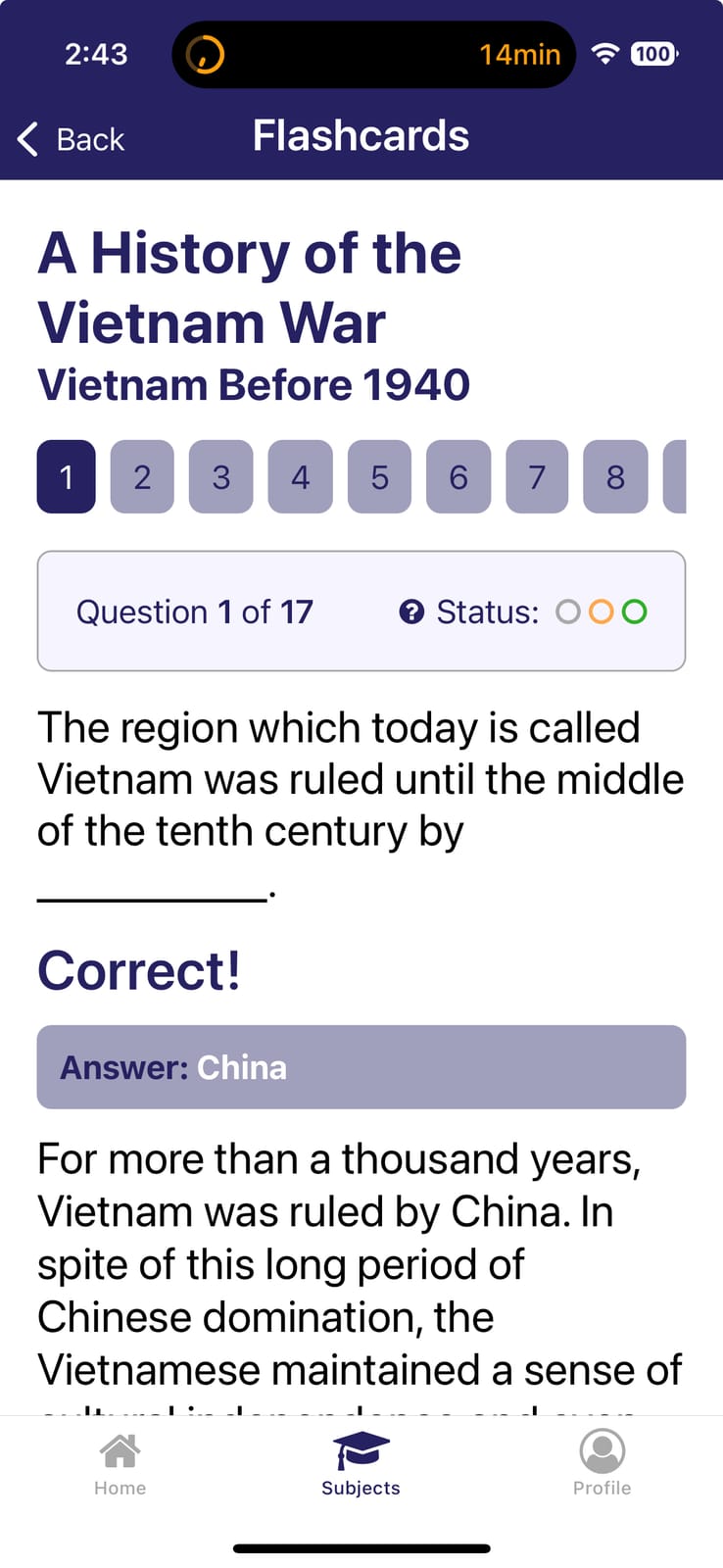
- Work through the InstantCert flashcards in chronological order, starting with pre-1940 Vietnam and moving through the fall of Saigon. The exam rewards students who can explain cause and effect across the full arc of the war. Flag any incorrect answers and revisit them before testing or seeking a free resource.
- Use the official practice exam available on the GetCollegeCredit.com Vietnam War page to get some free questions and the outline for the exam.
- Ken Burns' "The Vietnam War" documentary series is one of the best resources available for this exam. The only problem is it is huge but well worth the watch. Even watching a few episodes that cover your weakest content areas will make a real difference in how well the material sticks.
- One huge area you need to know is the Tet Offensive. Simple History has a quick video on it, although you may want to go deeper as this is a battle that often has many questions. It also affected a pivotal moment in politics.
What score do you need to pass?
A scaled score of 400 is the standard passing threshold. Credit typically applies toward a history, social science, or general elective requirement. Confirm with your school how it applies to your specific degree program before you start to study.
Pass and the credit appears as a pass but with no score on your transcript. Fail and the attempt does NOT appear on your transcript at all.
Can you pass the History of the Vietnam War DSST / DANTES* with just flashcards?
Yes, our students pass at a 96% rate, one of the highest DSST pass rates. The flashcards are in chronological order, allowing you to easily revisit problem areas. Those with a background in American history, Cold War policy, or general knowledge of the era will likely find the flashcards sufficient. Even with no prior knowledge, the flashcards can be used, but additional resources for challenging sections will be helpful.
Which colleges accept the History of the Vietnam War DSST / DANTES*?
Most institutions grant 3 semester hours for this exam, typically toward a history or social science requirement.
It's best to check with your school directly, as policies vary and acceptance of DSST & CLEP credits differs. You can look up credit recommendations at acenet.edu to see how schools typically apply DSST credit.
History of the Vietnam War DSST / DANTES* vs. taking the class
At $100, the math is clear: a few weeks of self-directed study for credit that would otherwise cost a semester of tuition.
| Exam fee | $100 (military free) |
| Typical tuition equivalent | $700–$3,000+ (one semester) |
| Credits earned | 3 semester hours (typical) |
| Time to prepare | 3–5 weeks self-study |
| GPA impact | None, pass/fail |
This exam makes sense if you already have some knowledge of the war and want a history credit quickly. Taking the class makes more sense if you need the credit toward a specific requirement or if you want the guided classroom experience where you can better discuss the war.
Happy testing!