
What This Exam Covers
The Astronomy DSST / DANTES exam covers the history and methods of science through astrophysics, the solar system, star life cycles, and the universe's large-scale structure. Conceptual understanding is key, not heavy math. Knowing the H-R diagram's significance matters more than calculating a star's luminosity from scratch.
Exam at a Glance
| Questions | 100 multiple choice |
| Time | 120 minutes |
| Passing score | 400 (scaled score) |
| College credits | 3 semester hours (typical) |
| Exam fee | $100 (military free) |
What's on the Astronomy DSST / DANTES*?
| Content Area | Weight | Topics |
|---|---|---|
| Introduction to the Science of Astronomy | 5% | Nature and methods of science, applications of scientific thinking, history of early astronomy |
| Astrophysics | 15% | Kepler's laws and orbits, Newtonian physics and gravity, relativity |
| Celestial Systems | 10% | Celestial motions, Earth and the Moon, seasons, calendar and timekeeping |
| The Science of Light | 15% | The electromagnetic spectrum, telescopes and the measurement of light, spectroscopy, blackbody radiation |
| Planetary Systems: Our Solar System and Others | 20% | Contents of our solar system, formation and evolution of planetary systems, exoplanets, habitability and life in the universe |
| The Sun and Stars: Nature and Evolution | 15% | Our star, the Sun; properties and classification of stars; birth, life and death of stars; nuclear fusion and the origin of the elements |
| Galaxies | 10% | Our galaxy: the Milky Way; classification and structure of galaxies; measuring cosmic distances |
| The Universe: Contents, Structure, and Evolution | 10% | Galaxy clusters and large-scale structure, the Big Bang and Hubble's law, the evolution and fate of the universe, dark matter and dark energy |
Source: For a full breakdown of what is on the exam, see the DSST / DANTES Astronomy exam fact sheet.
How hard is the Astronomy DSST / DANTES*?
Some of our students struggle with this exam because of the extensive vocabulary that needs to be memorized. Terms such as blackbody radiation, spectral classification, Kepler's laws, and Hubble's law are just a few that you'll need to learn. The good news is that the content holds together conceptually. However, once you grasp how stellar mass drives a star's life cycle, other concepts fall into place.
Plan for 4 to 5 weeks starting from scratch. Our 89% pass rate is lower than we would like, but it is higher than the 46% reported by the military.
How to study for the Astronomy DSST / DANTES*
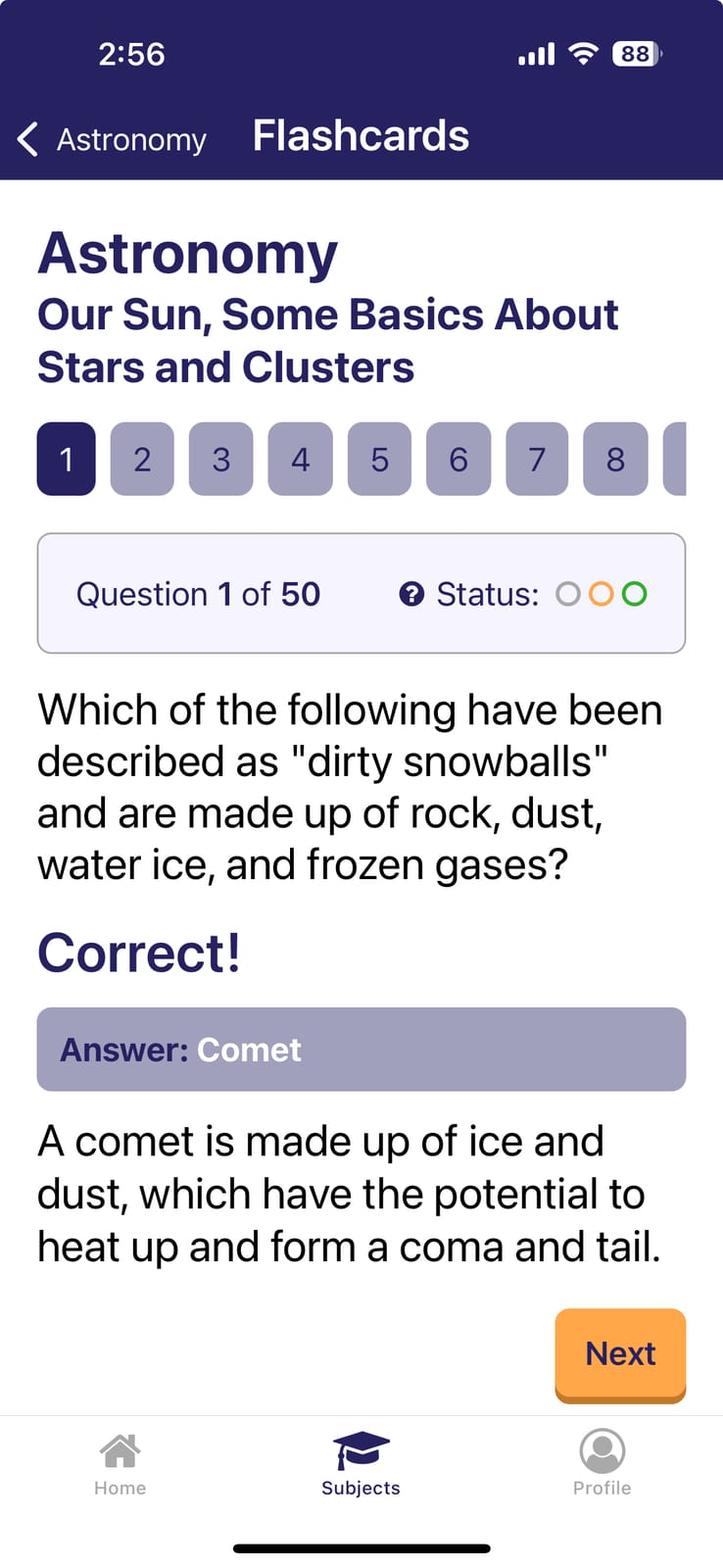
- Work through the InstantCert flashcards with a serious focus on Section VI stellar evolution and the H-R diagram. Understanding how a star's mass determines its full life cycle, from the main sequence through white dwarf, neutron star, or black hole, is the highest-value content on this exam. It also connects directly to questions in the Sun section and the galaxy section.
- Use the official DSST practice exam to get a few free questions.
- Crash Course Astronomy is a great way to study if you learn better from videos.
TIP: Master the H-R diagram thoroughly. Know where main sequence stars, giants, supergiants, and white dwarfs fall on the diagram. Know how a star's position shifts during its lifetime. Know how luminosity and temperature relate to each other. H-R diagram questions appear throughout the stellar evolution section and are among the most consistently tested topics on the exam.
What score do you need to pass?
A scaled score of 400 is the standard passing threshold at most schools. Credit typically applies toward a natural science or general education requirement. Confirm with your institution before starting to study.
Pass and the credit appears as a pass with no score on your transcript. Failing the exam does not result in any notation on your transcript.
Can you pass Astronomy DSST / DANTES* with just flashcards?
Yes, but many students supplement with Crash Course or other free resources. Our 287 flashcards cover all 8 content areas and is great for learning the vocabulary. 89% of students who submitted results passed.
Which colleges accept the Astronomy DSST / DANTES*?
Most institutions grant 3 semester hours for this exam, typically toward a natural science or general education requirement. Some programs require a lab section, which the DSST does not provide. Confirm with your advisor whether the Astronomy DSST satisfies your specific requirement before signing up to test.
Astronomy DSST / DANTES vs. taking the class
At $100, the math strongly favors testing out. Introductory astronomy at a typical college costs several hundred dollars to over $3,000 in tuition for the same 3 credits.
| Exam fee | $100 (military free) |
| Typical tuition equivalent | $700–$3,000+ (one semester) |
| Credits earned | 3 semester hours (typical) |
| Time to prepare | 4–5 weeks self-study |
| GPA impact | None, pass/fail |
| Lab science credit | DSST does NOT include a lab — verify with your advisor |
This exam makes the most sense if you have any science background or have spent time watching astronomy content. If your program requires a lab, take the class, as the DSST credit will not satisfy that requirement at most schools.
Happy testing!