
What This Exam Covers
The Business Ethics and Society DSST / DANTES exam covers ethical theory as applied to business. Concepts include moral philosophies and their business applications, corporate social responsibility, the ethics of employer-employee relations, stakeholder theory, the ethics of information and technology, international business ethics, and the relationship between business and government.
Exam at a Glance
| Questions | 100 multiple choice |
| Time | 120 minutes |
| Passing score | 400 (scaled score) |
| College credits | 3 semester hours (typical) |
| Exam fee | $100 (military free) |
What's on the Business Ethics and Society DSST / DANTES*?
| Category | Weight | Topics |
|---|---|---|
| Business Ethics and Moral Philosophy | ~25% | Ethical relativism vs. objectivism, consequentialist ethics (utilitarianism), deontological ethics (Kant), virtue ethics, stakeholder theory, applying ethical frameworks to business decisions |
| Social Responsibilities of Business | ~20% | Corporate social responsibility (CSR), the shareholder vs. stakeholder debate, business and community, corporate philanthropy, sustainability and environmental responsibility |
| Employer-Employee Relations | ~20% | Employee rights and duties, workplace discrimination and harassment, privacy in the workplace, whistleblowing, fair treatment and due process |
| Business, Government, and Regulation | ~15% | Role of government regulation, antitrust law, consumer protection, regulatory agencies, the tension between free markets and public interest |
| Ethics in International Business | ~10% | Cultural relativism in global business, bribery and corruption (FCPA), labor standards, multinational corporate responsibility |
| Ethics of Information and Technology | ~10% | Intellectual property, privacy and data ethics, marketing ethics, advertising standards, digital ethics |
Source: For a full breakdown of what is on the exam, see the DSST / DANTES Business Ethics and Society exam fact sheet.
How hard is the Business Ethics and Society DSST / DANTES*?
This is one of the easier DSST business exams and a lot of our students find they already know the concepts. You need to understand ethical frameworks and be able to apply them to business scenarios, but this isn't a complex philosophy class. Starting from scratch, plan for 2 to 4 weeks, but many can study in a few days if they have previous experience.
How to study for the Business Ethics and Society DSST / DANTES*
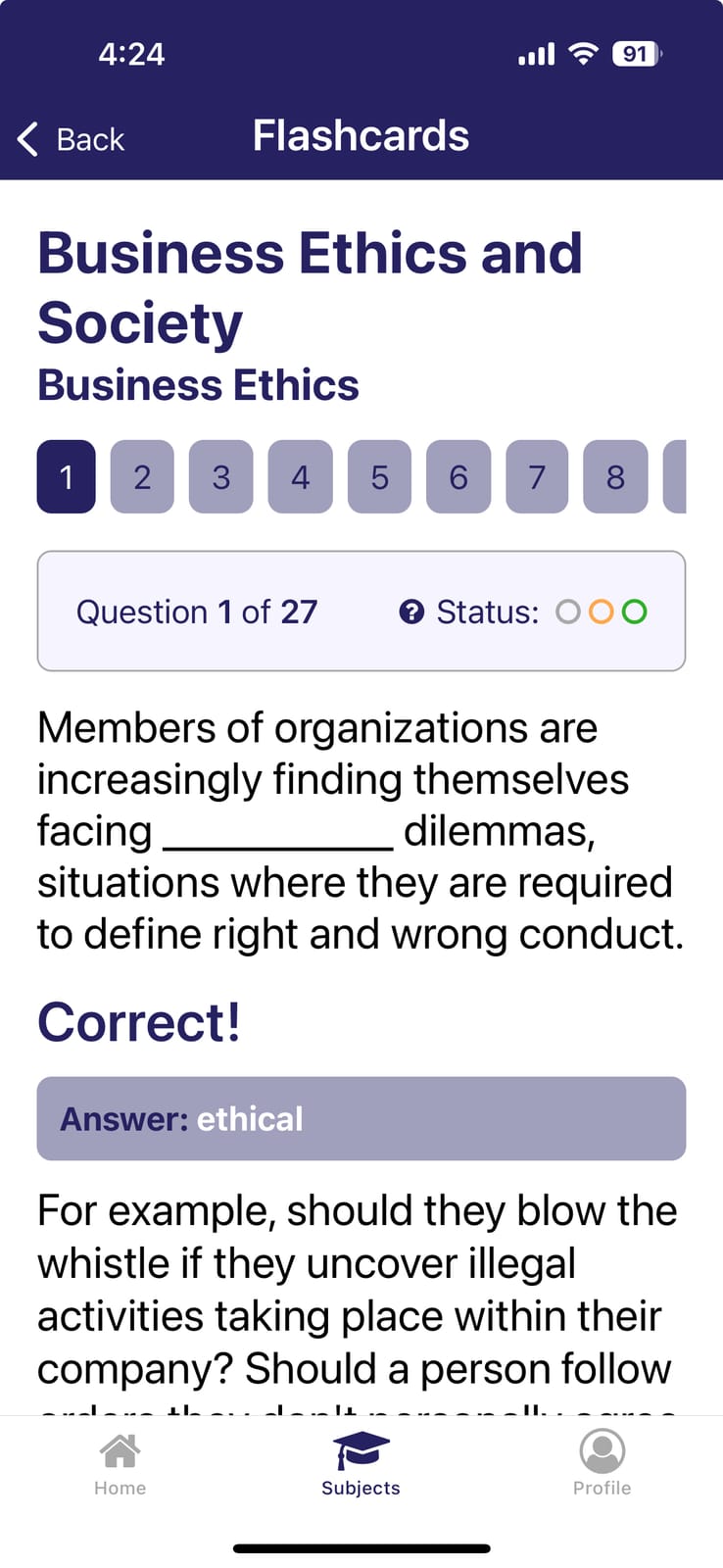
- Work through the InstantCert flashcards, paying attention to any sections you find overly complex.
- Use the official DSST practice exam from the GetCollegeCredit.com Business Ethics page to gauge your readiness on scenario-based questions.
- There is a thorough online course which is a bit overkill but has great knowledge.
- Know stakeholder theory vs. shareholder theory. The stakeholder view (Freeman) holds that corporations owe duties to all affected parties (employees, customers, communities, not just shareholders). The shareholder view (Friedman) holds that maximizing profit is the primary obligation. These theories appear often.
What score do you need to pass?
A scaled score of 400 is the standard passing threshold at most institutions. Credit typically counts toward a business administration, ethics, or general education requirement. Confirm with your institution how the credit applies before you test.
Fail and the attempt does NOT appear on your transcript. Military test-takers can retest after 6 months.
Can you pass Business Ethics and Society DSST / DANTES* with just flashcards?
Yes. The content is conceptual and vocabulary-forward, making structured flashcard review a highly effective preparation method. Our 97% pass rate is among the strongest of any DSST exam we offer and reflects how learnable this material is from flashcards.
Happy testing!