
What This Exam Covers
The Environmental Science DSST / DANTES exam focuses on introductory environmental science, with a strong emphasis on ecology. Almost a third of the questions test pure ecological foundations: ecosystems, food webs, biomes, population biology, and energy flow. The rest covers how humans impact the environment through conservation and policies that help protect wilderness areas.
Exam at a Glance
| Questions | 100 multiple choice |
| Time | 120 minutes |
| Passing score | 400 (scaled score) |
| College credits | 3 semester hours (typical) |
| Exam fee | $100 (military free) |
What's on the Environmental Science DSST / DANTES*?
| Content Area | Weight | Topics |
|---|---|---|
| Ecological Concepts | 30% | Ecosystems, organism relationships, biodiversity, trophic relationships (food chains and food webs), energy flows and cycles, biomes, population biology, evolution, ecological succession |
| Environmental Impacts | 25% | Human population dynamics, global climate change, pollution (physical, chemical, and biological), agricultural and industrial impacts, habitat destruction, land degradation |
| Environmental Management and Conservation | 25% | Renewable and nonrenewable resources, agricultural practices, pesticides and pest control, soil conservation, air pollution control, water quality and supply, wastewater treatment, solid and hazardous waste, environmental risk assessment |
| Social Processes and the Environment | 20% | Environmental justice, policy planning and decision making, global environmental governance, differing cultural and societal values |
Source: For a full breakdown of what is on the exam, see the DSST / DANTES Environmental Science exam page.
How hard is the Environmental Science DSST / DANTES*?
This exam is in the middle of the pack in terms of difficulty. It is definitely easier than some of the other science exams but does require you to learn a lot of vocabulary and environmental systems. The Ecological Concepts section makes up 30% and has a lot of terms such as biomes, trophic levels, energy flows, population dynamics, and ecological succession. Students who took a high school biology or ecology course find they may already know many of the terms.
Plan for 3 to 4 weeks starting from scratch, but it can be done in a week or 2 if you have some background. Our 96% pass rate is one of the strongest of any DSST we offer, and considerably higher than the military pass rate for this exam.
How to study for the Environmental Science DSST / DANTES*
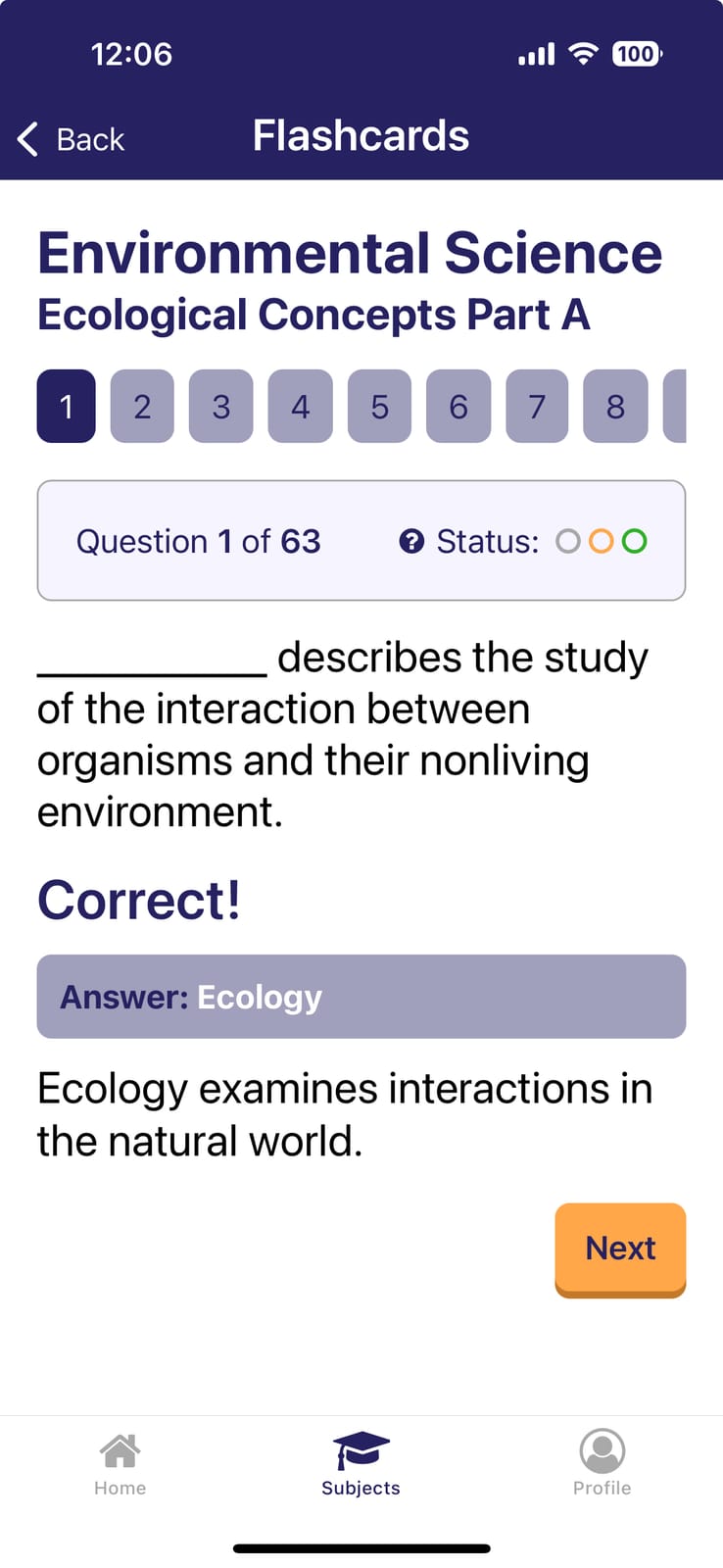
- Work through the InstantCert flashcards with a focus on learning the vocabulary like biomes, trophic relationships, and energy flow. If you can understand the different terminology this will get you a long way. Learn the difference between primary producers, primary consumers, and secondary consumers. Understand how energy is lost at each trophic level. These concepts show up on EVERY version of this exam.
- Use the official DSST practice questions to get a few free practice questions from the GetCollegeCredit website.
- Crash Course Ecology is a great free video resource for anyone who learns better by video.
TIP: This exam tests applied knowledge, not just definitions. While learning the vocabulary, make sure to learn how it relates to an underlying system. Knowing what eutrophication is matters less than knowing what causes it (nutrient runoff) and what follows (oxygen depletion, algal blooms, fish kills). The same logic applies to the greenhouse effect, acid rain, and ozone depletion. Know the system, not just the words.
What score do you need to pass?
400 is the standard passing threshold at most institutions, although some use 500. Credit usually counts toward a science or general education requirement. Check with your school for exact requirements before you start to study.
Pass and the credit appears as a pass with no letter grade on your transcript. Fail and the attempt does NOT appear on your transcript at all.
Can you pass Environmental Science DSST / DANTES* with just flashcards?
Environmental science is vocabulary-heavy, which is exactly where our structured flashcard review is most effective. Our 362 cards cover all four content areas, and the 96% pass rate is one of the highest on any DSST we offer.
Which colleges accept the Environmental Science DSST / DANTES*?
Most institutions grant 3 semester hours toward a natural science or general education requirement. Some programs require a lab science credit specifically. The DSST does NOT include a lab component, so confirm with your advisor whether this exam satisfies your specific requirement before signing up. You can search for ACE credit recommendations at acenet.edu.
Environmental Science DSST / DANTES* vs. taking the class
At $100, the financial case for testing out is straightforward. An introductory environmental science course costs $700 to $3,000+ in tuition for the same 3 credits, with no GPA impact on the DSST side.
| Exam fee | $100 (military free) |
| Typical tuition equivalent | $700–$3,000+ (one semester) |
| Credits earned | 3 semester hours (typical) |
| Time to prepare | 3–4 weeks self-study |
| GPA impact | None, pass/fail |
| Lab science credit | DSST does NOT include a lab — verify with your advisor |
This exam makes sense if you have any science background or covered ecology in high school. If your program requires a lab, then it's better to take the course.
Happy testing!