
What This Exam Covers
The Foundations of Education DSST covers historical ideas by leaders like Dewey and Jefferson, as well as contemporary issues such as race, curriculum, and technology. It examines how historical views have shaped contemporary ones.
Exam at a Glance
| Questions | 100 multiple choice |
| Time | 120 minutes |
| Passing score | 400 (scaled score) |
| College credits | 3 semester hours (typical) |
| Exam fee | $100 (military free) |
What's on the Foundations of Education DSST / DANTES*?
| Category | Weight | Topics |
|---|---|---|
| Contemporary Issues in Education | 50% | Equity (race, gender, socioeconomic status, special education, language minorities), governance (federal, state, and local roles; school boards; funding), curriculum (theory, standardized testing, textbook selection, academic freedom), professional issues (teacher ethics, certification, legal responsibilities, in loco parentis), technology issues (digital divide, distance learning, technology in the classroom) |
| Past and Current Influences on Education | 30% | Philosophies, theories, and ideologies (pragmatism/Dewey, perennialism/Hutchins, essentialism, reconstructionism, behaviorism/Skinner, constructivism/Piaget, humanism/Maslow), democratic ideals (Jefferson, common school movement/Horace Mann, land grant colleges, separation of church and state, Brown v. Board of Education), social and economic influences (poverty, family and community factors, multicultural education) |
| Interrelationships between Contemporary Issues and Influences | 20% | Tradition vs. progress, national vs. local control (ESEA, IDEA, No Child Left Behind, ESSA), secular vs. religious (First Amendment, prayer in schools, creationism vs. evolution), civil rights (desegregation, Title IX, ADA, IDEA), public vs. private schooling (vouchers, charter schools, homeschooling) |
Source: For a full breakdown of what is on the exam, see the DSST / DANTES Foundations of Education exam fact sheet.
How hard is the Foundations of Education DSST / DANTES*?
This exam can be relatively easy for most people. Half of the exam covers modern issues, which most of us have at least some knowledge of.
What often trips people up are the theorists of the past. For instance, what did Dewey theorize compared to Skinner? This section requires you to remember the names and also what they thought.
From scratch, plan for 3 to 4 weeks. Depending on your background in education or teaching, you might only need a week or two.
How to study for the Foundations of Education DSST / DANTES*
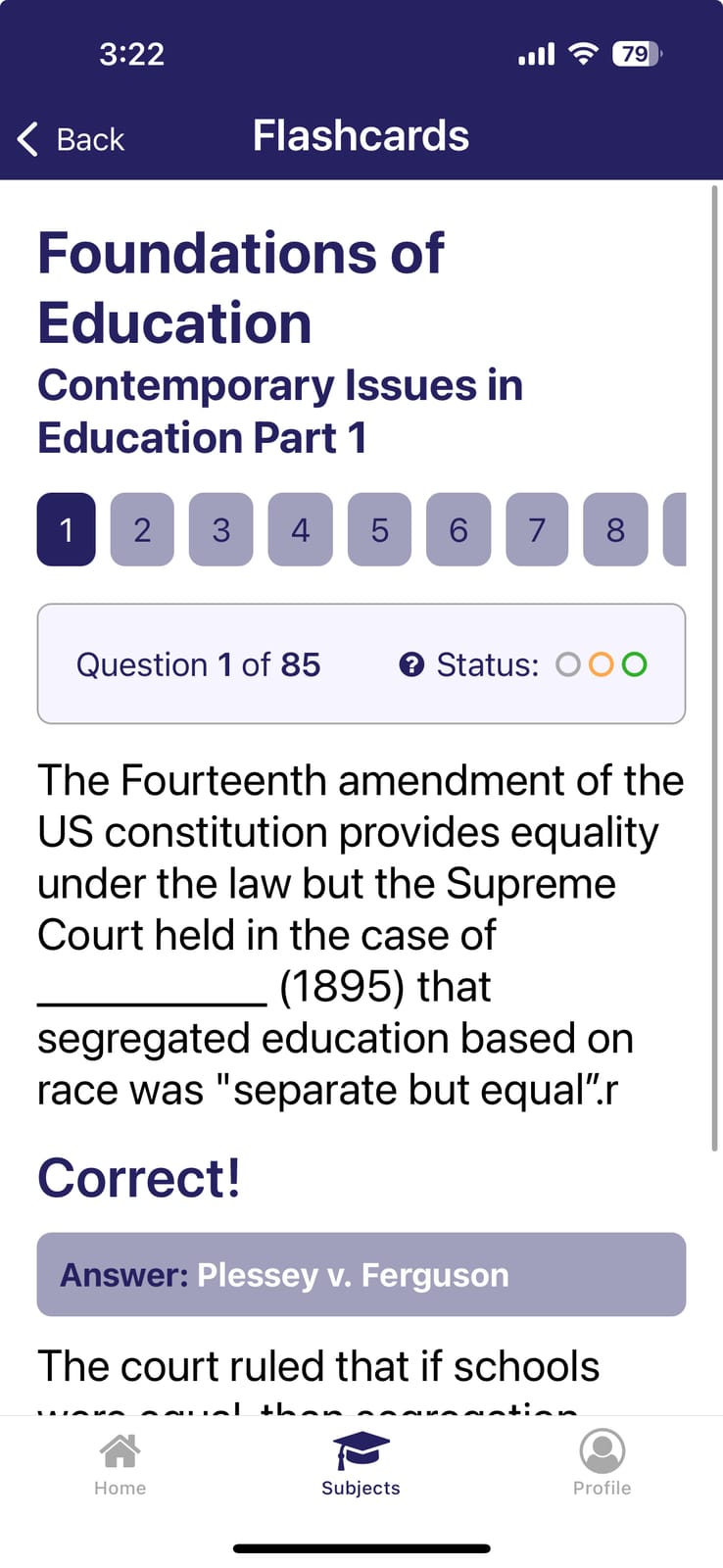
- Work through the InstantCert flashcards, putting extra time into the historical sections. Make sure you read the answers and know what each educational leader's theories were so you can differentiate.
- Download the official DSST Foundations of Education fact sheet which gives you 10 free questions to test yourself with.
- Crash Course Education gives a great introduction to the course matter, although it doesn't cover everything you'll need to know.
- Build a one-page cheat sheet of all the major education philosophers. Put their name and their core ideas. Creating this will help you learn, but you'll also have a good tool to review the day of the test. Names that you should definitely have on there are: Dewey, Mann, Skinner, Piaget, Maslow, Hutchins, and Vygotsky.
What score do you need to pass?
A score of 400 is the standard passing threshold at most schools, but some require 500.
Credit typically satisfies an education requirement or a general elective. Confirm with your school before you start to study.
When you pass, the credit appears on your transcript with no letter grade. Fail and the attempt does NOT appear on your transcript at all.
Can you pass Foundations of Education DSST / DANTES* with just flashcards?
Yes, because this exam focuses a lot on memorizing both contemporary issues and educational philosophers, this is a great exam for flashcards.
163 out of 174 students who submitted results passed, which is a 94% pass rate (last updated 2026).
Which colleges accept the Foundations of Education DSST / DANTES*?
Most colleges and universities accept DSST credit and award 3 semester hours for a passing score. Foundations of Education credit typically satisfies an education program requirement or a general social science elective, depending on your school. Policies vary, and most institutions cap how many DSST and CLEP credits count toward a degree, so confirm your school's rules before you commit.
One thing worth checking if you are in a teacher education program: some licensure programs require specific coursework rather than credit-by-exam for the introductory education sequence. Verify with your program advisor before you test.
Foundations of Education DSST / DANTES* vs. taking the class
An introductory Foundations of Education course at a community college costs a few hundred dollars. At a four-year university, the same course costs $1,000 to $3,000 or more. The DSST gets you the same 3 credit hours for $100, and it is free for active duty military.
| Exam fee | $100 (military free) |
| Typical tuition equivalent | $700 to $3,000+ (one semester) |
| Credits earned | 3 semester hours (typical) |
| Time to prepare | 3 to 4 weeks self-study |
| GPA impact | None, pass/fail only |
| Failed attempt on transcript | No |
If you just need an educational credit, then take the exam. However, if you are going into education and want to learn more about the actual philosophy, a classroom would serve you better.
Happy testing!