
What This Exam Covers
The Fundamentals of Counseling DSST covers major counseling theories, the counselor's role, ethics of the relationship, and the client's social and developmental context.
Exam at a Glance
| Questions | 100 multiple choice |
| Time | 120 minutes |
| Passing score | 400 (scaled score) |
| College credits | 3 semester hours (upper-level) |
| Exam fee | $100 (military free) |
What's on the Fundamentals of Counseling DSST / DANTES*?
| Category | Weight | Topics |
|---|---|---|
| Theoretical Approaches | 24% | Psychodynamic, humanistic and experiential, cognitive-behavioral, behavioral, systems, postmodern approaches |
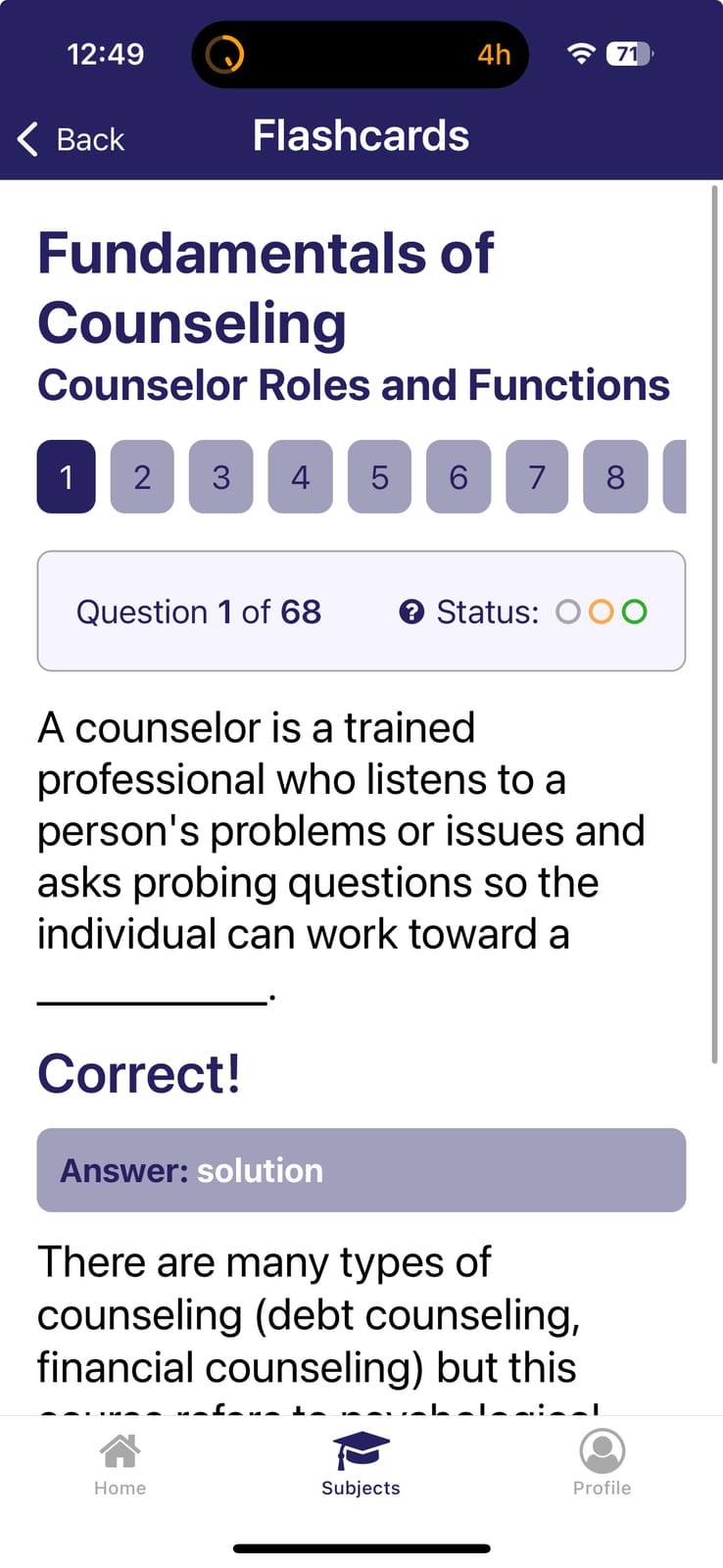
| Counselor Roles and Functions | 23% | Counseling as a profession, role expectations in different counseling settings, professional regulating bodies and associations, group approaches, family and couples counseling, individual counseling |
| The Counseling Relationship | 12% | The therapeutic alliance, counselor characteristics and skills, ethical and legal issues, telehealth functions |
| Social and Cultural Foundations | 12% | Multicultural issues (religion, race, ability, gender and gender identity, sexual orientation, ethnicity, socioeconomics, immigrants/refugees), discrimination issues, societal concerns (substance abuse, abuse, stress, violence, racism, service-related trauma) |
| Assessment and Appraisal Techniques | 10% | Testing and measurement, types of assessment |
| Human Growth and Development | 8% | Infant and child development, adolescent development, adult development and aging |
| Career Development | 6% | Theories, decision-making models, career information resources |
| Historical Development | 5% | Historical events and significant influences, significant people |
Source: For a full breakdown of what is on the exam, see the DSST / DANTES Fundamentals of Counseling exam fact sheet.
How hard is the Fundamentals of Counseling DSST / DANTES*?
Difficulty-wise, this exam falls in the middle, with a lot of theories and schools of thought to remember.
Six schools of counseling must be kept straight, with some sharing similar vocabulary, requiring the ability to distinguish between them.
With a psychology, social work, or counseling background, a couple of weeks is enough. Starting from scratch, plan for 4 to 5 weeks of study.
How to study for the Fundamentals of Counseling DSST / DANTES*
- Work through the InstantCert flashcards one theoretical approach at a time. For each school, you MUST be able to name the key theorist, the underlying assumption about people, the main techniques, and the problem or population it targets.
- Download the official DSST Fundamentals of Counseling fact sheet, which includes 8 free questions you can use to test yourself on theory and case scenarios.
- For a free video course check out Introduction on counselling, which goes over a lot of the topics that will be covered. Crash Course Psychology on YouTube is another solid option for the theory section.
- Carl Rogers and person-centered therapy show up often, so know unconditional positive regard, empathy, and genuineness (congruence), and that the counselor is NON-directive. Same with B.F. Skinner and reinforcement on the behavioral side.
What score do you need to pass?
A score of 400 is the standard passing threshold at most schools. Credit typically counts toward a counseling, psychology, human services, or education requirement.
This is one of the few DSST exams that ACE recommends as upper-level credit, so at some schools it can count as a senior credit. Confirm with your institution how the credit applies before you start studying.
Pass and the credit appears on your transcript with no letter grade. Fail and the attempt does NOT appear on your transcript at all. Military test-takers can retest after 6 months.
Can you pass Fundamentals of Counseling DSST / DANTES* with just flashcards?
Yes, but many find they need to supplement in order to get all the theories down. A lot of the exam is recognition: which theorist said what, when a school of thought was founded, which technique belongs to which school, or which ethical principle applies to which situation.
90% of students who submitted results passed (last updated 2026). That is slightly under our DSST average and reflects the real difficulty of keeping the different counseling theories straight.
Which colleges accept the Fundamentals of Counseling DSST / DANTES*?
Most colleges and universities accept DSST credit and award 3 semester hours for a passing score. ACE recommends this one as upper-level baccalaureate credit, which is a real perk if you are short on junior or senior credits and trying to avoid an upper-division tuition bill.
Counseling credit typically satisfies a counseling, psychology, human services, or education requirement. Policies vary, and most institutions cap how many DSST and CLEP credits count toward a degree, so confirm your school's rules before you commit to the exam.
Fundamentals of Counseling DSST / DANTES* vs. taking the class
An upper-level counseling course at a community college runs a few hundred dollars if you can find one at that level. At a four-year university, the same course is $1,500 to $3,000 or more. The DSST gets you the same 3 credit hours for $100, and it is free for active duty military.
| Exam fee | $100 (military free) |
| Typical tuition equivalent | $1,000–$3,000+ (one semester) |
| Credits earned | 3 semester hours (upper-level) |
| Time to prepare | 4–5 weeks self-study |
| GPA impact | None, pass/fail only |
| Failed attempt on transcript | No |
If you just need the credit, this exam can be great because some schools treat it as an upper-level credit. If you plan on doing counseling for a living or taking upper-level courses, then it might be better to take the class where you can discuss the theories in more detail.
Happy testing!