
What This Exam Covers
The General Anthropology DSST / DANTES covers all four sub-disciplines of anthropology, with cultural anthropology receiving the heaviest weight.
Some key areas of focus are theoretical perspectives, physical anthropology, archaeology, and how cultures organize around kinship, economics, politics, and religion.
Applied anthropology and cultural change in the modern global era are also covered.
Exam at a Glance
| Questions | 100 multiple choice |
| Time | 120 minutes |
| Passing score | 400 (scaled score) |
| College credits | 3 semester hours (lower-level) |
| Exam fee | $100 (military free) |
What's on the General Anthropology DSST / DANTES*?
| Category | Weight | Topics |
|---|---|---|
| Cultural Systems and Processes | 14% | Components of culture, symbolic systems, language and communication, cultural diffusion, cultural universals, sub-cultures and counter-cultures, world system and colonialism, arts and media |
| Physical Anthropology | 13% | Genetic principles, evolutionary principles, primatology, paleontology, fossil hominids |
| Anthropology in the Global Age | 12% | Applied anthropology, cultural preservation, directed and spontaneous cultural change, environment, cultural resource management, indigenous survival, the digital world |
| Religion | 11% | Belief systems, formal institutions, informal organizations, religious practices and practitioners, rituals |
| Anthropology: Methodologies and Disciplines | 10% | Physical anthropology, cultural anthropology, linguistics, archaeology, applied anthropology |
| History and Theory | 10% | Ethnographies and perspectives, sex and gender, race and ethnicity, cultural ecology |
| Archaeology | 10% | Methodology, Paleolithic and Mesolithic, Neolithic, development of civilization and urban societies, material culture |
| Social Organization | 10% | Marriage and family patterns, kinship and descent groups, social and economic stratification |
| Economic and Political Organization | 10% | Political systems, subsistence and settlement patterns, trade and reciprocity, redistribution and market exchange, modern political systems, globalization and the environment |
Source: For a full breakdown of what is on the exam, see the DSST / DANTES General Anthropology exam fact sheet.
How hard is the General Anthropology DSST / DANTES*?
The General Anthropology DSST is moderately difficult due to the breadth of topics.
There is a lot of new terminology you probably have never heard of, such as cline, polymorphism, or hominid taxonomies. It can take a lot of time to memorize all the different vocabulary and what they mean.
Plan on 2 to 3 weeks if you have had some previous background in Anthropology. Starting from scratch, give yourself 4 to 5 weeks.
How to study for the General Anthropology DSST / DANTES*
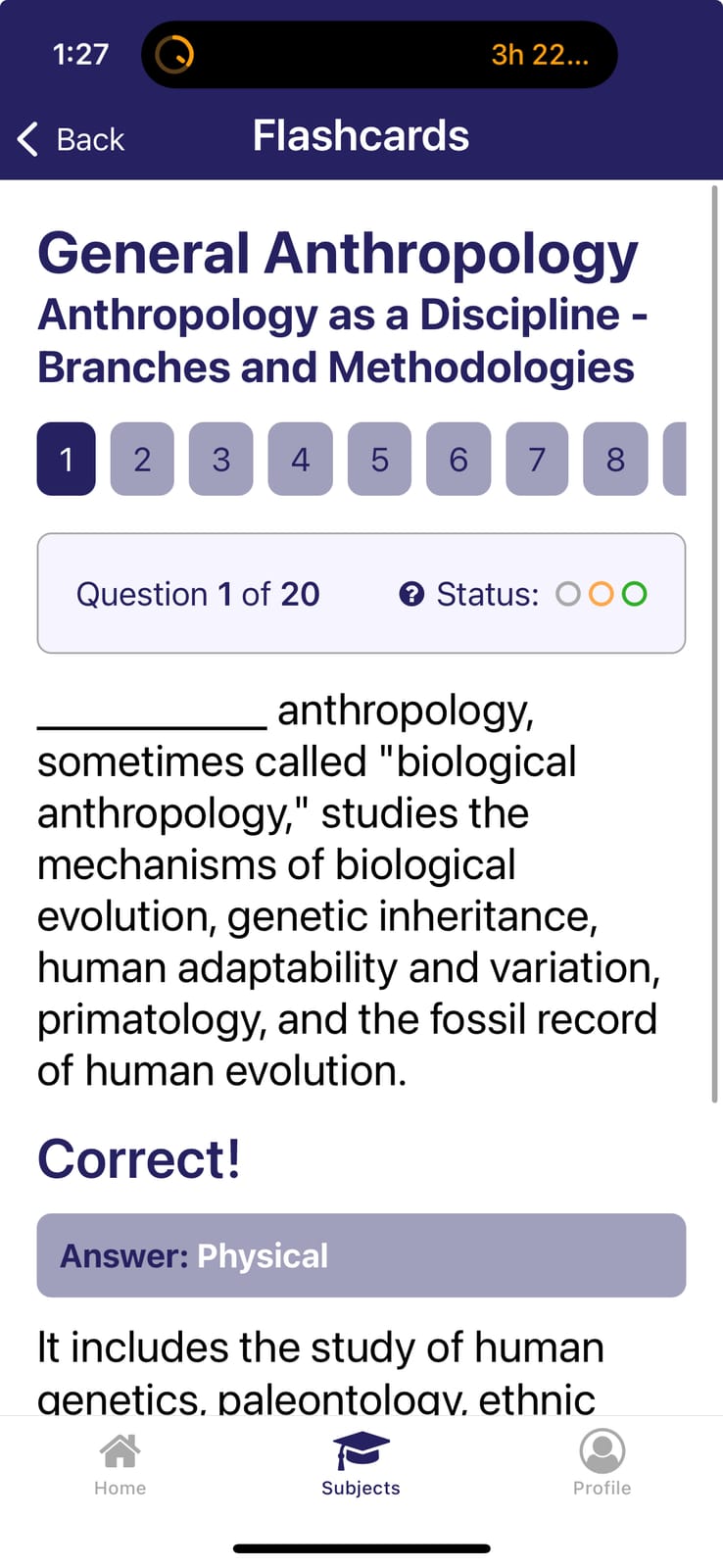
- Work through the InstantCert flashcards and make sure to read the answers so you know exactly what the terms mean.
- Download the official DSST General Anthropology fact sheet for 5 free sample questions and the full content outline. Use the outline as a checklist.
- There are a lot of free YouTube courses, such as Study Hall, which covers basic anthropology fairly well.
- Know cultural relativism vs. ethnocentrism and emic vs. etic cold. These two pairs show up in some form on almost every exam. Also learn the difference between matrilineal and matrilocal, and patrilineal and patrilocal.
What score do you need to pass?
A score of 400 is the standard passing threshold at most institutions, although some may require a higher score.
Credit typically counts toward a social science, anthropology, or humanities general education requirement. Confirm with your registrar how the credit applies before you start studying.
Pass and the credit appears on your transcript with no letter grade. Fail and the attempt does NOT appear on your transcript at all.
Can you pass General Anthropology DSST / DANTES* with just flashcards?
Yes, this exam is well-suited for a flashcard-only approach due to the volume of terminology.
91% of students who submitted results passed (last updated 2026), slightly above the DSST average. The sheer volume of the vocabulary means you should NOT skip a section because it is a small percentage. Even the 10% sections still represent 10 questions out of 100.
Which colleges accept the General Anthropology DSST / DANTES*?
Most colleges and universities accept DSST credit and award 3 semester hours for a passing score. ACE recommends this exam as lower-level baccalaureate credit, which means it typically slots into an introductory social science, anthropology, or general education elective.
Most institutions cap how many DSST and CLEP credits count toward a degree, so confirm your school's rules before you commit.
General Anthropology DSST / DANTES* vs. taking the class
An intro anthropology course at a community college costs a few hundred dollars at in-state rates. At a four-year university, the same course is $1,500 to $3,000 or more. The DSST gets you the same 3 credit hours for $100, and it is free for active duty military.
| Exam fee | $100 (military free) |
| Typical tuition equivalent | $1,000–$3,000+ (one semester) |
| Credits earned | 3 semester hours (lower-level) |
| Time to prepare | 4–5 weeks self-study |
| GPA impact | None, pass/fail only |
| Failed attempt on transcript | No |
If you need to fulfill a social science requirement or already have some knowledge, the exam is a clear winner. If you are majoring in anthropology, classroom discussions and deeper exploration of different approaches may be beneficial.
Happy testing!