
What This Exam Covers
The History of the Soviet Union DSST exam covers Russian and Soviet history from the late tsarist era to the USSR's dissolution in 1991.
Eight content areas span the old regime's governing institutions to Gorbachev's reforms and the Soviet state's collapse.
Exam at a Glance
| Questions | 100 multiple choice |
| Time | 120 minutes |
| Passing score | 400 (scaled score) |
| College credits | 3 semester hours (lower-level) |
| Exam fee | $100 (military free) |
What's on the History of the Soviet Union DSST / DANTES*?
| Period | Weight | Topics |
|---|---|---|
| Russia Under the Old Regime | 10% | Governing institutions, economics, culture and society, foreign affairs, revolutionary movements (Marxists, Social Revolutionaries, and others) |
| Russia in War and Revolutions, 1914–1928 | 12% | WWI and its impact on Russia, the February revolution, the Provisional Government and Dual Power, the October revolution, the Civil War, the New Economic Policy (NEP) |
| Early Stalinism, 1928–1939 | 13% | Collectivization of agriculture, forced industrialization (Five-Year Plans), the Great Purges, cultural regimentation, nationalities policy |
| The Second World War | 14% | Prewar foreign relations, the course of the war on the Eastern Front, the impact and experience of the war on Soviet society, wartime diplomacy and the Allied coalition |
| Postwar Stalinism | 11% | Reconstruction, origins of the Cold War, reconsolidation of Stalinist control, Soviet foreign relations in the late 1940s and early 1950s |
| The Khrushchev Years | 12% | Succession struggle after Stalin, de-Stalinization, relations with the United States (Berlin, Cuba, space race), rift with China, arms race and proxy conflicts |
| The Brezhnev Era | 12% | Reforms and "Stagnation," ideological dissent, détente, proxy wars in the Third World, war in Afghanistan |
| Reform and Collapse Under Gorbachev | 16% | Foreign policy and external pressures, perestroika (restructuring) and glasnost (openness), reemergence of the nationalities issue, end of the Union of Soviet Socialist Republics |
Source: DSST / DANTES History of the Soviet Union exam fact sheet.
How hard is the History of the Soviet Union DSST / DANTES*?
This exam is of easy to moderate difficulty, primarily due to the sheer volume of names and events that occur throughout the history of the Soviet Union.
Those who lived through the Cold War will definitely have an easier time, especially because the reform and collapse section has the most amount of questions.
If you have no knowledge of Russia, plan for a month, but those with some basic knowledge of the USSR can do it in a couple of weeks.
Our 97% pass rate reflects that this isn't the hardest exam if you work through the flashcards diligently.
How to study for the History of the Soviet Union DSST / DANTES*
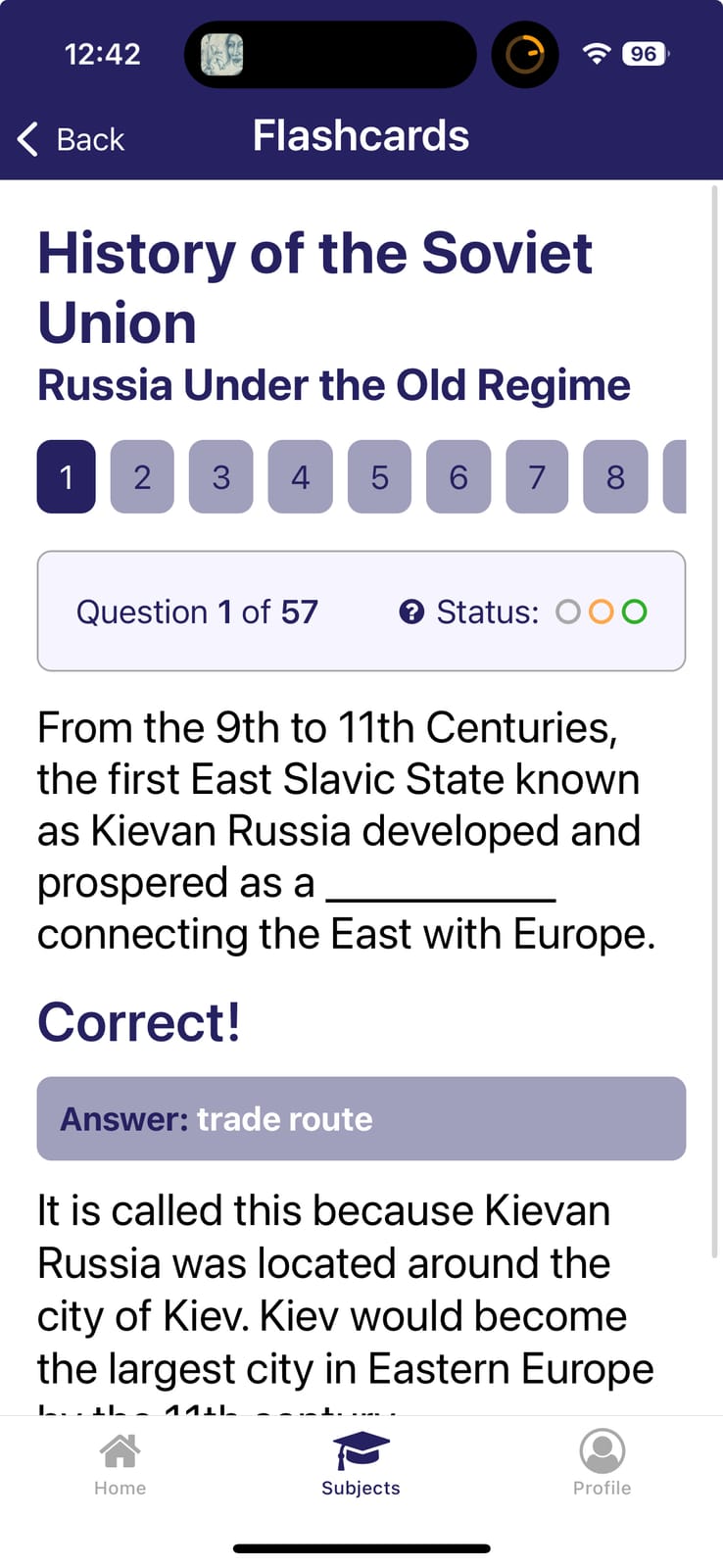
- Work through the InstantCert flashcards and know what each era stood for: Lenin's NEP, Stalin's collectivization and purges, Khrushchev's de-Stalinization, Brezhnev's stagnation, Gorbachev's perestroika and glasnost. The exam tests connections between eras, not just isolated leaders or facts.
- Download the free official DSST fact sheet from GetCollegeCredit.com for 10 sample questions.
- The complete history of the USSR covers much of what you will need to learn for this exam.
- Make a cheat sheet with Soviet leadership matched to the era. This way, you can quickly review it before the exam, and making it helps reinforce the knowledge.
What score do you need to pass?
A score of 400 is the standard passing threshold at most schools, although check with your institution for their exact requirements.
ACE recommends this exam as 3 lower-level baccalaureate semester hours, and credit typically counts toward a history, political science, or social science requirement.
Pass and the credit appears on your transcript with no letter grade. Fail and the attempt does NOT appear on your transcript at all.
Can you pass History of the Soviet Union DSST / DANTES* with just flashcards?
For most students, yes. Since a lot of what you will need to know is memorization, flashcards are a great way to solidify the leaders and their eras.
Our students do great. 330 out of 339 students who submitted results passed, which is a 97% pass rate (last updated 2026).
Which colleges accept the History of the Soviet Union DSST / DANTES*?
Most colleges and universities accept DSST credit and award 3 semester hours for a passing score. ACE recommends this exam at the lower-level baccalaureate level, so it typically satisfies a history, social science, or general education requirement.
Each institution sets its own rules on how DSST credits apply and how many test-out credits count toward a degree. Confirm with your registrar before you start studying.
History of the Soviet Union DSST / DANTES* vs. taking the class
A semester of Soviet or world history at a community college runs a few hundred dollars in-state. At a four-year university, the same course typically costs $1,500 to $3,000 or more. The DSST earns you the same 3 credit hours for $100, and active duty military pay nothing.
| Exam fee | $100 (military free) |
| Typical tuition equivalent | $1,000–$3,000+ (one semester) |
| Credits earned | 3 semester hours (lower-level) |
| Time to prepare | 4–6 weeks self-study |
| GPA impact | None, pass/fail only |
| Failed attempt on transcript | No |
For students who want just the credit, the exam is a smart option. If you want to go in-depth and learn about Russia, then taking the class will give you discussions and insight you miss with a simple exam.
Happy testing!