
What This Exam Covers
The Introduction to Law Enforcement DSST / DANTES covers American policing at all levels of government. This includes how the U.S. criminal justice system works, the structure of federal and local law enforcement agencies, and the legal standards that govern police work.
40% of the exam is devoted to police organization, management, and issues. This includes community policing, operations, use of force, diversity in policing, and emerging threats like cybercrime and homeland security. The breakdown of the other 60% is listed below.
Exam at a Glance
| Questions | 100 multiple choice |
| Time | 120 minutes |
| Passing score | 400 (scaled score) |
| College credits | 3 semester hours (typical) |
| Exam fee | $100 (military free) |
What's on the Introduction to Law Enforcement DSST / DANTES*?
| Category | Weight | Topics |
|---|---|---|
| Law Enforcement Organization, Management, and Issues | 40% | Operations, community relations and policing, police issues, women and other minorities in policing, emerging issues (cybercrime, homeland security, militarization) |
| Overview of U.S. Criminal Justice System and Process | 22% | Role of police, victims, prosecutors, defense, courts, and corrections; measurement of crime (UCR, NCVS, survey data) |
| Criminal and Constitutional Law and Precedents | 15% | The Constitution and Bill of Rights, Supreme Court case law, federal/state/local laws and ordinances |
| Law Enforcement Systems in the United States | 15% | Federal agencies (FBI, DEA, ATF, DHS, Secret Service), state police, local and county law enforcement, special district agencies |
| History of Law Enforcement | 8% | Pre-colonial and colonial heritage, 1800s and 1900s, contemporary policing (2000s), contributions of theorists and practitioners (August Vollmer, O.W. Wilson) |
Source: For a full breakdown of what is on the exam, see the DSST / DANTES Introduction to Law Enforcement exam fact sheet.
How hard is the Introduction to Law Enforcement DSST / DANTES*?
Many students find this exam fairly easy due to their general knowledge of policing.
To prepare for the exam, learn community policing models, the chain of command, gender issues within policing, crime rate calculations, use of force, and how policing has adapted to modern issues like cybercrime and homeland security.
The legal section (15%) requires learning a handful of key Supreme Court cases as well as knowing the amendments covering policing.
How to study for the Introduction to Law Enforcement DSST / DANTES*
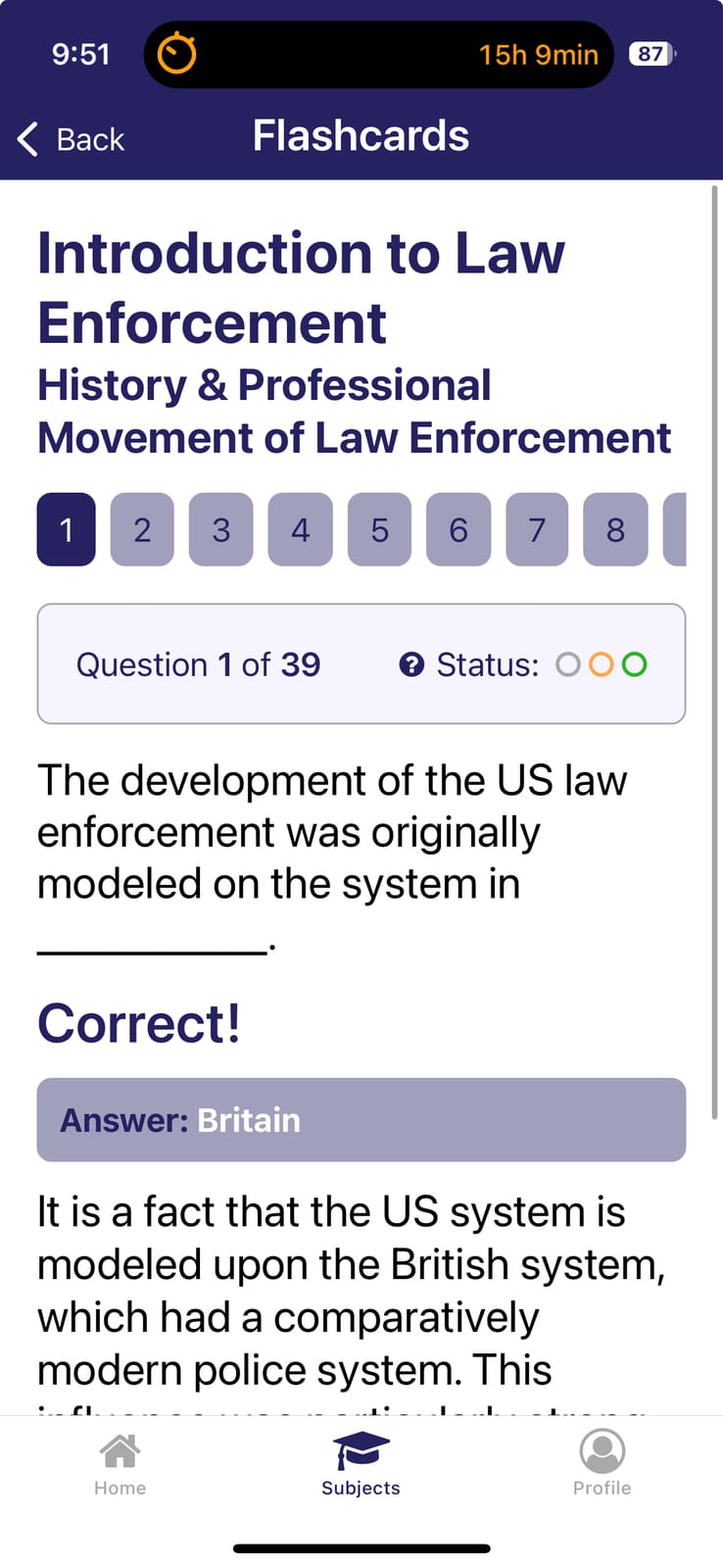
- Work through the InstantCert flashcards paying close attention to community policing vs. problem-oriented policing, use of force standards, police subculture, and how cybercrime and homeland security have reshaped modern policing.
- Download the official DSST Introduction to Law Enforcement fact sheet for free sample questions and use the content outline as a study checklist.
- Free YouTube courses are available, but none specifically for this exam. This video is for students in an actual police academy but it covers many of the topics you need to know.
- Know the key Supreme Court cases that shaped policing: Mapp v. Ohio (exclusionary rule), Miranda v. Arizona (Miranda warnings), and Terry v. Ohio (stop and frisk). There will always be a number of questions on these cases.
What score do you need to pass?
A score of 400 is the standard passing threshold at most institutions, but some do require 500 or higher. Credit typically satisfies a criminal justice, law enforcement, or social science requirement. Confirm with your institution how the credit applies before you start studying.
Passing the exam results in credit appearing on your transcript with no letter grade. Failing the exam means the attempt does not appear on your transcript at all.
Can you pass Introduction to Law Enforcement DSST / DANTES* with just flashcards?
Yes, because the content is well-defined and a lot of it is memorization, the flashcards work great. Students with any background in law enforcement or criminal justice will find this exam quite easy.
96% of students who submitted results passed (last updated 2026), one of the higher rates for any DSST exam.
Which colleges accept the Introduction to Law Enforcement DSST / DANTES*?
Most colleges and universities accept DSST credit and award 3 semester hours for a passing score. ACE recommends this exam at the lower-level baccalaureate level, meaning it typically satisfies a criminal justice, law enforcement, or social science general education requirement.
Most institutions cap how many DSST and CLEP credits count toward a degree, so confirm your school's policy before you commit to the exam.
Introduction to Law Enforcement DSST / DANTES* vs. taking the class
An intro law enforcement course at a community college typically runs a few hundred dollars. At a four-year university, the same course costs $1,000 to $3,000 or more. The DSST earns you the same 3 credit hours for $100, and it is free for active duty military.
| Exam fee | $100 (military free) |
| Typical tuition equivalent | $700–$3,000+ (one semester) |
| Credits earned | 3 semester hours (typical) |
| Time to prepare | 3–4 weeks self-study |
| GPA impact | None, pass/fail only |
| Failed attempt on transcript | No |
If you just need the credit, the exam is the way to go, especially if you have any experience in law enforcement. If you plan to major in criminal justice or work towards a career, then the classroom could be a good idea so you can go more in depth into the material.
Happy testing!