
What This Exam Covers
The Money and Banking DSST / DANTES exam covers how banking works and 25% of the exam specifically covers commercial banks and other financial intermediaries, such as credit unions. The exam covers banking mechanics, the Fed's monetary policy, economic theories on money's impact, and the international monetary system. If you've taken Principles of Macroeconomics, much of this material will be familiar.
Exam at a Glance
| Questions | 100 multiple choice |
| Time | 120 minutes |
| Passing score | 400 (scaled score) |
| College credits | 3 semester hours (typical) |
| Exam fee | $100 (military free) |
What's on the Money and Banking DSST / DANTES*?
| Category | Weight | Topics |
|---|---|---|
| The Role and Kinds of Money | 6% | Alternative definitions of money (M1, M2), money vs. other financial assets, commodity money vs. fiat money, functions of money (medium of exchange, store of value, unit of account) |
| Commercial Banks and Other Financial Intermediaries | 25% | Regulation of the banking industry, structure of the banking industry, operation and management of financial markets and intermediaries, deposit insurance (FDIC), fractional reserve banking, deposit creation multiplier |
| Money and Macroeconomic Activity | 19% | Basic classical and Keynesian economics, monetarism (Milton Friedman) and rational expectations, quantity theory of money (MV=PQ), money and inflation, velocity of money |
| Central Banking and the Federal Reserve System | 20% | Historical and philosophical framework of central banking, Fed structure and organization (Board of Governors, Federal Open Market Committee), tools of monetary policy (open market operations, discount rate, reserve requirements), the Fed's dual mandate |
| Monetary Policy in the United States | 20% | Policy effectiveness and lags, conducting monetary policy (expansionary vs. contractionary), interest rates and the impact on money supply, monetary vs. fiscal policy, historical U.S. financial crises |
| The International Monetary System | 10% | International banking, international monetary institutions (IMF, World Bank) and debt crises, international payments and exchange rates, Bretton Woods system, monetary policy in conjunction with exchange rates |
Source: For a full breakdown of what is on the exam, see the DSST / DANTES Money and Banking exam page.
How hard is the Money and Banking DSST / DANTES*?
This is one of the harder DSST exams, but if you've taken other exams like Macroeconomics or Introduction to Business, you will have some of the knowledge already. The 89% pass rate among our students is one of the lower rates we see in the business category, and it reflects the genuine difficulty of the conceptual material. The two areas that cause the most trouble are the monetary theory section and the Federal Reserve material. Both of these have a lot of theories that you have to understand.
How to study for the Money and Banking DSST / DANTES*
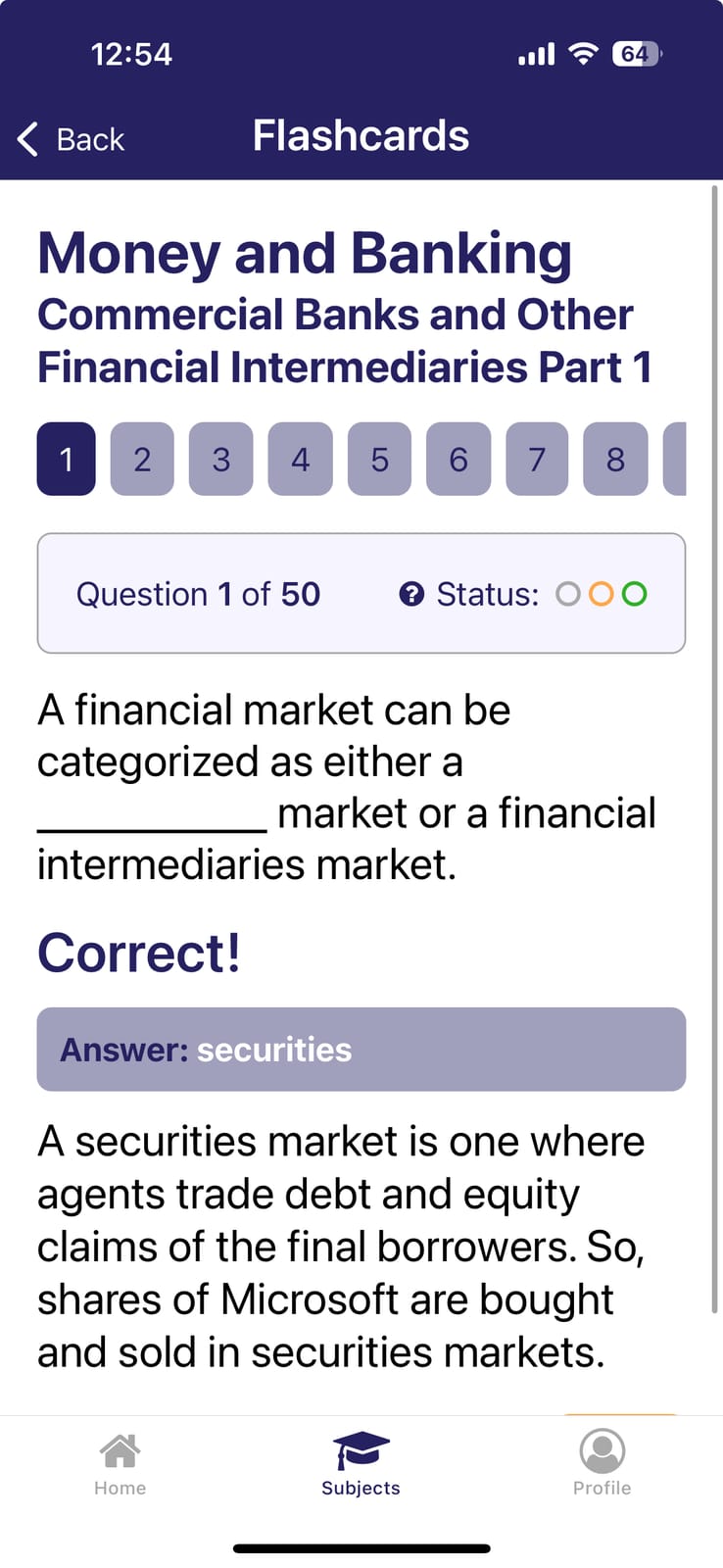
- Work through the InstantCert flashcards, paying close attention to the Commercial Banks and Federal Reserve sections. Don't just memorize the names of the policy tools because you need to have at least a little understanding of how these policies affect the economy.
- Download the official Money and Banking fact sheet from GetCollegeCredit.com for free sample questions. The sample questions at the back give you a realistic sense of how the exam phrases questions.
- If you have no macroeconomics background, work through Khan Academy's free money and banking course.
- Before exam day, make sure you can explain the differences between classical, Keynesian, and monetarist views on monetary policy. These three frameworks appear throughout the exam in different forms. Know each school's position on whether monetary policy affects real output, and under what conditions.
- Know the money multiplier both as a concept and as a calculation. If the reserve requirement is 10%, a $1,000 deposit can create up to $10,000 in total money supply (money multiplier = 1 / reserve requirement). The exam tests both the concept and the math.
What score do you need to pass?
A scaled score of 400 is the standard passing threshold at most schools, but some require 500. Credit typically applies toward an economics or business administration requirement. Confirm with your institution how the credit applies before you test.
Pass and the credit appears on your transcript with no grade. Fail and the attempt does NOT appear on your transcript at all. Military test-takers can retest after 6 months.
Can you pass Money and Banking DSST / DANTES* with just flashcards?
Yes, but this can be a harder exam, so you may need some supplementary material. Students who go in with a macroeconomics foundation do better than those relying purely on memorization. Study the underlying concepts given in the answers alongside the flashcards.
Which colleges accept the Money and Banking DSST / DANTES*?
Most regionally accredited colleges and universities accept DSST credit and award 3 semester hours for a passing score. Money and Banking credit typically satisfies an economics, finance, or business administration requirement. Policies vary by school, and most institutions cap how many DSST and CLEP credits count toward a degree, so confirm your school's rules before you commit.
Money and Banking DSST / DANTES* vs. taking the class
A money and banking course at a community college typically costs a few hundred dollars. At a four-year university, a single course runs $1,000 to $3,000 or more. The DSST gets you the same 3 credit hours for $100, and it is free for active duty military.
| Exam fee | $100 (military free) |
| Typical tuition equivalent | $700–$3,000+ (one semester) |
| Credits earned | 3 semester hours (typical) |
| Time to prepare | 5–6 weeks self-study |
| GPA impact | None, pass/fail only |
| Failed attempt on transcript | No |
For the credit alone, the exam is the clear choice. If you are heading into finance or economics and want genuine classroom depth in monetary theory, international finance, or financial institution management, the course has value. For most students who just need the credit, $100 and 5 to 6 weeks of focused study will get you there.
Happy testing!