
What This Exam Covers
The Organizational Behavior DSST exam covers how people think, feel, and act at work. It starts with an overview of Organizational Behavior, its history, and how researchers study it, then works through individual psychology, group dynamics, and organization-level topics.
Students with management or work experience will find they know a lot of this material just from what they have seen in their workplace. Even if you have never had a job, some of these principles are fairly easy to understand.
Exam at a Glance
| Questions | 100 multiple choice |
| Time | 120 minutes |
| Passing score | 400 (scaled score) |
| College credits | 3 semester hours (typical) |
| Exam fee | $100 (military free) |
What's on the Organizational Behavior DSST / DANTES*?
| Category | Weight | Topics |
|---|---|---|
| Organizational Behavior Overview | 10% | Definition and framework of OB, fundamental concepts, history of the field, scientific approaches, research designs, data collection methods |
| Individual Processes and Characteristics | 30% | Perceptual processes and attribution, personality theories, attitudes and emotions, learning processes, motivation theories (Maslow, Herzberg, McClelland, expectancy theory, equity theory), work stress |
| Interpersonal and Group Processes | 30% | Group dynamics and development, group behavior and conflict, leadership theories and influences (trait, behavioral, situational, transformational), power and politics, communication processes, conflict management |
| Organizational Processes and Characteristics | 15% | Organizational decision-making, structure and design (mechanistic vs. organic), organizational culture, organizational strategy |
| Change and Development Processes | 15% | Basic change processes, concepts of change, applications and techniques of organizational development |
Source: For a full breakdown of what is on the exam, see the DSST / DANTES Organizational Behavior exam page.
How hard is the Organizational Behavior DSST / DANTES*?
Organizational Behavior DSST sits in the middle, only because there is quite a bit of theory and vocabulary to memorize.
If you have worked in management, then you can probably study in as little as a week, but from scratch, plan on 2 to 5 weeks of study.
How to study for the Organizational Behavior DSST / DANTES*
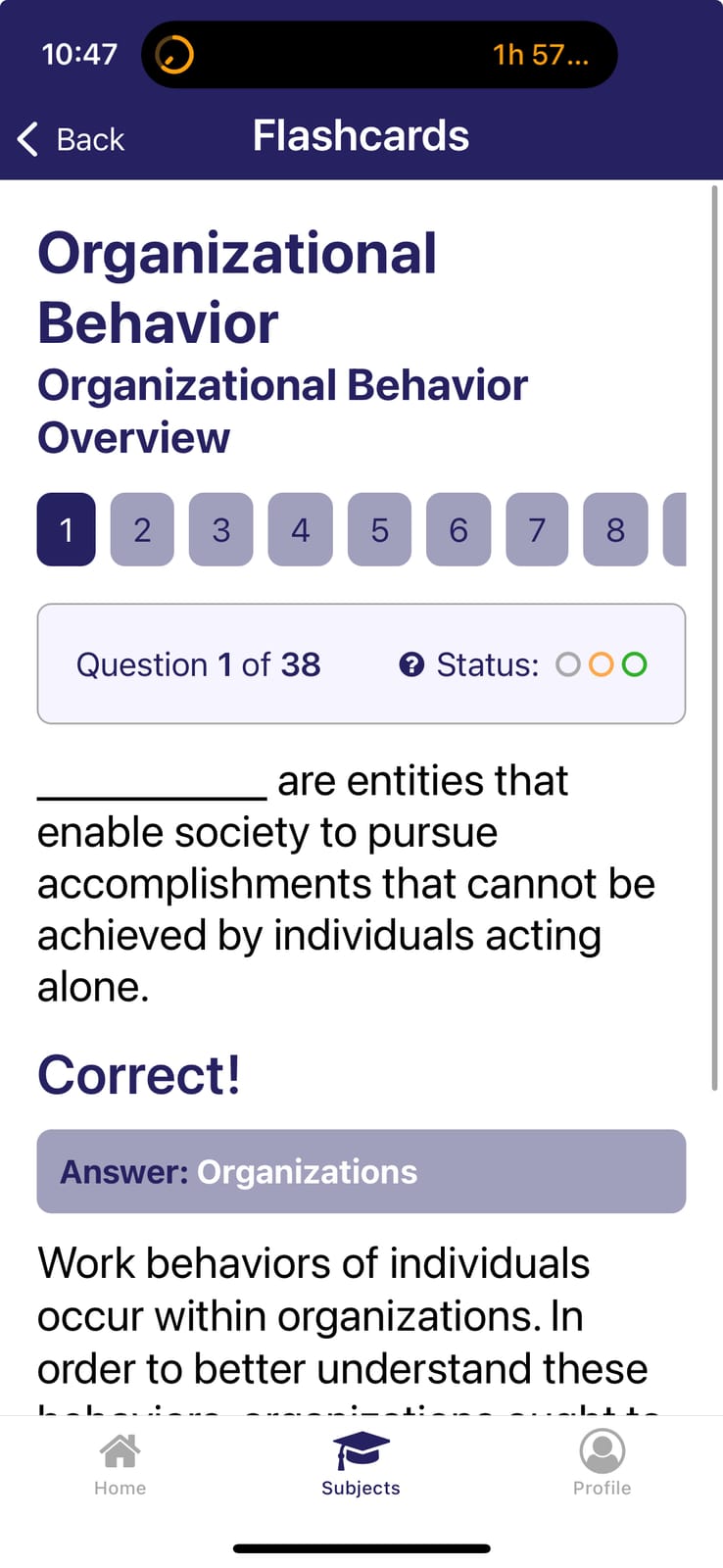
- Work through the InstantCert flashcards section by section. Make sure to learn Maslow's hierarchy, Herzberg's two-factor theory, McClelland's needs theory, Vroom's expectancy theory, and Adams' equity theory, as they often come up in questions.
- Download the 8 official practice questions for free at GetCollegeCredit.com.
- There are a few YouTube courses out there. Crash Course does not have a specific Organizational Behavior course, but covers a lot of this material in their Psychology series, especially the motivation episode. For a more in-depth option (a little drier), try this Organizational Behavior playlist.
- Create a cheat sheet on paper before exam day. You are not actually going to cheat, but it lets you quickly review what needs the most work. Trait theory, the Ohio State behavioral dimensions (initiating structure and consideration), Michigan's production-centered vs. employee-centered approach, Fiedler's contingency model, path-goal theory, and Hersey-Blanchard's situational leadership model all appear on this exam and are easy to confuse. A one-page reference will let you quickly review these before you walk in.
What score do you need to pass?
A score of 400 is the standard passing threshold at most schools, but some require 500. Credit typically counts toward a business administration, management, or organizational psychology requirement. Confirm with your institution how the credit applies before you test.
Pass and the credit appears on your transcript with no letter grade. Fail and the attempt does NOT appear on your transcript at all. Military test-takers can retest after 6 months.
Can you pass Organizational Behavior DSST / DANTES* with just flashcards?
Yes, for many of our students they can use just the flashcards, especially to learn the different theories and vocabulary. The one thing to watch is that many of these theories are similar to each other, so make sure you understand the slight differences and not just the names.
549 out of 581 students who submitted results passed, which is a 94% pass rate (last updated 2026).
Which colleges accept the Organizational Behavior DSST / DANTES*?
Most colleges and universities accept DSST credit and award 3 semester hours for a passing score. Organizational Behavior credit typically satisfies a business administration, management, or organizational behavior requirement. Policies vary by school, and most institutions cap how many DSST and CLEP credits count toward a degree, so confirm your school's rules before you commit to the exam.
Organizational Behavior DSST / DANTES* vs. taking the class
A semester of Organizational Behavior at a community college typically costs a few hundred dollars. At a four-year university, a single course runs $1,000 to $3,000 or more. The DSST gets you the same 3 credit hours for $100, and it is free for active duty military.
| Exam fee | $100 (military free) |
| Typical tuition equivalent | $700–$3,000+ (one semester) |
| Credits earned | 3 semester hours (typical) |
| Time to prepare | 2–5 weeks self-study |
| GPA impact | None, pass/fail only |
| Failed attempt on transcript | No |
For students who simply want the credit, it is a simple choice and you should do the DSST exam. If you are heading into a management or HR career and want real classroom exposure to the theories and the chance to discuss them, then the class is the better option.
Happy testing!