
What This Exam Covers
The Personal Finance DSST exam covers: budgeting and cash management, credit and debt, major purchases like housing and auto, federal taxes, insurance, investing, and retirement and estate planning.
This is one of the most practical DSST exams as many things, such as credit cards, you have already been exposed to. However, you will need to expand on what you know — such as how interest is calculated and specific vocabulary around money.
Exam at a Glance
| Questions | 100 multiple choice |
| Time | 120 minutes |
| Passing score | 400 (scaled score) |
| College credits | 3 semester hours (typical) |
| Exam fee | $100 (military free) |
What's on the Personal Finance DSST / DANTES*?
| Category | Weight | Topics |
|---|---|---|
| Foundations of Personal Finance | 8% | Financial planning process, budgeting, cash management, financial planning certifications |
| Credit and Debt | 15% | Credit and debit cards, installment loans, interest calculations, federal credit laws, creditworthiness and credit scoring and reporting, bankruptcy |
| Major Purchases | 15% | Auto, furniture, and appliances; housing (buying vs. renting, mortgage types, the homebuying process) |
| Taxes | 15% | Payroll taxes, income taxes, IRS and audits, estate and gift taxes, tax planning and estimating, progressive vs. regressive taxes, other taxes, tax professionals |
| Insurance | 15% | Risk management, life insurance policies (term, whole, universal), property and liability, health and disability and long-term care, specialty insurance, insurance analysis and information sources |
| Investments | 16% | Liquid assets, bonds, equities, mutual funds and ETFs, other investment types, time value of money, asset and portfolio allocation |
| Retirement and Estate Planning | 16% | Qualified retirement accounts (401(k), traditional IRA, Roth IRA), Social Security benefits, wills and trusts, tax-deferred annuities |
Source: For a full breakdown of what is on the exam, see the DSST / DANTES Personal Finance exam page.
How hard is the Personal Finance DSST / DANTES*?
This is one of the easier DSST exams, particularly for adults who have managed a household, dealt with taxes, or held any kind of banking.
Students with any background in financial services, insurance, or accounting often need only a week or less of study. Those who have had all their finances managed by their parents or spouses will need 3 to 5 weeks.
How to study for the Personal Finance DSST / DANTES*
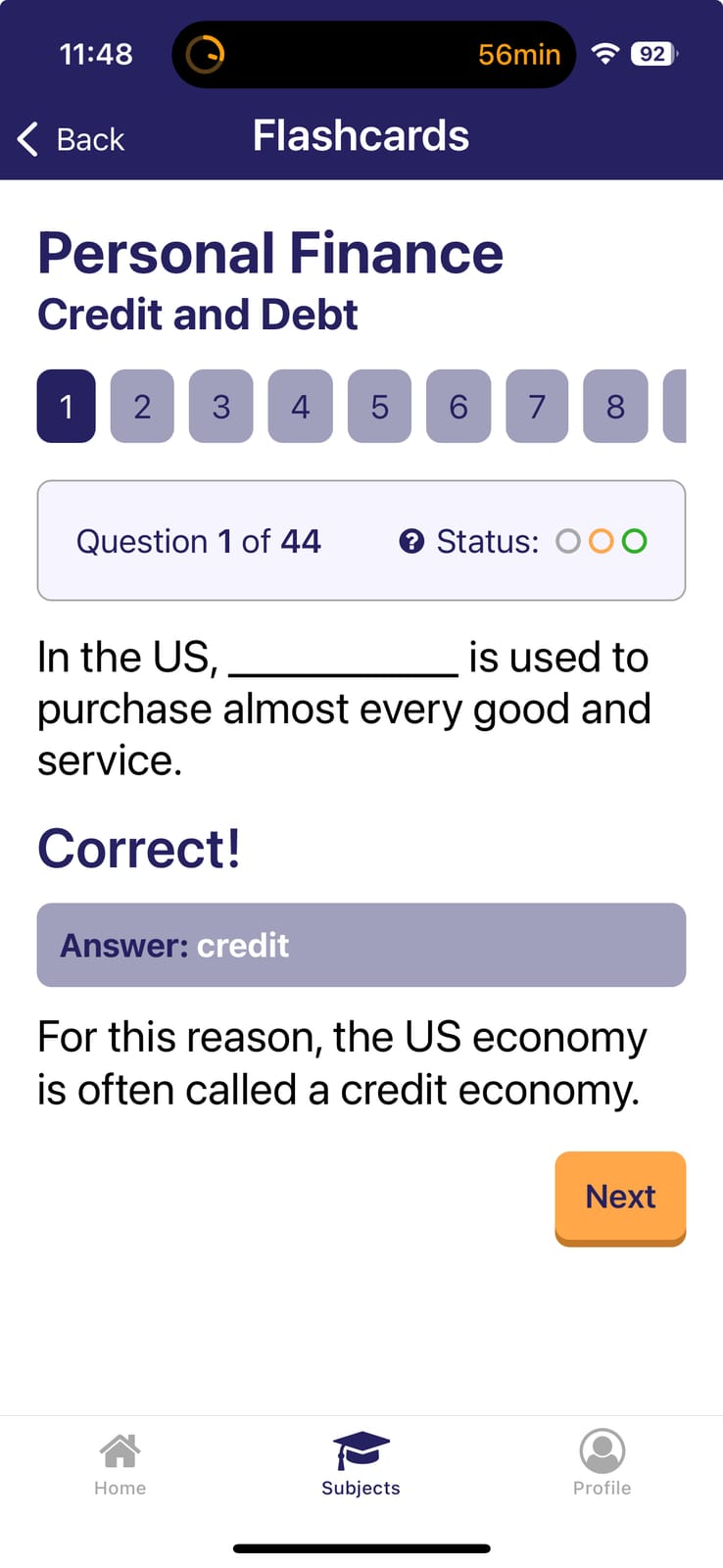
- Work through the InstantCert flashcards section by section. The insurance section has the most specialized vocabulary — know the difference between term, whole life, and universal life insurance, and understand the specific features of health, disability, and long-term care policies. These insurance terms come up in many questions on the exam.
- Download the official 9 free sample questions from GetCollegeCredit.com.
- Khan Academy's free Personal Finance course covers taxes, investing, and insurance at exactly the right level for this exam. The investing videos are especially useful for the 16% Investments section. However, it does go really in depth, so it is a bit overkill for those just trying to get the credit.
- Know your retirement accounts and how they work. Traditional IRA vs. Roth IRA (pre-tax vs. post-tax contributions, withdrawal rules, and penalties), 401(k) basics, Social Security eligibility, and tax-deferred annuities are in many questions.
What score do you need to pass?
A score of 400 is the standard passing threshold for the Personal Finance DSST. Credit typically counts toward a business, finance, or general elective requirement. Some schools require a higher score, so confirm with your institution how the credit applies before you start to study.
Pass and the credit appears on your transcript with no letter grade. Fail and the attempt does NOT appear on your transcript at all. Military test-takers can retest after 6 months.
Can you pass Personal Finance DSST / DANTES* with just flashcards?
Yes, many of our students report using only our flashcards. If you have dealt with loans, investments, and other banking products you should be fine with the flashcards.
606 out of 623 students who submitted results passed, which is a 97% pass rate (last updated 2026). Some of these certainly used other free resources, but the high pass rate speaks to how manageable this exam can be.
Which colleges accept the Personal Finance DSST / DANTES*?
Most colleges and universities accept DSST credit and award 3 semester hours for a passing score. Personal Finance credit typically satisfies a business, finance, or general elective requirement — though this varies by program. Most institutions also cap how many DSST and CLEP credits can count toward a degree, so confirm your school's specific rules before you commit to the exam.
ACE (the American Council on Education) recommends credit for a passing score of 400, which is what most institutions follow. You can look up recommendations by institution at acenet.edu.
Personal Finance DSST / DANTES* vs. taking the class
A semester of Personal Finance at a community college typically costs a few hundred dollars. At a four-year university, a single course runs $1,000 to $3,000 or more. The DSST gets you the same 3 credit hours for $100, and active duty military pay nothing.
| Exam fee | $100 (military free) |
| Typical tuition equivalent | $700–$3,000+ (one semester) |
| Credits earned | 3 semester hours (typical) |
| Time to prepare | 2–4 weeks self-study |
| GPA impact | None, pass/fail only |
| Failed attempt on transcript | No |
For students who just want the credit and already have some financial literacy, this exam is an easy win. If you are completely new to personal finance and want a structured environment with a professor and actual discussion, then take the class.
Happy testing!