
What This Exam Covers
The Principles of Finance DSST exam covers financial statement analysis, time value of money, stock and bond valuation, capital budgeting, cost of capital, risk and return, and international finance.
This exam requires not just memorizing the above terms but actually working with formulas.
Exam at a Glance
| Questions | 100 multiple choice |
| Time | 120 minutes |
| Passing score | 400 (scaled score) |
| College credits | 3 semester hours (typical) |
| Exam fee | $100 (military free) |
What's on the Principles of Finance DSST / DANTES*?
| Category | Weight | Topics |
|---|---|---|
| Financial Statements and Planning | 20% | Balance sheet, income statement, statement of cash flows, financial ratio analysis (liquidity, profitability, leverage, activity), financial forecasting, pro forma statements |
| Time Value of Money | 20% | Present value and future value, annuities (ordinary and due), perpetuities, compounding periods, effective annual rate, loan amortization |
| Working Capital Management | 10% | Cash conversion cycle, accounts receivable and credit policy, inventory management, short-term financing options |
| Valuation and Characteristics of Stocks and Bonds | 8% | Bond pricing and yield to maturity, common vs. preferred stock, dividend discount model, efficient market hypothesis |
| Capital Budgeting | 12% | Net present value (NPV) and decision rule, internal rate of return (IRR) and decision rule, payback period, profitability index, mutually exclusive projects |
| Cost of Capital | 11% | Cost of equity (CAPM and dividend growth approaches), after-tax cost of debt, weighted average cost of capital (WACC), capital structure decisions |
| Risk and Return | 12% | Expected return, standard deviation, systematic vs. unsystematic risk, beta, Capital Asset Pricing Model (CAPM), portfolio diversification |
| International Financial Management | 7% | Spot vs. forward exchange rates, purchasing power parity, interest rate parity, foreign currency risk, hedging strategies |
Source: For a full breakdown of what is on the exam, see the DSST / DANTES Principles of Finance exam page.
How hard is the Principles of Finance DSST / DANTES*?
Many students find this exam harder than others because it demands more than just memorizing facts, it requires working with formulas.
Students with an accounting or finance background will find this exam much easier and probably a week or two of study will get you the pass. Starting from scratch, plan for 5 to 7 weeks.
How to study for the Principles of Finance DSST / DANTES*
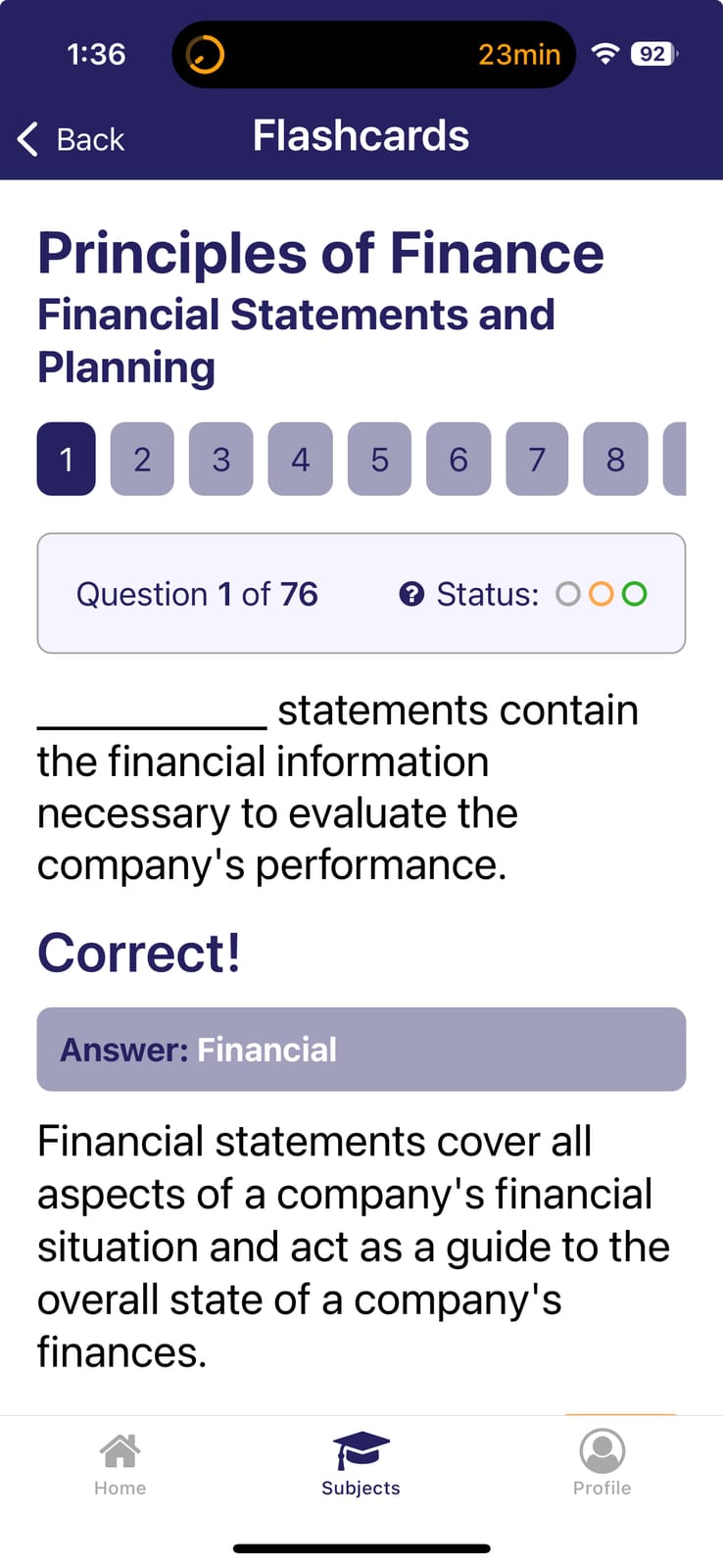
- Work through the InstantCert flashcards making sure you understand the formulas, not just taking guesses.
- Use the official DSST practice exam from the GetCollegeCredit.com Principles of Finance page, which gives you 8 free questions.
- OpenStax has a free online book if you want to go deeper.
- Master Net Present Value (NPV) and internal rate of return (IRR). NPV accepts a project if the result is greater than 0. IRR accepts if the rate exceeds the cost of capital. Know both decision rules, know how to calculate both, and know what to do when they conflict on mutually exclusive projects. These topics usually appear in multiple questions.
What score do you need to pass?
A scaled score of 400 is the standard passing threshold, although some schools require a higher score.
Credit typically counts toward a business administration, finance, or accounting requirement. If you need a specific course requirement, make sure to check with your school.
Pass and the credit appears on your transcript with no letter grade. Fail and the attempt does NOT appear on your transcript at all.
Can you pass Principles of Finance DSST / DANTES* with just flashcards?
Yes, especially for a lot of the vocabulary. However, many find that they need to work through some additional problems using the formulas.
221 out of 255 students who submitted results passed, which is an 87% pass rate (last updated 2026). That's lower than most DSST exams, which reflects how some students struggle with using the formulas correctly.
Which colleges accept the Principles of Finance DSST / DANTES*?
Most colleges and universities accept DSST credit and award 3 semester hours for a passing score. Principles of Finance credit typically counts toward a business administration, finance, or accounting requirement, though this varies by program.
Principles of Finance DSST / DANTES* vs. taking the class
A corporate finance course at a community college typically runs a few hundred dollars. At a four-year university, one course can cost $1,000 to $3,000 or more. The DSST gets you the same 3 credit hours for $100, and active duty military pay nothing.
| Exam fee | $100 (military free) |
| Typical tuition equivalent | $700–$3,000+ (one semester) |
| Credits earned | 3 semester hours (typical) |
| Time to prepare | 5–7 weeks self-study |
| GPA impact | None, pass/fail only |
| Failed attempt on transcript | No |
For students who have the background to handle the math, this exam can be fairly easy and a great way to get the credit. If you have never taken a finance or accounting course and want some extra help instead of learning on your own, then the course would be right for you.
Happy testing!