
What This Exam Covers
The Principles of Supervision DSST / DANTES exam is similar to an introductory course on management and supervision. It covers the fundamentals of supervising people in an organizational context: supervisor roles and responsibilities, core management functions (planning, organizing, staffing, leading, controlling), and the workplace environment. This exam is one of the most popular DSST exams, especially among military personnel in leadership roles.
Exam at a Glance
| Questions | 100 multiple choice |
| Time | 120 minutes |
| Passing score | 400 (scaled score) |
| College credits | 3 semester hours (typical) |
| Exam fee | $100 (military free) |
What's on the Principles of Supervision DSST / DANTES*?
| Category | Weight | Topics |
|---|---|---|
| Roles and Responsibilities of Managers and Supervisors | 20% | Foundations of management and supervision, knowledge and skill requirements, managerial roles and levels of management, business ethics and corporate social responsibility |
| Management Functions | 50% | Planning and decision-making (goals, objectives), organizing and staffing (structure, delegation, recruiting), leading (motivation, communication, leadership styles), controlling (performance standards, evaluation), communication |
| Organizational Environment | 30% | Legal, political, economic, and social environment; labor-management relations (unions, exempt vs. non-exempt); organizational culture; diversity, equity, and inclusion; global management; organizational change; workplace safety and security |
Source: For a full breakdown of what is on the exam, see the DSST / DANTES Principles of Supervision exam fact sheet.
How hard is the Principles of Supervision DSST / DANTES*?
This is one of the easier DSST exams, particularly for military personnel or those with supervisory or management experience. Experienced supervisors already practice these principles intuitively — the exam requires only that you learn the correct vocabulary. For someone with no management background, plan for a few weeks of study. For current or former supervisors, our flashcards are usually enough.
How to study for the Principles of Supervision DSST / DANTES*
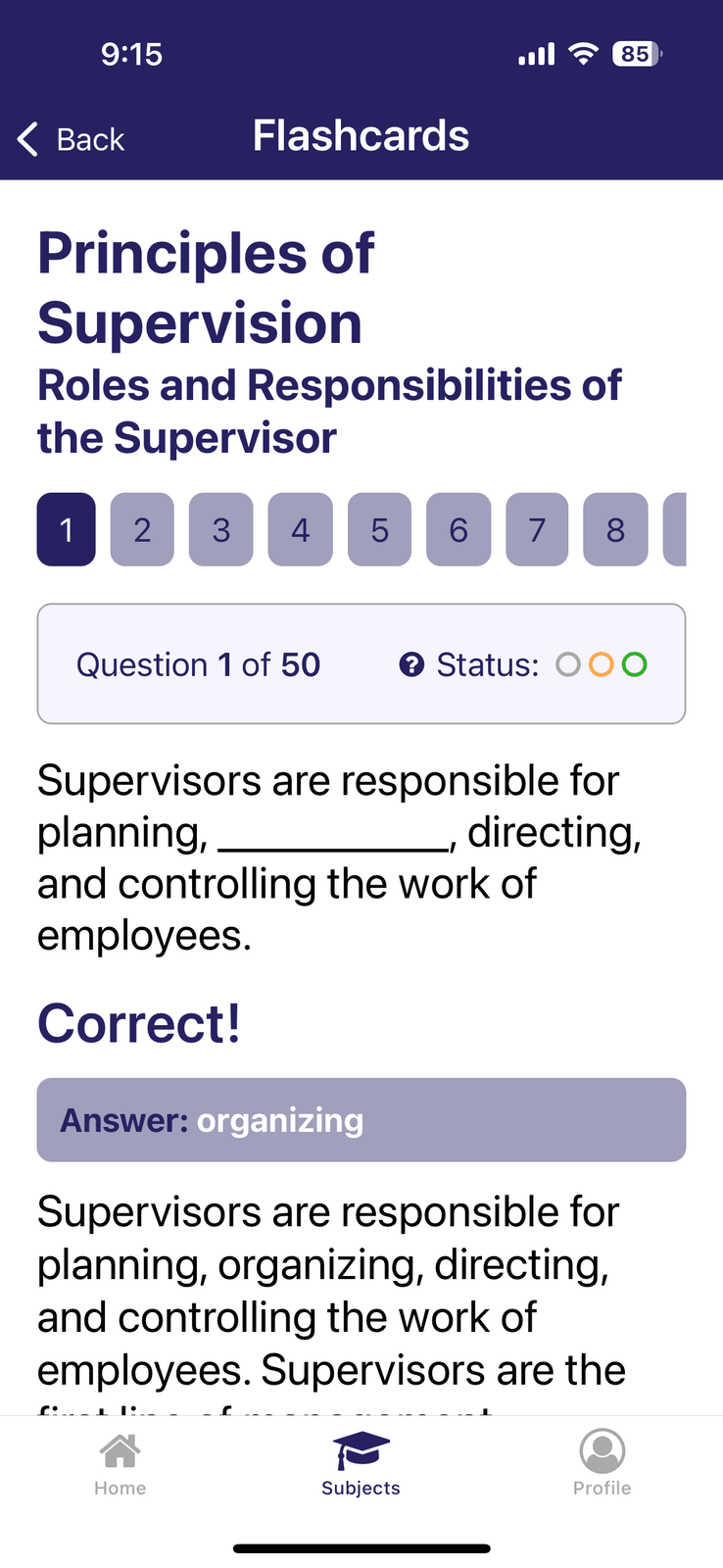
- Work through InstantCert flashcards, emphasizing the management functions section, which makes up nearly half the exam. Know each function (planning, organizing, leading, controlling) deeply, including the specific activities and decisions each involves.
- Use the official DSST practice exam to calibrate your readiness.
- If you're currently a supervisor or NCO, connect the flashcard concepts to your actual job. This exam rewards the ability to apply management principles to scenarios — real-world experience is a direct advantage here.
- Familiarize yourself with major motivation theories: Maslow's hierarchy, Herzberg's two-factor theory, and McGregor's Theory X and Theory Y. These appear frequently in the leading section and are easy points once you know them.
What score do you need to pass?
A score of 400 is the standard passing threshold at most institutions, but it can be higher at certain schools. Credit typically counts toward a business administration or management requirement. Confirm with your institution whether the credit applies to what you need before you start studying. If you fail, the attempt does NOT appear on your transcript, but you do lose your fee — and if you are military, you only get one free chance to take it.
Can you pass Principles of Supervision DSST / DANTES* with just flashcards?
Yes — and this is one of the exams where real-world management experience effectively substitutes for a portion of the study time. Flashcards cover the formal vocabulary and theory; your job experience fills in the applied understanding. Our 98% pass rate is the highest of any exam we offer, reflecting how learnable this content is for motivated students.
Which colleges accept the Principles of Supervision DSST / DANTES*?
Many colleges and universities in the United States accept DSST exams for credit, but policies on the number of credits awarded, minimum score requirements, and how the credit applies vary by institution. Some schools cap the total number of DSST or CLEP credits that count toward a degree, so confirm those limits before you test.
Principles of Supervision credit typically counts toward a business administration, management, or general elective requirement — commonly as 3 semester hours. Whether it satisfies a specific major requirement depends on your program.
Principles of Supervision DSST / DANTES* vs. taking the class
An introductory supervision or management course at most schools runs one semester and 3 credit hours. At $100 for the exam (free for military), passing the DSST is one of the most cost-efficient ways to earn those credits, especially if you already have supervisory experience.
| Exam fee | $100 (military free) |
| Typical tuition equivalent | $500–$3,000+ (one semester) |
| Credits earned | 3 semester hours (typical) |
| Time to prepare | 1–4 weeks self-study |
| Management experience counts | Yes — directly reduces study time |
| GPA impact | None, pass/fail, not graded |
The exam is the right call for most students, especially those in or around military or supervisory roles. Taking the class makes sense if your school won't accept the credit or if your program requires a specific upper-level management course that this exam doesn't satisfy.
Happy testing!