What This Exam Covers
The Substance Abuse DSST / DANTES exam (formerly Drug and Alcohol Abuse) covers how drugs are classed, the neuroscience of addiction, and the clinical and social dimensions of substance use and dependence. You'll need to understand how drugs work in the body, not just their names.
Exam at a Glance
| Questions | 100 multiple choice |
| Time | 120 minutes |
| Passing score | 400 (scaled score) |
| College credits | 3 semester hours (typical) |
| Exam fee | $100 (military free) |
What's on the Substance Abuse DSST / DANTES*?
| Category | Weight | Topics |
|---|---|---|
| Overview of Substance Abuse and Dependence | 13% | Terminology (abuse, dependency, addiction), theories and models of abuse, statistics by age/gender/ethnicity, societal costs, diagnosis (DSM-5) |
| Alcohol | 13% | History and types, blood alcohol level determinants, acute and chronic effects, tolerance, withdrawal, dependency, treatment and intervention |
| Tobacco and Nicotine | 10% | History and types (including vapes), acute and chronic effects, tolerance, withdrawal, dependency, cessation interventions, current trends |
| Opioids | 10% | History and types (including endogenous opioids), effects, therapeutic uses, tolerance, withdrawal, overdose, current treatment trends |
| Cannabinoids | 8% | History and types (including endogenous cannabinoids), effects, therapeutic uses, tolerance, toxicity, dependency, current trends |
| Hallucinogens | 7% | History and types, acute and chronic effects, therapeutic uses, tolerance, toxicity, dependency, current trends |
| Pharmacological and Neurophysiological Principles | 6% | Nervous system and neurotransmission, routes of administration, drug metabolism and dose-response, drug interactions |
| Anti-Anxiety, Sedatives, and Hypnotics | 6% | History and types, effects, uses and administration, tolerance, withdrawal, overdose, dependency, treatment |
| Inhalants | 6% | History and types, acute and chronic effects, uses, tolerance, withdrawal, overdose, dependency, treatment |
| Psychomotor Stimulants | 6% | Caffeine and xanthines, amphetamines, cocaine; effects, uses, tolerance, withdrawal, dependency, treatment |
| Antidepressants and Mood Stabilizers | 4% | History and types, effects (including suicidal behavior risk), uses and administration, tolerance and withdrawal |
| Classification of Drugs | 4% | DEA schedules, drug regulations and legal framework |
| Other Drugs of Abuse | 4% | Anabolic steroids, over-the-counter (OTC) drugs, synthetic drugs, club drugs |
| Antipsychotic Drugs | 3% | History and types, effects (including side effects and toxicity), uses and administration |
Source: For a full breakdown of what is on the exam, see the DSST / DANTES Substance Abuse exam fact sheet.
How hard is the Substance Abuse DSST / DANTES*?
This exam can be on the easier side depending on your background. Many people have some knowledge of drugs and their classification already. You'll need pharmacological knowledge, but it's not highly technical.
The drug classes section, nearly half the exam, involves memorizing drug names, classes, and effects. Many people have some of this knowledge already since the opioid epidemic has been so prominent in recent years. Those in healthcare, counseling, or law enforcement will find much of the exam easy.
How to study for the Substance Abuse DSST / DANTES*
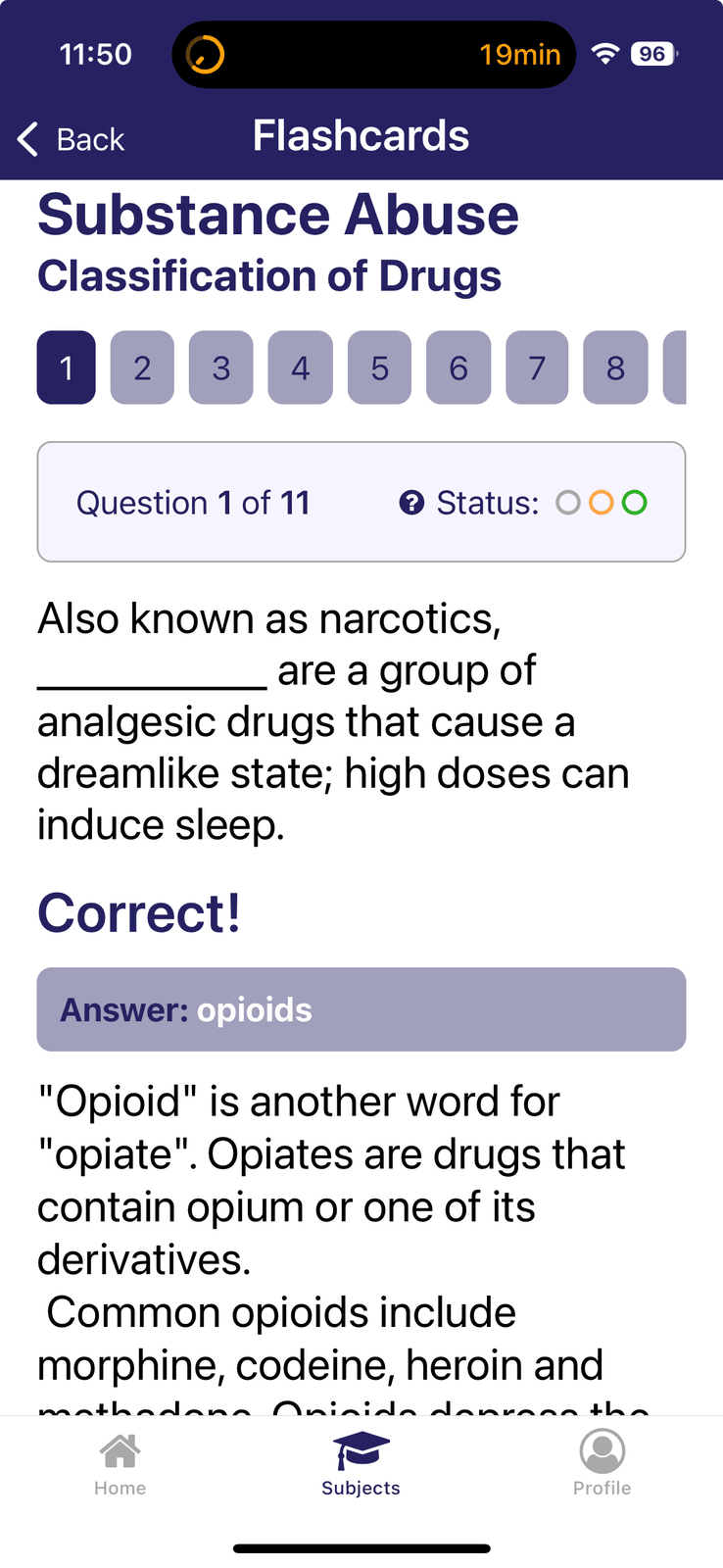
- First work through the InstantCert flashcards and see how much you already know. Since the exam focuses on drug categories, spend time learning each one before moving on.
- Use the official DSST practice exam from the GetCollegeCredit.com Substance Abuse page to check your readiness in the actual exam format.
- The NIDA DrugFacts series is a free, authoritative, and up-to-date reference for this exam. Use it to fill in gaps on specific drug classes after your flashcard run. NIDA drug information is here.
What score do you need to pass?
A score of 400 is the standard passing threshold but some schools require higher, so check with your school before starting to study. You can also confirm what the credit counts toward, typically health sciences, social sciences, or a general elective requirement.
Pass and it shows as just a pass with no grade attached. Fail and the attempt does NOT appear on your transcript, but you do need to wait 30 days and you lose the fee you paid. Military personnel usually get only one free test-taking chance, so use it wisely.
Can I pass Substance Abuse DSST / DANTES* with just flashcards?
Many students have passed with only InstantCert, reflecting the 96% pass rate of our students.
If you have no background in drugs, their effects, or classification, you may need supplementary materials like the NIDA DrugFacts page.
Which colleges accept the Substance Abuse DSST / DANTES*?
Most colleges and universities that accept DSST credit award 3 semester hours for a passing score. The credit typically satisfies a health sciences, behavioral sciences, or general elective requirement. Most schools have caps on how many DSST or CLEP credits count toward a degree, so it is worth checking your school's policy before doing multiple exams.
Check the ACE National Guide to College Credit for Workforce Training for the current ACE credit recommendation on this exam. Your school's registrar uses ACE recommendations as the baseline for awarding credit.
Substance Abuse DSST / DANTES* vs. taking the class
An undergraduate course on drugs and society typically runs one semester and costs several hundred to several thousand dollars in tuition depending on your school. The DSST gives you the same 3 credit hours for $100 (free if you are active duty). No GPA impact, no tuition bill, no class schedule to work around.
| Exam fee | $100 (military free) |
| Typical tuition equivalent | $500–$3,000+ (one semester) |
| Credits earned | 3 semester hours (typical) |
| Time to prepare | 3–5 weeks self-study |
| GPA impact | None, pass/fail only |
| Failed attempt on transcript | No |
This is great for people who just need the credit. However, if you plan on doing upper-level classes, you may want to take the course at your school.
Happy testing!