
What This Exam Covers
The Introductory Business Law CLEP covers similar material to an undergraduate business law course. It covers how the U.S. legal system applies to commercial transactions, reviewing contracts, torts, the legal environment of business, and foundational legal procedure. You will need to learn vocabulary and concepts, but 30% of the exam is actually applying this knowledge to case studies.
If you have had exposure to contract law within your organization, you'll have a head start studying for this exam. Those with experience in contract law, paralegal work, or HR already have a real head start.
Exam at a Glance
| Questions | 100 multiple choice |
| Time | 90 minutes |
| Passing score | 50 (most schools) |
| College credits | 3 semester hours (typical) |
| Exam fee | $97 |
What's on the Introductory Business Law CLEP*?
| Category | Weight | Topics |
|---|---|---|
| Contracts | 30%–40% | Formation (offer, acceptance, consideration), capacity, joint obligations, third-party beneficiaries, assignment and delegation, statute of frauds, breach, discharge, illegal contracts, defenses to formation (fraud, duress, mutual mistake, undue influence) |
| Legal Environment of Business | 20%–25% | Ethics, corporate social responsibility, government regulation, administrative agencies, environmental law, securities and antitrust law, employment law, creditors' rights, international business law |
| Torts | 10%–15% | Intentional torts, negligence (duty, breach, causation, damages), strict liability, defenses to tort liability |
| History and Sources of American Law / Constitutional Law | 5%–10% | Common law, statutory law, constitutional basis for business regulation, commerce clause, due process, equal protection |
| American Legal Systems and Procedures | 5%–10% | Court structure and jurisdiction, civil vs. criminal procedure, alternative dispute resolution, trial process |
| Miscellaneous | 5%–10% | Agency relationships, partnerships, corporations, sole proprietorships, sales and commercial transactions, property basics |
Source: For a full breakdown of what is on the exam, see the College Board Introductory Business Law CLEP page.
How hard is the Introductory Business Law CLEP*?
This exam is moderate in difficulty, mainly because 30% of it requires applying knowledge rather than just memorizing facts.
Plan for 4 to 6 weeks of study if you're starting with no legal background. Students with paralegal training, HR experience, or any prior business law coursework will have those estimates cut in half or even less. Although not the highest of our courses, our 91% pass rate shows this to be still an easy exam for a lot of our students.
How to study for the Introductory Business Law CLEP*
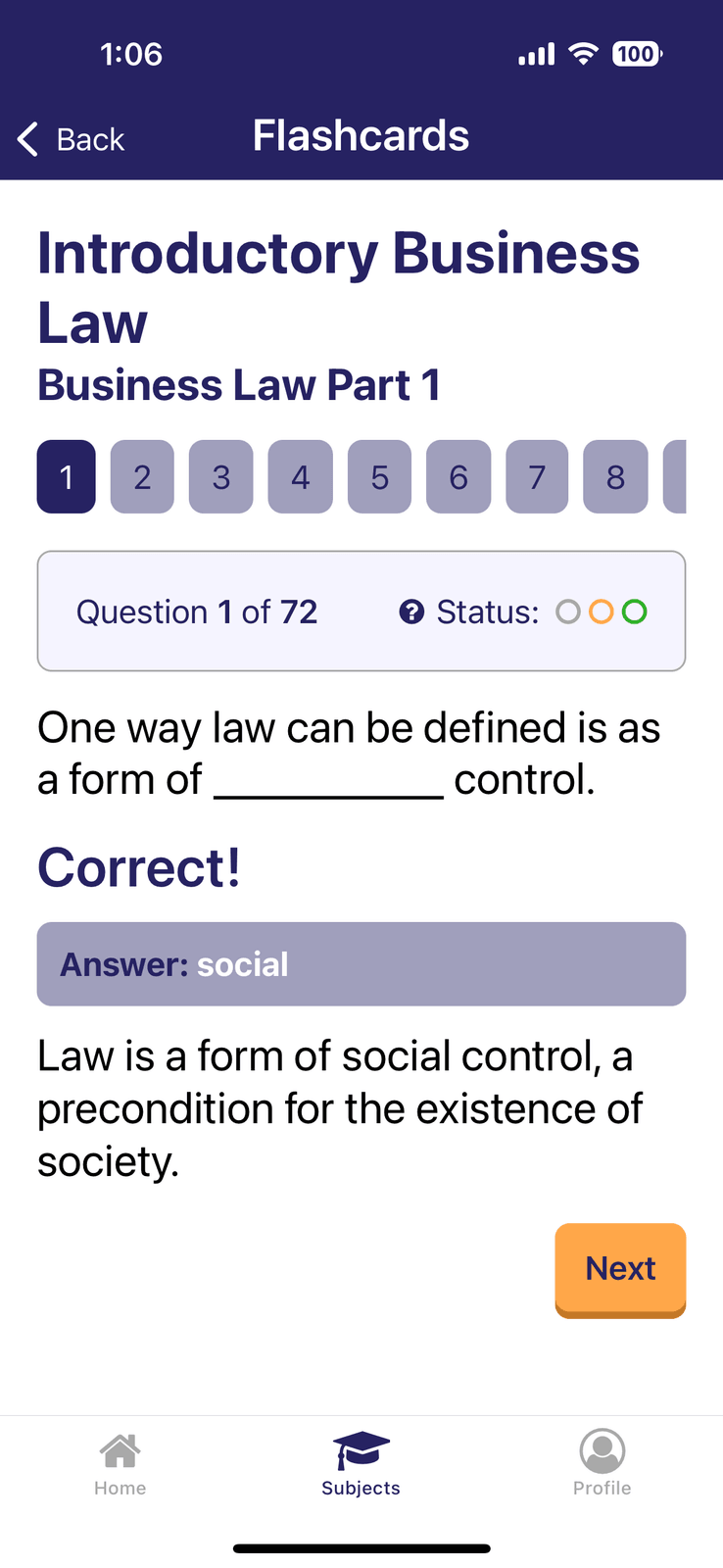
- Work through the InstantCert flashcards, making notes of what sections you need further study with. The set covers both terminology and scenario-based problems. If you are having a lot of trouble with the applied questions, make sure to study the underlying concepts. When you get one wrong, read the explanation fully. Understanding why the answer is correct matters more on this exam because you need more than just the vocabulary.
- Use the College Board's free Introductory Business Law practice questions to get comfortable with the format.
- ModernStates has a free Introductory Business Law course for CLEP prep. It's especially useful for the legal environment and torts sections, which require broader contextual understanding rather than discrete fact recall.
- Focus hard on the defenses to contract formation. Mutual mistake, duress, fraud, and undue influence come up repeatedly in scenario questions. Knowing when a contract is void vs. voidable is one of the most tested distinctions on this exam.
What score do you need to pass?
A score of 50 is the standard passing threshold at most schools for business law, but some require a score of 60. The credit typically counts toward a business core requirement, but confirm with your institution before testing.
Passing the exam results in the credit showing up on your transcript as a Pass with no letter grade. Failing the exam means that the attempt does NOT appear on your transcript. You can retake after 3 months, though you will lose the $97 exam fee.
Can you pass Introductory Business Law CLEP* with just flashcards?
Many students pass with flashcards alone, but the applied knowledge part of the exam requires more than memorization. These scenario-based questions require you to reason through the legal analysis, not just recall a definition. Learn the principles behind the vocabulary and rules, don't just memorize them.
Our flashcard set for Business Law includes both a terminology section and a scenario-based section created to match the case problem format the exam uses.
Which colleges accept the Introductory Business Law CLEP*?
Most accredited U.S. colleges and universities accept the Introductory Business Law CLEP for credit, typically awarding 3 semester hours. A few schools, mostly highly selective universities like Harvard, do not accept CLEP credit at all. Another thing to note is if you are taking multiple CLEP exams, then check with your school to see how many CLEP or DSST exams they accept.
Use the College Board's CLEP credit-granting policy search tool to look up exactly what your school awards. Search by institution and select Introductory Business Law to see their minimum score requirement and credit grant. Even with this tool, it is worth checking with your school to ensure the information is up to date.
Introductory Business Law CLEP* vs. taking the class
The Introductory Business Law CLEP is equivalent to one semester of undergraduate business law. At $97, it is far cheaper than tuition no matter your school. The tradeoff is self-directed study with no professor, no structured assignments, and no classroom discussion of case law.
| Exam fee | $97 one-time |
| Typical tuition equivalent | $500–$3,000+ (one semester) |
| Credits earned | 3 semester hours (typical) |
| Time to prepare | 4–6 weeks self-study |
| GPA impact | None, pass/fail, not graded |
| Legal background required | No, but it helps |
CLEP is the right call if you just need the credit or already know the material. Taking the class makes more sense if your degree requires a specific business law course or you plan on taking upper-level business law courses. Taking the class at your school will allow you to discuss the concepts better.
Happy testing!