
What This Exam Covers
The Human Growth and Development CLEP is similar to a one-semester undergraduate course in developmental psychology. It covers physical, cognitive, social, and emotional development across the full lifespan, from prenatal stages to old age and death. The exam is NOT a simple march through life stages. Knowing the theorists and their frameworks is more important than knowing specific milestones and their ages. See the section on how to study below for the major theorists you need to learn about.
Exam at a Glance
| Questions | 90 multiple choice |
| Time | 90 minutes |
| Passing score | 50 (most schools) |
| College credits | 3 semester hours (typical) |
| Exam fee | $97 |
What's on the Human Growth and Development CLEP*?
| Category | Weight | Topics |
|---|---|---|
| Theoretical Perspectives | 10% | Major developmental theories (Freud, Piaget, Vygotsky, Bronfenbrenner, Erikson), theoretical frameworks, historical context of developmental psychology |
| Research Strategies and Methodology | 6% | Longitudinal vs. cross-sectional research, experimental and observational designs, ethical considerations in research, nature vs. nurture debate |
| Biological Development Throughout the Life Span | 12% | Prenatal development, physical growth, brain development, puberty, genetic factors, biological changes in aging |
| Perceptual Development Throughout the Life Span | 6% | Visual and auditory perception, perceptual learning, cross-modal perception, sensory changes across the lifespan |
| Cognitive Development Throughout the Life Span | 12% | Piaget's four stages, information processing, memory development, learning across the lifespan |
| Language Development | 8% | Language acquisition, theories of language learning (Chomsky, Vygotsky), vocabulary development, bilingualism, communication development |
| Intelligence Throughout the Life Span | 6% | Theories of intelligence (Gardner, Sternberg), IQ testing, gifted and learning disabilities, cognitive changes in aging |
| Social Development Throughout the Life Span | 12% | Attachment theory, peer relationships, socialization, moral development (Kohlberg), identity development (Erikson's psychosocial stages) |
| Family, Home, and Society Throughout the Life Span | 8% | Family systems, parenting styles, cultural and socioeconomic influences, peer groups, community context |
| Personality and Emotion | 8% | Personality theories, temperament, emotional development, self-concept, emotion regulation across the lifespan |
| Schooling, Work, and Interventions | 6% | Educational influences on development, work and career development, early intervention programs, atypical development |
| Developmental Psychopathology | 6% | Childhood disorders (ADHD, autism spectrum), anxiety and depression in development, conduct disorders, assessment and treatment |
Source: For a full breakdown of what is on the exam, see the College Board Human Growth and Development CLEP page.
TIP: Build a one-page chart with each theorist's name, framework, and key stages or concepts. Reviewing that chart daily for the last week of prep covers a large portion of the exam.
How hard is the Human Growth and Development CLEP*?
This is a middle of the road CLEP exam. It's similar in difficulty to Introductory Psychology but the exam requires specific knowledge of theories, their authors, and correct terminology. The content is intuitive in a way that can be misleading because we all have lived through at least some of the stages of life. That familiarity does NOT translate to a passing score if you have not learned the theoretical frameworks behind the stages. Just because you were a baby doesn't mean you will pass.
Questions are often application-based. You're not just asked to name Erikson's stages; you're given a scenario and asked what his theory would predict. This distinction matters for how you study.
How to study for the Human Growth and Development CLEP*
The most-tested material on this exam is the major developmental theorists. Five names account for a significant share of the questions:
| Theorist | Framework | What to Know |
|---|---|---|
| Piaget | Cognitive development | Four stages (sensorimotor, preoperational, concrete operational, formal operational), object permanence, conservation |
| Erikson | Psychosocial development | Eight stages from infancy through old age, the conflict at each stage, the virtue earned by resolving it |
| Kohlberg | Moral development | Three levels (preconventional, conventional, postconventional), the reasoning behind moral decisions at each level |
| Vygotsky | Sociocultural theory | Zone of proximal development (ZPD), scaffolding, role of social interaction in learning |
| Bronfenbrenner | Ecological systems theory | Microsystem, mesosystem, exosystem, macrosystem, chronosystem — layers of environmental influence on development |
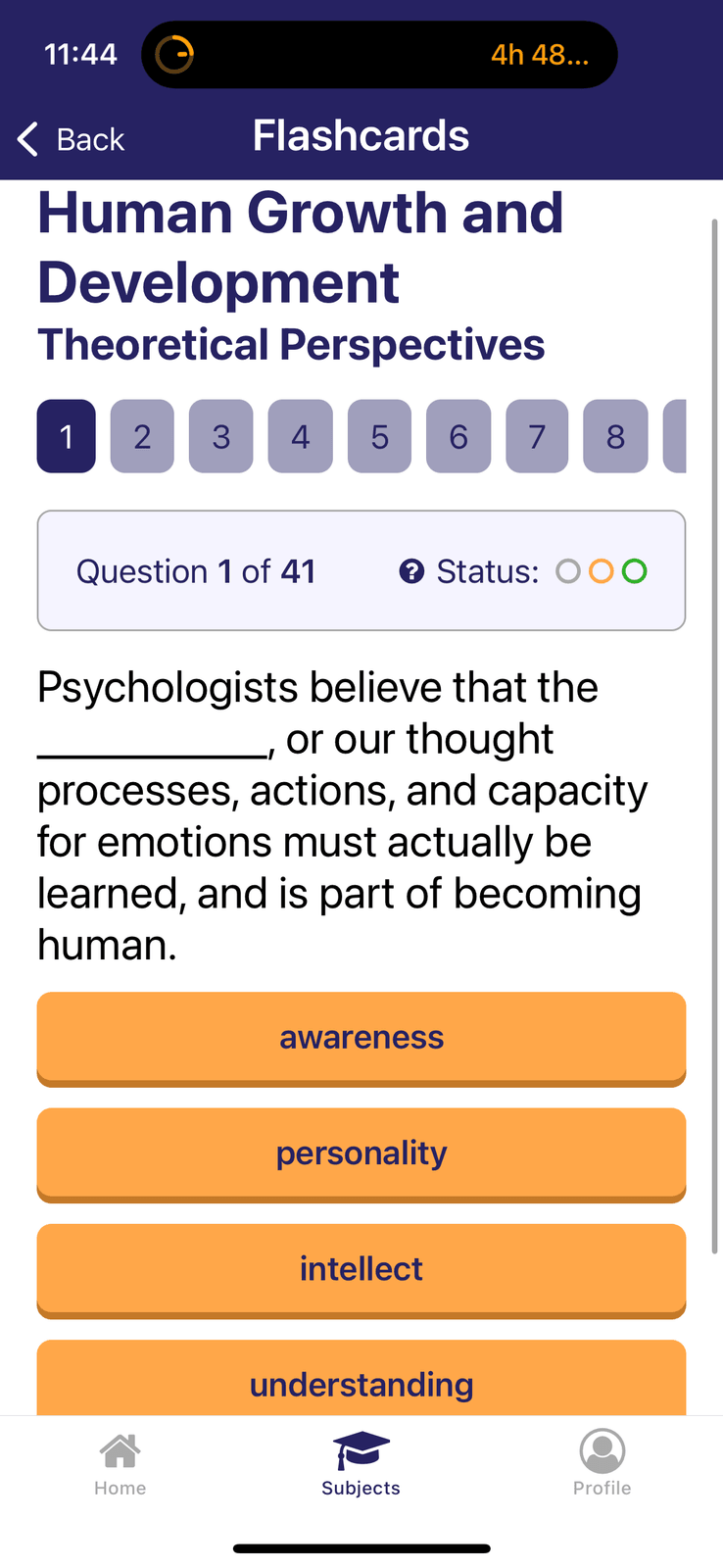
Work through the InstantCert flashcards, focusing on the five major theorists: Piaget's cognitive stages, Erikson's psychosocial stages, Vygotsky's zone of proximal development, Kohlberg's moral reasoning levels, and Bronfenbrenner's ecological model. The 366 cards cover the full exam scope and drill the theorist-to-concept associations the exam actually tests.
Use the College Board's free Human Growth and Development practice questions if you want a quick idea of the types of questions. The official questions are the best signal of what application-based questions look like on the real test.
Crash Course Psychology covers developmental psychology in several focused episodes if you prefer videos. The episodes on Piaget, Erikson, and attachment are directly relevant. Watch these AFTER you have gone through the flashcards, not as a starting point as video works better as reinforcement once you know the vocabulary.
What score do you need to pass?
A score of 50 is the standard passing threshold but some schools require 60. Human Growth and Development credit usually counts toward education, psychology, or social science requirements, but check with your advisor before testing, as some schools apply it differently or award it to a specific course equivalent.
If you fail the attempt does NOT appear on your transcript and you can retake after 3 months but you will lose your $97.
Can you pass Human Growth and Development CLEP* with just flashcards?
Yes, for most students. The exam is heavily theory-based, and the flashcards drill that content exactly. A 94% pass rate among InstantCert students shows how learnable this material is with the right prep.
One thing to keep in mind is the questions are application-based, not just recall. You need to understand the logic of each framework well enough to apply it to a scenario you've never seen. Students who memorize stage names without understanding the reasoning behind them sometimes get caught. Study until you can explain why each theory predicts what it does, not just what the stages are called.
Happy testing!
Which colleges accept the Human Growth and Development CLEP*?
Most accredited U.S. colleges and universities accept the Human Growth and Development CLEP for 3 semester hours of credit. A few highly selective schools such as Harvard do not accept CLEP credit at all, and some schools cap how many total CLEP credits count toward a degree.
The credit typically applies to education, psychology, or general social science requirements.
Use the College Board's CLEP credit-granting policy search tool to look up your school's policy. Search by your institution and select Human Growth and Development to see their specific policy but be aware that sometimes this data can be out of date so check with your school to be sure.
Human Growth and Development CLEP* vs. taking the class
A one-semester developmental psychology course runs $500 to $3,000+ depending on your school. The CLEP costs $97. The credit awarded is the same.
| Exam fee | $97 one-time |
| Typical tuition equivalent | $500–$3,000+ (one semester) |
| Credits earned | 3 semester hours (typical) |
| Time to prepare | 2–5 weeks self-study |
| GPA impact | None — pass/fail, not graded |
CLEP is the right choice if you already have a psychology or education background, want to free up your schedule, or cut tuition costs. Taking the class makes more sense if you're majoring in psychology and want a really good base knowledge, not just the credit.
Happy testing!