
What This Exam Covers
The Principles of Microeconomics CLEP tests individual consumers and firms' decision-making skills. Concepts you'll need to learn are supply and demand, price elasticity, market structures, production costs, factor markets, and the economics of government intervention. Over half the exam is dedicated to product markets, so spend a lot of time on those areas.
Exam at a Glance
| Questions | ~80 multiple choice |
| Time | 90 minutes |
| Passing score | 50 (most schools) |
| College credits | 3 semester hours (typical) |
| Exam fee | $97 |
What's on the Principles of Microeconomics CLEP*?
| Category | Weight | Topics |
|---|---|---|
| Product Markets | 55%–70% | Supply and demand (15–20%): curves, elasticity, shifts, consumer/producer surplus. Theory of consumer choice (5–10%): utility maximization, budget constraints, substitution and income effects. Production and costs (10–15%): short-run and long-run costs, marginal cost, average costs. Firm behavior and market structure (23–33%): perfect competition, monopoly, monopolistic competition, oligopoly, price and output decisions |
| Basic Economic Concepts | 10%–16% | Scarcity, opportunity cost, production possibilities curve, comparative advantage, specialization and trade, marginal analysis |
| Factor Markets | 6%–12% | Marginal revenue product, labor demand and supply, wage determination, income distribution, other factor markets |
| Market Failure and the Role of Government | 8%–14% | Externalities (positive and negative), public goods, antitrust policy, income distribution and equity, effects of government intervention |
Source: For a full breakdown of what is on the exam, see the College Board Principles of Microeconomics CLEP page.
How hard is the Principles of Microeconomics CLEP*?
Many people find microeconomics a bit difficult. The market structures section is where many students struggle. Make sure you know four structures: perfect competition, monopolistic competition, oligopoly, and monopoly. Understanding what each predicts about price, output, and profit is crucial. You can't just memorize these terms; you need to know what they mean and how they affect markets.
Starting from scratch? Plan 4 to 6 weeks. Already have some economics from high school? You can probably get there in 1 to 3 weeks with the flashcards.
How to study for the Principles of Microeconomics CLEP*
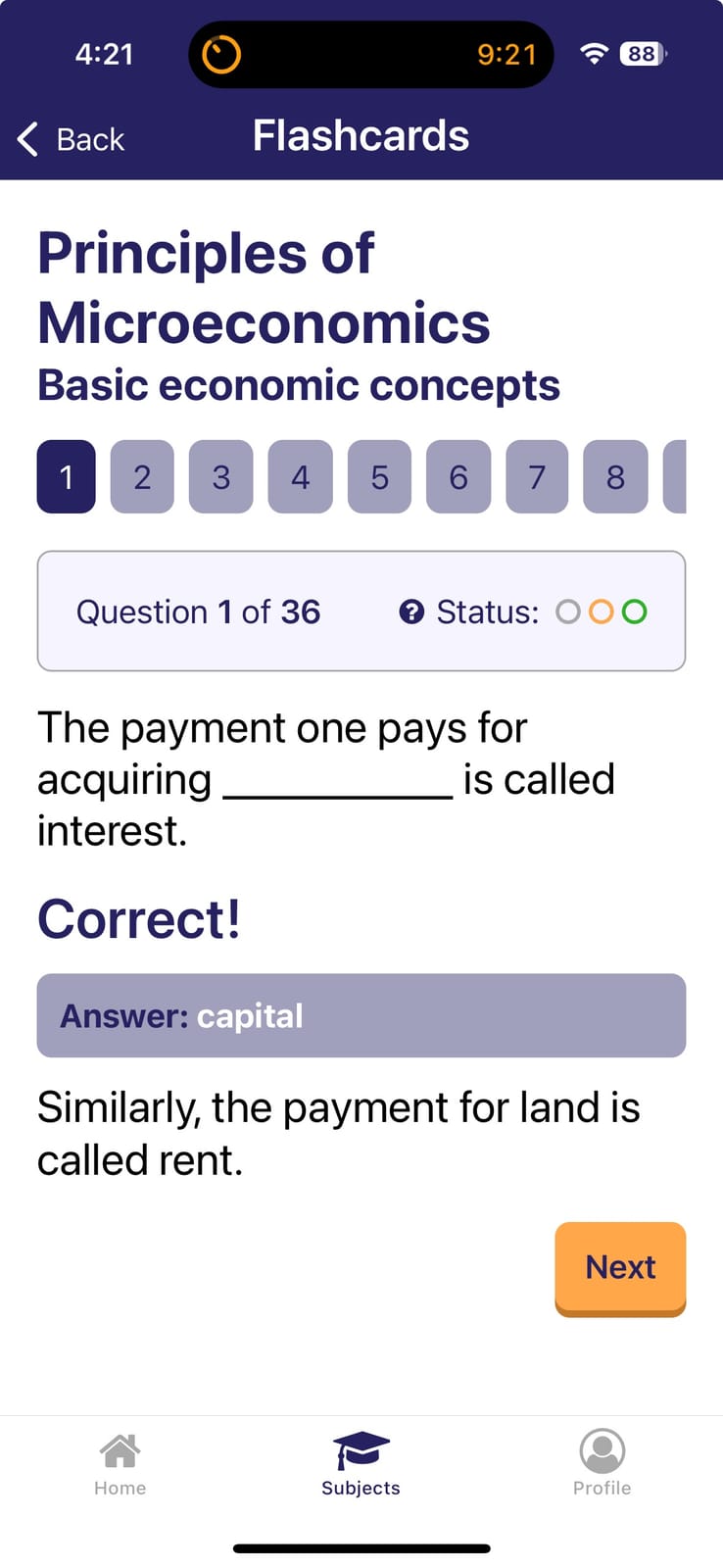
- Work through InstantCert flashcards, focusing on market structures questions. If you find that you're getting a lot of the same questions wrong, try to find some extra study material.
- Use the College Board's free Microeconomics practice questions to practice graph-based questions under real exam conditions. The official sample questions are the closest thing to the actual test.
- Crash Course Microeconomics is a great free resource for those that learn well from video.
- ModernStates.org has a free Microeconomics course built for CLEP prep.
What score do you need to pass?
A score of 50 is the standard passing rate at most schools, but some require a score of 60. Microeconomics credit typically satisfies a social science or economics general requirement. Confirm your institution's policy before you start studying so you know it will give you the correct credit.
Passing the credit appears on your transcript as a Pass, but with no letter grade. Failing the attempt does not appear on your transcript at all. You can retake after 3 months, but you will lose your exam fee.
Can you pass Principles of Microeconomics CLEP* with just flashcards?
Many students pass with our flashcards alone. The material is conceptual and adapts well to flashcard study. If you keep getting the same questions wrong, look at free resources available.
Students struggle with some graphs, so checking out Modern States for a feel of how they work may be worthwhile.
Which colleges accept the Principles of Microeconomics CLEP*?
Most U.S. colleges and universities accept the Microeconomics CLEP for credit, typically awarding 3 semester hours toward a social science or economics general education requirement.
Use the College Board's CLEP credit-granting policy search tool to look up exactly what your school awards. Search by institution and select Principles of Microeconomics to see their minimum score and credit hours. Just be aware that sometimes policies are not updated in the tool so always best to check with your school directly.
Principles of Microeconomics CLEP* vs. taking the class
At $97, the Microeconomics CLEP is dramatically cheaper than a semester of introductory microeconomics at most schools. You earn the same 3 credit hours with no GPA impact. The tradeoff is self-directed prep without a professor, structured assignments, or graded exams along the way.
| Exam fee | $97 one-time |
| Typical tuition equivalent | $500–$3,000+ (one semester) |
| Credits earned | 3 semester hours (typical) |
| Time to prepare | 2–6 weeks self-study |
| GPA impact | None — pass/fail, not graded |
| Pairs well with | Macroeconomics CLEP (knock out both econ requirements at once) |
CLEP is the right call if you have any economics background or want to reduce total tuition costs. Taking the class makes more sense if your program requires a graded economics course or if you plan to take upper-level econ courses.
Happy testing!