
What This Exam Covers
The Introduction to World Religions DSST / DANTES exam covers the same material as a college course on comparative religion. You'll review major world religions, including Abrahamic faiths, Buddhism, Hinduism, and East Asian religions, as well as indigenous faiths. This is an academic approach, focusing on the religions themselves, not their theology or prayers.
Exam at a Glance
| Questions | 100 multiple choice |
| Time | 120 minutes |
| Passing score | 400 (scaled score) |
| College credits | 3 semester hours (typical) |
| Exam fee | $100 (military free) |
What's on the Introduction to World Religions DSST / DANTES*?
| Topic | Weight | Subtopics |
|---|---|---|
| Definition and Origins of Religion | 5% | Basic dimensions (ethics, ritual, doctrine); approaches to religion (natural and revealed theology, descriptive, historical) |
| Indigenous Religions | 5% | Native North American traditions (Inuit, Lakota, Hopi, Cherokee, Navajo); Central and South American (Incan, Mayan, Aztec); West African (Yoruba, Dogon); Middle Eastern (Mesopotamian, Canaanite); Central Asian and Siberian traditions |
| Hinduism | 11% | Historical development (Vedic, Classical, Medieval, Modern periods); major theistic traditions; philosophical systems, the 4 paths of Yoga, moksha, festivals, caste system |
| Buddhism | 11% | Life of Buddha; Theravada, Mahayana, and Vajrayana traditions; Four Noble Truths, Noble Eightfold Path, Three Jewels, rituals, symbols, festivals |
| Confucianism | 5% | Life of Confucius, classical Confucianism; ritual, filial piety, loyalty, humaneness, festivals |
| Daoism | 4% | Lao Tzu, ancient Chinese tradition; Dao, wu wei, rituals |
| Shintoism | 4% | Influence on Japanese culture and Buddhism, WWII context; three forms of Shinto, Kami, festivals |
| Judaism | 11% | Ancient Israelites through modern Judaism, the Holocaust, Kabbalah; Orthodox, Conservative, Reform, Reconstructionist; Torah, Talmud, covenant, rituals, festivals |
| Christianity | 17% | Life of Jesus through modern church, The Reformation; Roman Catholic, Orthodox, Protestant; Old and New Testaments, Trinity, Creeds, liturgical calendar |
| Islam | 17% | Life of Muhammad through modern Islam; Sunni, Shi'a, Sufi; Five Pillars, Quran, Sharia, jihad, festivals |
| Religious Movements and Syncretism | 10% | Pre-1000 CE (Zoroastrianism, Jainism, Mystery Cults); post-1000 CE (Baha'i, Sikhism); contemporary movements (Mormonism, Jehovah's Witnesses, Scientology, New Age) |
Source: For a full breakdown of what is on the exam, see the DSST / DANTES Introduction to World Religions exam fact sheet.
How hard is the Introduction to World Religions DSST / DANTES*?
Many find this exam relatively easy due to their childhood exposure and cultural background. Many find it quite interesting to learn about the different faiths as well. Learning the vocabulary around each faith can be a challenge, but our flashcards make it manageable. Study one tradition at a time, and you should be fine. If you have no religious upbringing, three to five weeks should suffice. If you remember your Sunday school, you might pass in a week.
How to study for the Introduction to World Religions DSST / DANTES*
- Work through the InstantCert flashcards, one religion at a time. Mixing traditions during study is a common mistake, as some concepts are similar in related religions.
- Download the official DSST info sheet for World Religions to get exam details and a few free practice questions.
- Crash Course religion is a great resource if you learn better by videos.
What score do you need to pass?
The standard passing score is 400. The credit usually counts towards a humanities or religious study general requirement. Confirm with your school what the credit satisfies before you test.
Pass and the credit shows up as a pass on your transcript with no letter grade attached. Fail and the attempt does NOT appear on your transcript at all but you must wait 30 days to re-test.
Can you pass Introduction to World Religions DSST / DANTES* with just flashcards?
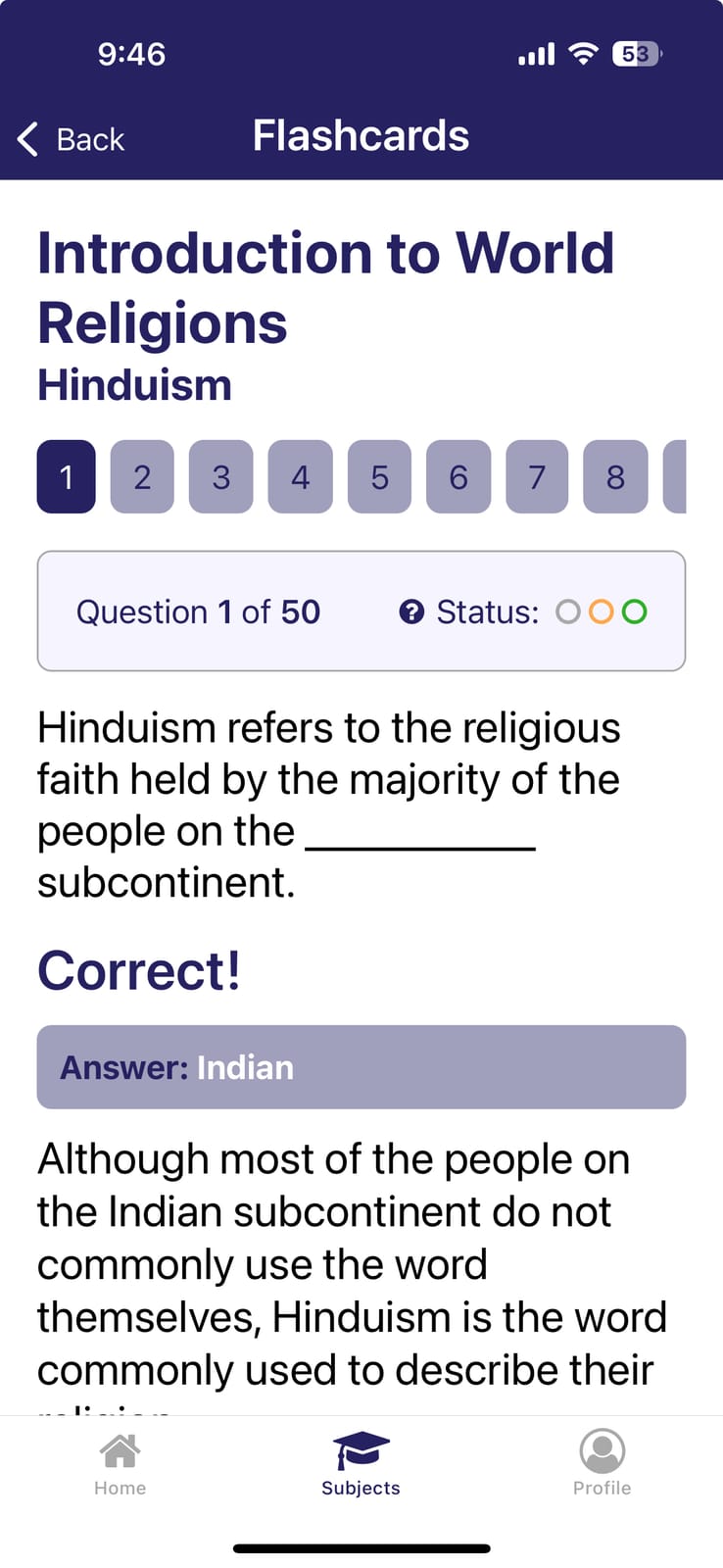
Yes. The religion-by-religion structure of the 340 InstantCert flashcards is well matched to how the exam is organized, and students who work through each tradition do very well. Our 97% pass rate is among the highest of any exam we offer.
If you have zero background, consider adding a few Crash Course episodes or the Pew Research Center's religion pages to fill in the gaps. That extra step is usually enough to get most students a pass.
Which colleges accept the Introduction to World Religions DSST / DANTES*?
Most colleges accept the DSST credit and count it as 3 semester hours. Most schools cap the number of DSST or CLEP credits you can have, so confirm your school's policy before starting to study.
Check the ACE National Guide to College Credit for Workforce Training for the current credit recommendation on this exam. If you are also looking at other humanities DSST exams, the Ethics in America DSST and the General Anthropology DSST are worth a look.
Introduction to World Religions DSST / DANTES* vs. taking the class
A full semester of comparative religion class costs hundreds or even thousands of dollars. The DSST gets you the same 3 credit hours for $100, and it's free if you are active duty.
| Exam fee | $100 (military free) |
| Typical tuition equivalent | $500–$3,000+ (one semester) |
| Credits earned | 3 semester hours (typical) |
| Time to prepare | 3–5 weeks self-study |
| GPA impact | None, pass/fail only |
| Failed attempt on transcript | No |
If you already have a solid general knowledge of world religion, this exam is a no brainer. If you plan to study more religions at a higher level, then taking the class may be beneficial, as you'll get to discuss more with your professor and class.
Happy testing!