

The Principles of Macroeconomics CLEP is the equivalent of a one-semester introductory macroeconomics course. It asks how a whole economy works: how output gets measured, why prices and unemployment rise and fall, what banks and the Federal Reserve do, how fiscal and monetary policy push on all of it, and how one country's economy connects to the rest of the world. It is NOT a vocabulary test. This is a graph exam. You get an AS/AD diagram, a money market graph, or a Phillips curve, and you have to say what happens when one of the inputs changes. College Board splits the exam into 7 content areas, and the largest one, stabilization policy, is 20% to 25% of the test. The general breakdown is below.
| Category | Share of exam | What is in it |
|---|---|---|
| Inflation, Unemployment, and Stabilization Policies | 20% to 25% | Fiscal and monetary policies, demand and supply effects, the policy mix, government deficits, the Phillips curve, inflation expectations |
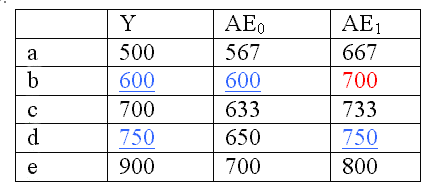
| National Income and Price Determination | 15% to 20% | Aggregate demand and what shifts it, the multiplier, aggregate supply in the short run and the long run, wage and price flexibility, output gaps, business cycles |
| Financial Sector | 15% to 20% | How money is created, the banking system, money demand and the money market, central bank policy tools, interest rates, the quantity theory of money |
| Measurement of Economic Performance | 12% to 16% | National income accounts (circular flow, GDP and its components, real vs. nominal), inflation measurement (CPI, GDP deflator, price indices), types of unemployment, the natural rate of unemployment |
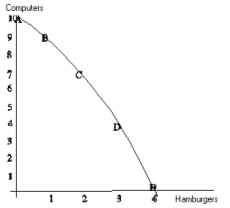
| Basic Economic Concepts | 12% to 15% | Scarcity, opportunity cost, the production possibilities curve, comparative advantage, specialization and trade, supply and demand, price controls |
| Economic Growth and Productivity | 5% to 10% | How growth is defined and measured, investment in human and physical capital, technology, research and development, growth policy |
| Open Economy: International Finance | 5% to 10% | Balance of payments accounts, foreign exchange markets, net exports, capital flows, links to goods and financial markets |
| Questions | About 80 multiple choice |
| Time | 90 minutes |
| Passing score | 50 (some schools require 60) |
| College credits | 3 semester hours (typical) |
| Exam fee | $97 |
| Retake wait after a fail | 90 days |
How do our free questions compare to the real exam?
Closer than most of our free sets, but not evenly, and you should know where the holes are before you read anything into your score. One of the 7 content areas has no question at all. Here is the count for our 20 free questions (10 here, 10 more by email) against the real weights.
| Category | Share of real exam | Our 20 free questions |
|---|---|---|
| Inflation, Unemployment, and Stabilization Policies | 20% to 25% | 4 of 20 |
| National Income and Price Determination | 15% to 20% | 5 of 20 |
| Financial Sector | 15% to 20% | 2 of 20 |
| Measurement of Economic Performance | 12% to 16% | 4 of 20 |
| Basic Economic Concepts | 12% to 15% | 4 of 20 |
| Economic Growth and Productivity | 5% to 10% | 1 of 20 |
| Open Economy: International Finance | 5% to 10% | 0 of 20 |
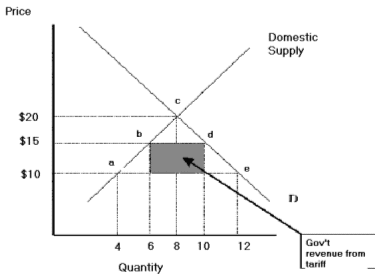
TIP: Our 20 free questions have NOTHING on Open Economy: International Finance. That means no exchange rates and no balance of payments, and that area is 5% to 10% of the real exam, or 4 to 8 of the 80 questions. Two of our questions are about tariffs and quotas, but College Board files trade barriers under Basic Economic Concepts, so they do not fill the gap. The Financial Sector is thin too. It gets 2 of our 20 questions and it is 15% to 20% of the real exam, which is 12 to 16 questions. The Phillips curve never comes up, and it sits inside the largest content area on the test. One more gap, and it is the big one. None of our free questions puts a graph in the question. The graphs are in the answer explanations, 13 of the 20 have one, and the real exam hands you the graph first and asks what changes. A good score here tells you the terms are in decent shape. It does not tell you whether you can read an AS/AD diagram cold.
Where should I spend my time studying?
Five things, based on the College Board weights and what we tell every student on our study guide page:
- Start with stabilization policy. Inflation, Unemployment, and Stabilization Policies is the largest content area at 20% to 25%, which is 16 to 20 of the 80 questions. It ties fiscal policy, monetary policy, the Phillips curve, and inflation expectations together, so it also forces you to review most of what comes before it.
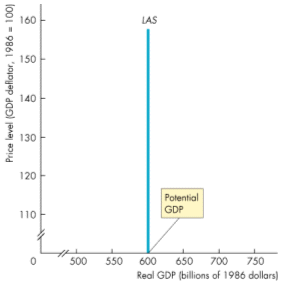
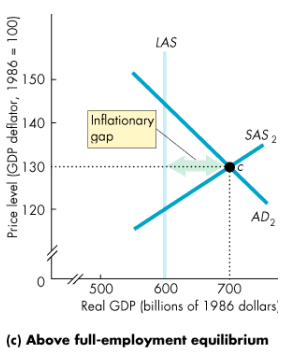
- Learn three graphs well enough to draw them from memory. The AS/AD diagram, the money market graph, and the Phillips curve show up all over this exam. For each one, shift a curve and say out loud what happens to the price level, real output, or the interest rate. If you cannot do that, you do not know the graph yet.
- Study relationships, NOT names. You will not just be asked to define the multiplier or the natural rate of unemployment. You will be asked what happens to one thing when another thing changes. Keep going until you can explain the chain of cause and effect, one link at a time.
- Do not skimp on the Financial Sector. It is 15% to 20% of the exam, and our free questions give you only 2 on it. Know how banks create money, what each of the Federal Reserve's policy tools does, and how the interest rate gets set.
- Cover the area our free questions skip. Open Economy: International Finance is 4 to 8 questions, and it is manageable once you know what moves an exchange rate and what goes in each balance of payments account.
For the full topic breakdown and pass-rate history, see the Principles of Macroeconomics CLEP study guide page.